
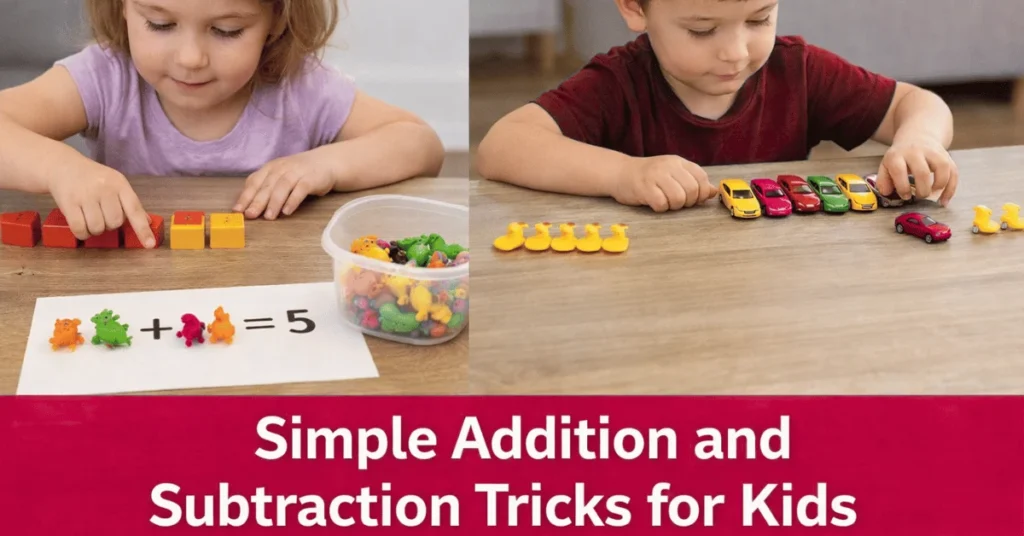
I’ve watched many children shut down the moment numbers appear on a page.
Their hands stop moving.
Their eyes drift away.
It’s rarely because math is difficult.
It’s because math feels unfamiliar.
When I started working closely with young learners, I noticed something simple.
The moment numbers became visible and touchable, fear disappeared.
That’s when simple addition and subtraction tricks for kids began to work.
This page shares those tricks.
Not shortcuts.
Not rules to memorize.
Just clear ways kids actually understand numbers.
What Are Simple Addition and Subtraction Tricks for Kids?
Simple addition and subtraction tricks for kids are easy methods that help children understand how numbers combine and separate using objects, visuals, and thinking patterns instead of memorized steps.
These tricks focus on meaning.
Not speed.
Not pressure.
When kids know why 3 + 2 becomes 5, they stop guessing.
When they see why 6 − 2 leaves 4, they stop fearing mistakes.
That understanding builds number sense, which matters more than quick answers.
I’ve seen children improve without worksheets, apps, or drills.
They just needed math to feel familiar.
Why Addition and Subtraction Feel Hard for Many Kids
Addition and subtraction feel hard when children are asked to calculate before they understand what numbers represent in real life.
Many kids can count toys perfectly.
Yet struggle with “4 + 1” on paper.
That gap happens because symbols come too early.
Children think in objects first.
I’ve worked with kids who failed timed tests.
Then solved the same problems easily using blocks.
The skill was always there.
The approach was wrong.
When Kids Are Ready to Learn Addition and Subtraction
Kids are ready for addition and subtraction when they can count objects accurately, compare groups, and explain “more” and “less” using their own words.
This usually appears between ages four and six.
But readiness matters more than age.
Some children add naturally at four.
Others need more time with counting and sorting.
I’ve learned not to rush this stage.
Rushing creates confusion.
Clarity creates progress.
Simple Addition Tricks That Actually Work
Counting On Instead of Starting Over
The count-on trick helps kids add by starting from the larger number rather than recounting everything.
Example:
5 + 2
Start at five.
Say six, seven.
This small change reduces errors fast.
I’ve seen kids smile when they realize math doesn’t always restart at one.
Counting on supports number sequence awareness.
It also builds confidence.
Adding with Objects
Using objects makes addition clear because kids can see numbers grow.
Place three blocks on the table.
Add two more.
Count together.
When kids move the objects themselves, learning sticks longer.
Mistakes turn into learning moments.
This method strengthens hands-on math and basic math understanding.
Making Ten First
Making ten helps kids add by breaking numbers into friendly parts.
Example:
8 + 3
Take two from three.
Make ten.
Add the remaining one.
Ten feels safe to children.
It anchors their thinking.
I’ve seen this trick reduce hesitation and improve accuracy in older kids.
Simple Subtraction Tricks Kids Understand
Take Away Using Objects
Subtraction makes sense when kids physically remove items from a group.
Start with six toys.
Take away two.
Count what remains.
This removes guesswork.
The answer stays visible.
This method supports visual math and reduces frustration.
Counting Back Slowly
Counting back helps kids subtract step by step without confusion.
Example:
7 − 3
Start at seven.
Count back three numbers.
This works best after forward counting feels natural.
It builds control and focus.
Think “What’s Missing?”
This trick turns subtraction into a thinking question instead of a rule.
Example:
5 − 2
Ask:
What number plus two makes five?
Kids enjoy this because it feels like solving a puzzle.
It strengthens problem-solving skills and flexible thinking.
Using Addition and Subtraction in Everyday Life
Everyday routines give kids constant chances to practice addition and subtraction without stress.
Snack time becomes counting pieces.
Cleanup becomes taking away toys.
Playtime becomes comparing groups.
I’ve seen parents worry they lack time.
They didn’t need extra time.
They just needed different words.
That shift made math part of daily life.
Common Parent Mistakes and How to Avoid Them
Most struggles happen when adults rush answers or correct too quickly.
Rushing creates fear.
Correcting too fast stops thinking.
I encourage parents to pause instead.
Ask how the child thought about it.
That question builds confidence.
It also reveals understanding.
How to Tell If These Tricks Are Helping
These tricks are working when kids explain their thinking, stay calm, and try again after mistakes.
They talk through numbers.
They slow down naturally.
They stop avoiding math tasks.
I’ve seen children who once cried during homework begin asking math questions on their own.
That change doesn’t come from pressure.
It comes from understanding.
Why Simple Methods Beat Memorization
Memorization fades, but understanding stays.
Kids who rely only on memory panic when numbers change.
Kids who understand patterns adapt easily.
That’s why simple addition and subtraction tricks for kids matter so much.
They support long-term learning, not just correct answers.
Final Thoughts
Math doesn’t need to feel heavy.
It needs to feel clear.
When children understand what numbers are doing, confidence follows.
When confidence appears, progress becomes steady.
If you’re teaching a child right now, slow down.
Let numbers move.
Let mistakes happen.
That’s where real learning begins.
Explore More: 10 Math Activities for preschoolers at Home in 2026