
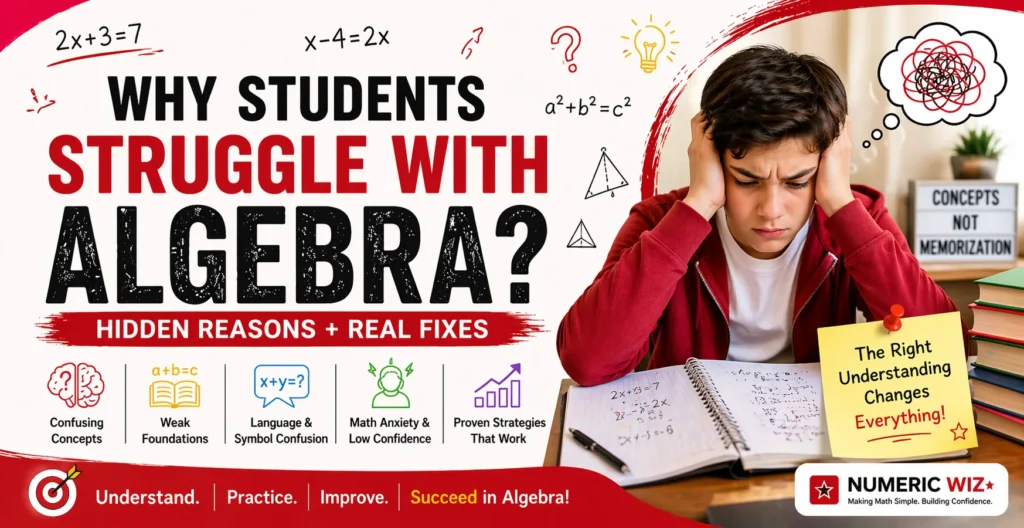
Why Students Struggle with Algebra
Most students struggle with algebra because they shift from numbers to symbols without strong foundations, clear understanding of variables, or confidence in problem-solving. This creates confusion, especially when concepts become abstract, and students start memorizing steps instead of truly understanding relationships between quantities.
I’ve seen this again and again.
A student who was doing fine in arithmetic suddenly freezes when they see x or y.
It’s not because they’re “weak in math.”
It’s because algebra speaks a different language, and no one taught them how to read it.
The moment math moves from “find the answer” to “understand the relationship,” many students feel lost.
That’s where the struggle begins.
Why Do Students Struggle with Algebra? (Core Reasons Explained)
The truth is simple.
Students don’t struggle with algebra randomly.
There are clear reasons:
- Weak foundational knowledge
- Poor number sense
- Confusion with variables and equations
- Lack of conceptual understanding
- Over-reliance on memorization
I remember working with a student who could solve equations only if the steps were shown.
The moment I changed the question slightly, they were stuck.
That’s when it became clear.
They didn’t understand algebra.
They were just copying patterns.
Why Algebra Feels Hard for Beginners
Algebra feels hard because it asks students to think differently.
In arithmetic:
- You calculate answers
In algebra:
- You represent relationships
That shift is uncomfortable.
Instead of numbers, students now see:
- unknown quantities
- symbolic representation
- abstract concepts
It’s like learning a new language overnight.
And when no one explains the meaning behind symbols, students start guessing instead of thinking.
Arithmetic vs Algebra Thinking
| Arithmetic Thinking | Algebra Thinking |
| Uses numbers | Uses variables (x, y) |
| Fixed answers | General relationships |
| Direct calculation | Symbolic reasoning |
| Concrete | Abstract thinking |
Real Insight
I’ve worked with students who said,
“I understand math, but algebra makes no sense.”
When I checked deeper, the issue wasn’t algebra.
It was:
- weak fractions
- confusion with negative numbers
- no clarity about what variables actually mean
Once we fixed those, algebra suddenly became easier.
That’s the part most people miss.
Hidden Skill Gaps (The Real Problem Most Ignore)
Most students struggle with algebra not because algebra is difficult, but because their basic math foundation is weak. Gaps in fractions, integers, and number sense quietly build over time. When algebra starts, these hidden gaps create confusion, errors, and loss of confidence almost immediately.
Here’s the hard truth.
Algebra doesn’t fail students.
Weak foundations fail them.
I’ve seen students stuck on simple equations like 2x + 3 = 7.
Not because they didn’t know steps.
Because they didn’t understand what subtraction or balance actually means.
Weak Foundations That Cause Algebra Struggles
Most algebra problems trace back to earlier topics.
The biggest gaps I notice are:
- Weak fractions understanding
- Confusion with negative numbers
- Poor order of operations
- Lack of number sense
- Weak multiplication fluency
These may look small.
But in algebra, they become huge barriers.
Why Fractions and Integers Break Algebra Understanding
Fractions and integers are silent troublemakers.
Students often:
- Fear fractions
- Misread negative signs
- Mix up operations
So when they see something like:
x/2 + 3 = 7
They panic.
Not because of algebra.
Because of fractions.
Same with integers.
A small sign error can destroy the whole solution.
Why Students Can Do Arithmetic but Not Algebra
This confuses many parents.
“My child always good at math… But now why he is struggling with algebra?”
Here’s what’s happening:
Arithmetic:
- Follow steps
- Get answer
Algebra:
- Understand relationships
- Think logically
Many students were trained to:
- memorize steps
- not question why
So when algebra asks them to think,
they feel lost.
Foundational Gaps → Algebra Impact
| Weak Skill | What Happens in Algebra |
| Fractions | Trouble solving equations |
| Integers | Sign errors |
| Order of operations | Wrong simplification |
| Number sense | No estimation or logic |
| Multiplication | Slow problem solving |
Real Insight
I once worked with a Grade 8 student who failed algebra twice.
We didn’t start with equations.
We went back to:
- fractions
- integers
- basic operations
Within 3 weeks, something changed.
They said,
“Now algebra makes sense.”
Nothing magical happened.
We just fixed the foundation.
Symbol & Language Confusion (The Biggest Hidden Barrier)
Students struggle with algebra mainly because they don’t understand the language of algebra. Symbols like variables, expressions, and equations represent relationships, not just answers. When students misinterpret these symbols, they rely on guessing or memorizing steps, which leads to confusion and repeated mistakes.
Here’s what I’ve noticed over the years.
Students aren’t confused by math.
They’re confused by the language of math.
When a student sees:
3x + 2 = 11
They don’t see meaning.
They see symbols.
And when symbols have no meaning,
everything feels random.
Difficulty Understanding Variables in Algebra
The biggest confusion starts here.
Students think:
- x is a label
- not a value
But in algebra:
- x represents an unknown quantity
That one misunderstanding breaks everything.
I once asked a student:
“What is x?”
They said, “It’s just x.”
That’s the problem.
Expression vs Equation Confusion
Another common issue.
Students don’t know the difference between:
- Expression → 3x + 2
- Equation → 3x + 2 = 11
They treat both the same.
But they’re not.
- Expression → no answer needed
- Equation → must be solved
Expression vs Equation
| Concept | Meaning |
| Expression | No equal sign |
| Equation | Has equal sign |
| Expression | Simplify |
| Equation | Solve |
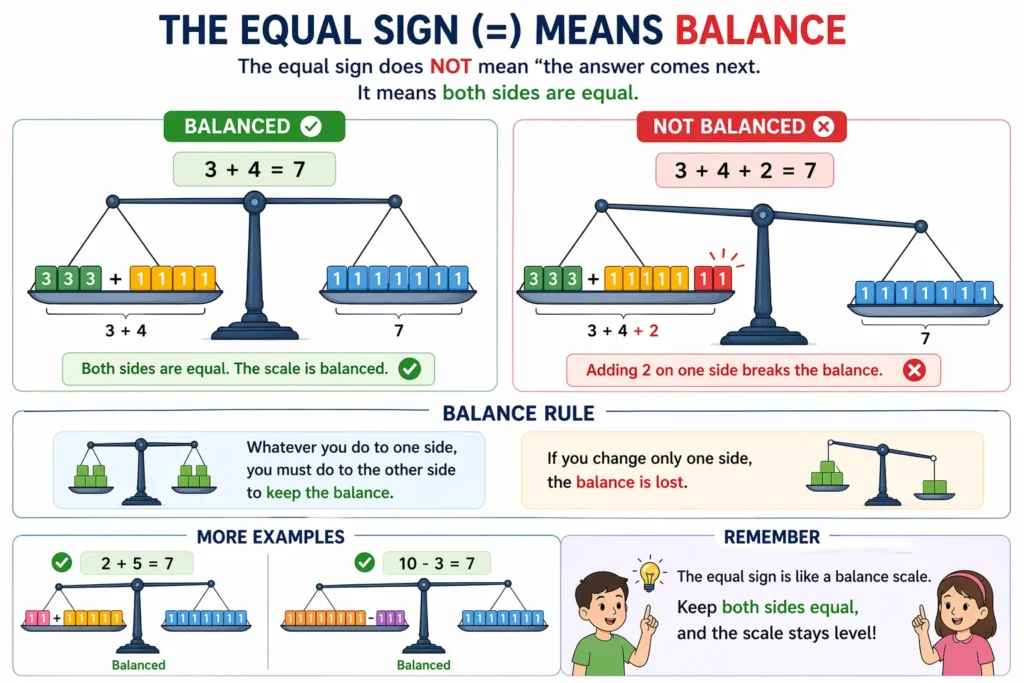
Why the Equal Sign Causes Confusion
This one is deeper than it looks.
Students think:
- = means answer comes next
But actually:
- = means balance
That misunderstanding creates errors like:
3 + 4 = 7 + 2
Students say: ❌ wrong
But actually: ❌ misunderstanding
Because both sides must be equal.
Common Algebra Misconceptions
| Misconception | Reality |
| x is a label | x is a value |
| = means answer | = means balance |
| Solve by steps only | Understand relationships |
Real Insight
I’ve worked with students who memorized 10+ methods.
But they still failed.
Why?
Because they didn’t understand:
- what symbols mean
- how equations behave
Once I explained algebra using simple objects and balance ideas,
their confusion dropped instantly.
That’s when algebra started making sense
Why Students Struggle with Algebra Word Problems
Students struggle with algebra word problems because they cannot translate real-world language into mathematical expressions or equations. This requires both reading comprehension and algebraic thinking, and when either is weak, students feel confused, overwhelmed, and unsure how to even begin solving the problem.
Here’s what I’ve seen many times.
A student solves equations well.
But the moment it becomes a word problem… they stop.
Not because algebra changed.
Because language entered the problem.
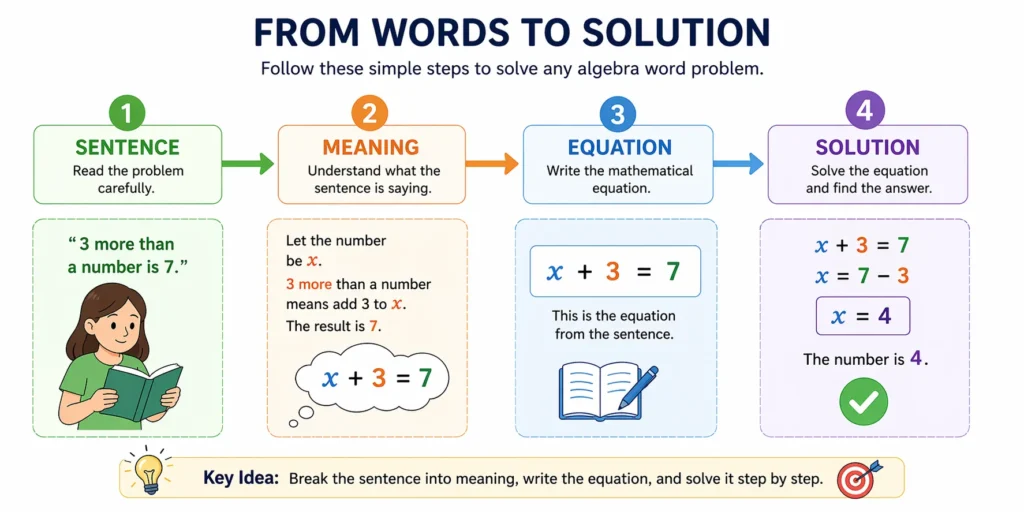
Why Word Problems Feel Harder Than Equations
Word problems combine two skills:
- reading understanding
- algebra reasoning
If either is weak, the student struggles.
Students often:
- rush reading
- miss key information
- don’t know what to represent
So they guess.
Translating Words into Algebra (The Missing Skill)
This is the real issue.
Students don’t know how to convert:
- “more than” → +
- “less than” → −
- “times” → ×
Without this mapping, algebra feels impossible.
Word → Algebra Translation
| Word Phrase | Algebra Meaning |
| More than | + |
| Less than | − |
| Twice a number | 2x |
| Sum of | + |
| Difference | − |
Real Insight
I worked with a student who said,
“I hate word problems.”
But when I asked them to explain the sentence in simple words,
they understood it perfectly.
The issue wasn’t math.
It was translation.
Once we practiced breaking sentences into small parts,
their confidence improved quickly.
Great — continuing exactly in your structure, tone, and SEO system.
Why Students Struggle with Algebra Word Problems
Students struggle with algebra word problems because they cannot translate real-world language into mathematical expressions or equations. This requires both reading comprehension and algebraic thinking, and when either is weak, students feel confused, overwhelmed, and unsure how to even begin solving the problem.
Here’s what I’ve seen many times.
A student solves equations well.
But the moment it becomes a word problem… they stop.
Not because algebra changed.
Because language entered the problem.
Why Word Problems Feel Harder Than Equations
Word problems combine two skills:
- reading understanding
- algebra reasoning
If either is weak, the student struggles.
Students often:
- rush reading
- miss key information
- don’t know what to represent
So they guess.
Translating Words into Algebra (The Missing Skill)
This is the real issue.
Students don’t know how to convert:
- “more than” → +
- “less than” → −
- “times” → ×
Without this mapping, algebra feels impossible.
Word → Algebra Translation
| Word Phrase | Algebra Meaning |
| More than | + |
| Less than | − |
| Twice a number | 2x |
| Sum of | + |
| Difference | − |
Real Insight
I worked with a student who said,
“I hate word problems.”
But when I asked them to explain the sentence in simple words,
they understood it perfectly.
The issue wasn’t math.
It was translation.
Once we practiced breaking sentences into small parts,
their confidence improved quickly.
Mindset & Psychological Barriers
Students struggle with algebra not only due to skill gaps but also because of math anxiety, low confidence, and fear of making mistakes. These emotional barriers reduce participation, slow learning, and cause students to avoid practice, which makes algebra even harder over time.
Here’s something many people ignore.
Algebra is not just about numbers.
It’s about confidence.
Algebra Anxiety and Confidence Issues
Students often feel:
- “I’m bad at math”
- “I’ll get it wrong”
So they stop trying.
That’s when learning stops.
Cognitive Load & Overwhelm
Algebra has many steps.
Students must:
- remember rules
- apply logic
- track steps
This overload causes mistakes.
Emotional Barrier → Learning Impact
| Barrier | Effect |
| Anxiety | Avoids practice |
| Low confidence | Gives up early |
| Fear | No risk-taking |
| Overwhelm | Confusion |
Real Insight
I’ve seen students cry over algebra.
Not because they couldn’t learn.
Because they believed they couldn’t.
Once we built small wins,
everything changed.
Top 10 Common Algebra Mistakes Students Make
Most algebra mistakes happen due to misunderstanding concepts, rushing steps, or weak foundational skills. These errors are predictable and can be corrected when students understand the logic behind each step rather than memorizing procedures.
: Common Mistakes in Algebra
- Sign errors
- Ignoring brackets
- Wrong simplification
- Skipping steps
- Misunderstanding variables
Mistake → Cause
| Mistake | Cause |
| Sign error | Weak integer skills |
| Skipping steps | Overconfidence |
| Wrong simplification | Poor understanding |
Real Insight
Every student I’ve worked with made the same mistakes.
Once they learned why mistakes happen,
they started improving faster.
Early Warning Signs a Student Is Struggling
Students show clear signs when they struggle with algebra, such as avoiding math, making repeated mistakes, low confidence, and difficulty understanding basic equations. Recognizing these signs early allows timely support and prevents deeper learning gaps from developing.
Signs Your Child Is Struggling with Algebra
- Avoids math
- Gets confused easily
- Low confidence
- Repeats mistakes
Real Insight
Parents often notice something feels wrong.
Trust that instinct.
Early action changes everything.
What Students Should Know Before Algebra
Students need strong pre-algebra skills such as number sense, fractions, integers, and pattern recognition before learning algebra. Without these, algebra becomes confusing because students lack the basic tools required to understand relationships and solve equations.
Algebra Readiness Checklist
- Fractions
- Integers
- Patterns
- Basic operations
How to Fix Algebra Struggles (Action Plan)
Algebra struggles can be improved through structured practice, strong conceptual understanding, and consistent support. When students focus on basics, build confidence step by step, and receive proper guidance, their performance and understanding improve significantly over time.
2-Week Quick Fix Plan
In the first 2 weeks, the goal is not to master algebra but to rebuild confidence and fix basic gaps. Students should focus on simple concepts like integers, fractions, and understanding variables so they stop feeling lost when solving equations.
Start small.
Focus on:
- fractions basics
- negative numbers (integers)
- understanding variables
Daily routine:
- 20 minutes practice
- 5 simple questions
- review mistakes
No pressure.
Just clarity.
I’ve seen students go from “I don’t get this”
to “this makes sense” in just days.
2-Week Focus
| Focus Area | Goal |
| Fractions | Basic understanding |
| Integers | No sign confusion |
| Variables | Meaning clarity |
1-Month Improvement Plan
Within one month, students can build strong understanding by practicing equations, reducing mistakes, and improving problem-solving skills. The focus should shift from basics to applying concepts correctly and confidently in different types of algebra questions.
Now we move forward.
Focus on:
- solving equations
- reducing common mistakes
- improving problem-solving
Daily:
- 30 minutes practice
- mix of easy + moderate questions
- explain answers aloud
That last step matters.
When students explain,
they understand better.
1-Month Growth
| Skill | Improvement |
| Equations | Solve confidently |
| Errors | Reduce mistakes |
| Thinking | Logical reasoning |
Real Insight
One student I worked with improved in 3 weeks.
Not because they studied more.
Because they started thinking instead of memorizing.
3-Month Confidence Plan
In three months, students can fully transform their algebra skills by mastering concepts, gaining confidence, and solving problems independently. With consistent effort and guidance, algebra becomes easier, and students start approaching problems with clarity instead of fear.
This is where real change happens.
Focus on:
- advanced equations
- word problems
- independent solving
Students should now:
- solve without help
- explain steps clearly
- avoid repeated mistakes
3-Month Result
| Area | Outcome |
| Confidence | High |
| Accuracy | Strong |
| Independence | Yes |
Real Insight
I’ve seen students who once avoided math
start helping others.
That shift doesn’t come from talent.
It comes from:
- structure
- clarity
- consistent effort
How Parents Can Help
Parents can help students improve in algebra by encouraging daily practice, focusing on understanding concepts rather than memorization, and providing emotional support. With the right guidance and patience, students can rebuild confidence and develop stronger algebra skills.
: How to Help a Child Struggling with Algebra
- Daily practice
- Concept focus
- Support mindset
Real Experience
Students improve in algebra when their foundational gaps are identified and addressed correctly. With proper guidance, structured practice, and conceptual clarity, even struggling students can gain confidence and perform well within a few weeks.
Real Story
I worked with a student who failed twice.
We fixed basics first.
Within a month,
they started solving confidently.
That’s the difference understanding makes.
Final Reflection
Sometimes the problem isn’t the student.
It’s how algebra was taught.
When students understand meaning,
everything changes.
Algebra stops being scary.
It starts making sense.
And that moment…
is where confidence begins.
Explore More: 10 Ways To Teach Multiplication Without Memorization
FAQs
1. Why do students struggle with algebra?
Students struggle with algebra due to weak foundational skills, confusion with variables and equations, and lack of conceptual understanding.
2. Why is algebra difficult for beginners?
Algebra feels difficult because it involves abstract thinking, symbolic representation, and understanding unknown quantities instead of simple calculations.
3. Why do students struggle with variables?
Students struggle with variables because they don’t understand that variables represent unknown values, not just symbols.
4. Why are algebra word problems hard?
Algebra word problems are hard because students struggle to convert mathematical language into equations.
5. What are common mistakes students make in algebra?
Common mistakes include sign errors, misunderstanding equations, and weak simplification skills.
6. How can students improve in algebra?
Students improve by strengthening basics, practicing regularly, and focusing on conceptual learning instead of memorization.
7. What skills are needed before learning algebra?
Students need strong number sense, fractions, integers, and understanding of basic operations.
8. Why do students lose confidence in algebra?
Students lose confidence due to math anxiety, repeated mistakes, and lack of clear understanding.
9. How can parents help with algebra struggles?
Parents can help by encouraging daily practice, focusing on concepts, and providing consistent support.
10. How long does it take to improve in algebra?
With structured practice and guidance, students can improve their algebra skills and confidence within a few weeks.