
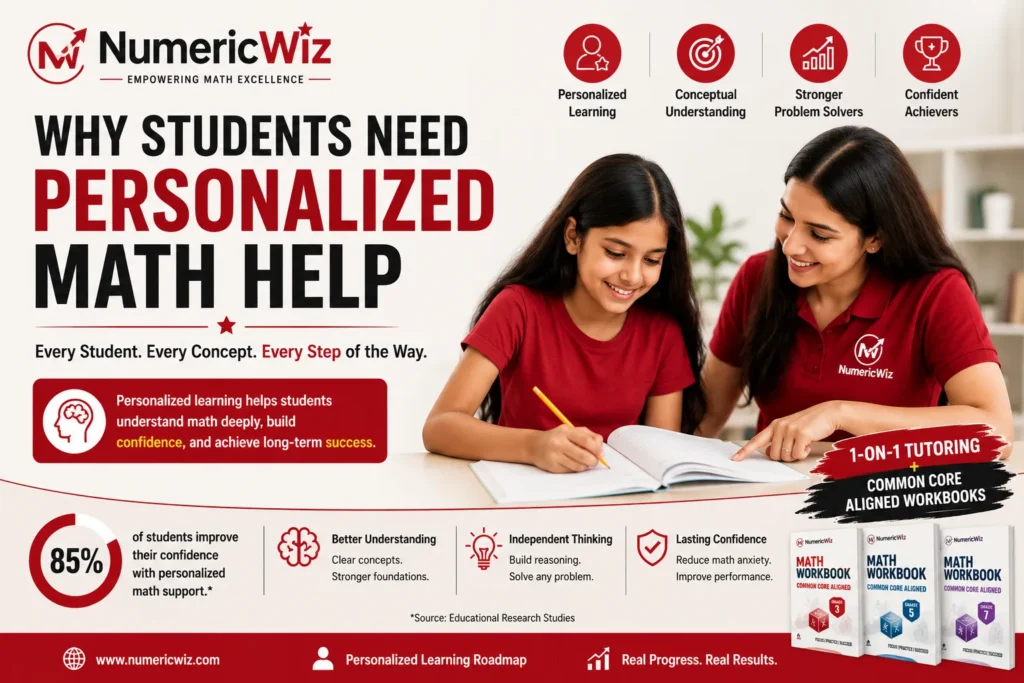
Have you ever watched a student solve homework confidently at home, then suddenly freeze during a test?
I’ve seen this happen many times. A student memorizes steps, follows examples carefully, and seems completely fine during practice. Then the wording changes slightly in an exam, and confidence disappears within seconds.
That’s usually the moment parents begin wondering:
“Maybe my child doesn’t actually understand math deeply.”
The truth is, many students are not struggling because they are lazy or incapable. They’re struggling because their learning needs were never fully understood in the first place. Some students carry hidden learning gaps for years. Others never properly develop number sense. Many quietly build math anxiety after repeatedly feeling confused in class but being too embarrassed to ask questions.
The difficult part is that these problems often stay hidden until grades begin dropping or confidence completely disappears.
Over the years, I’ve noticed something important. Students improve much faster when learning becomes personal. When someone slows down, identifies the exact struggle, and explains concepts in a way that finally makes sense, students begin changing how they see math and themselves.
That’s where personalized math help makes a real difference.
Instead of forcing every student through the same learning style, personalized support focuses on how a specific student learns best. And honestly, sometimes that single change is what finally helps a child stop fearing math.
Why Do So Many Students Struggle With Math?
Most students don’t suddenly become weak in math overnight. The struggle usually begins much earlier with one small concept that never fully clicked.
A misunderstanding in fractions during elementary school later turns into confusion in percentages. That confusion slowly grows into difficulty with algebra, equations, and problem-solving. Eventually, many students begin believing:
“I’m just not a math person.”
I’ve watched this pattern repeat countless times.
One student I worked with could solve equations perfectly as long as the format stayed familiar. But the moment the numbers changed or a word problem appeared, panic immediately took over. The issue wasn’t intelligence. The real issue was weak foundations hidden underneath memorized procedures.
Hidden Learning Gaps Keep Growing
Math works like a staircase. If one step becomes unstable, every step above it becomes harder to manage.
That’s why students with weak number sense often struggle later with algebra, ratios, percentages, and multi-step problem-solving questions. The difficult part is that classrooms move quickly. A student may miss one concept on Monday and face three new lessons before fully understanding the first one.
Without proper support, those learning gaps continue growing silently in the background.
Large Classrooms Cannot Match Every Learning Style
Some students learn visually. Others need repetition before concepts fully make sense. Some students understand best through discussion and examples connected to real-life situations.
But traditional classrooms usually move at one fixed pace for everyone.
I still remember students sitting quietly through lessons because they were terrified of asking questions in front of classmates. Once students stop asking questions, confusion begins piling up silently.
That fear affects learning far more than many people realize.
Memorization Creates Short-Term Results
This is one of the biggest problems in math education today.
Students often memorize formulas long enough to complete homework or pass quizzes. But when questions become unfamiliar, the brain struggles because the underlying concepts were never fully understood.
I’ve noticed many students can repeat procedures perfectly yet completely freeze when solving slightly different problems. That’s because memorization without conceptual understanding in mathematics rarely creates long-term retention.
Real understanding looks different. Students who truly understand concepts can explain reasoning, adapt to unfamiliar questions, recognize patterns, and solve problems more independently.
Math Anxiety Changes Student Behavior
Many students don’t actually hate math. They hate the feeling of constantly being confused.
Over time, repeated confusion creates math anxiety. Students begin avoiding participation, rushing through homework, panicking during tests, and doubting themselves before even attempting difficult questions.
That emotional side of learning often gets ignored. But confidence affects academic performance more than many people realize.
I once worked with a student who whispered every answer because they were terrified of making mistakes. A few months later, that same student confidently explained entire solutions aloud. The math ability was already there. The learning environment simply changed.
Common Causes of Math Struggles
| Problem | What Students Experience | Long-Term Effect |
|---|---|---|
| Weak number sense | Confusion in basic operations | Difficulty in algebra |
| Memorization-only learning | Can’t apply concepts | Weak retention |
| Fear of mistakes | Avoids participation | Low confidence |
| Fast-paced classrooms | Missed lessons | Learning gaps |
| Weak conceptual understanding | Formula dependency | Test anxiety |
What Is Personalized Math Help?
Personalized math help means teaching according to a student’s exact learning needs, pace, strengths, and weaknesses instead of forcing every student through the same learning system.
The funny thing is that many students don’t actually need more worksheets or harder practice. They need concepts explained differently.
I’ve seen students struggle with one topic for months, then suddenly understand it within minutes after hearing a clearer explanation connected to something familiar in real life.
That moment changes everything.
Students stop memorizing blindly and finally begin understanding why concepts work.
Personalized Learning Focuses on the Student First
Traditional tutoring often begins with:
“Let’s finish today’s homework.”
Personalized support starts differently. It asks:
“Why is this student struggling in the first place?”
That small difference matters a lot.
Some students need slower pacing before confidence appears. Others need visual explanations or repeated practice. Some students understand quickly once concepts become connected to real-life situations.
Personalized learning studies the student first, not just the textbook.
One-to-One Support Changes Participation
One thing I’ve consistently noticed during one-on-one tutoring sessions is that quiet students often become much more expressive once they feel safe asking questions.
That safety changes learning behavior completely.
Students begin admitting confusion openly, explaining reasoning aloud, attempting harder problems, and asking follow-up questions without fear of embarrassment.
Math is not only about answers. It’s about reasoning clearly. And reasoning improves when students feel comfortable thinking openly.
Personalized Learning Builds Real Understanding
Students with strong conceptual understanding usually remember concepts longer because they understand relationships instead of isolated formulas.
I’ve worked with students who memorized formulas perfectly but completely froze during word problems. Once concepts became visual and connected to real-life examples, understanding improved much faster.
Ratios suddenly made sense through cooking examples. Percentages became easier during shopping discounts.
That’s when math stopped feeling abstract and started feeling understandable.
Assessment and Diagnosis Matter More Than People Think
One major weakness in generic tutoring is skipping proper assessment.
Without diagnosis, tutoring becomes guesswork.
Strong personalized learning plans begin by identifying learning gaps, weak foundations, confidence barriers, and misunderstanding patterns. Sometimes a student struggling with algebra is actually carrying weak multiplication foundations underneath.
Without identifying the root problem, the same confusion keeps repeating again and again.
Why Personalized Math Help Works Better Than Generic Tutoring
Personalized math help works better because students receive support matched to their exact learning gaps, pace, and thinking style instead of following one fixed teaching system.
I’ve seen students spend months in tutoring programs without meaningful progress.
Not because tutoring failed.
Because the support was too general.
The student kept practicing symptoms while the actual problem stayed hidden underneath.
Students Learn at Different Speeds
Some students understand concepts immediately.
Others need:
- repetition
- visuals
- discussion
- slower pacing
Neither group is “smarter.”
They simply process information differently.
Traditional classrooms usually move at one fixed speed, which leaves many students quietly behind.
Immediate Feedback Prevents Bigger Problems
In group learning, mistakes can continue unnoticed for weeks.
Students repeat incorrect methods until confusion becomes habit.
With personalized math help, feedback happens immediately.
Students quickly understand:
- where mistakes started
- why confusion happened
- how to fix reasoning errors
That direct correction prevents small misunderstandings from turning into major learning gaps later.
Confidence Improves Faster With Individual Attention
This is one of the first changes parents usually notice.
Students begin:
- participating more
- attempting difficult questions
- speaking more confidently
- worrying less about mistakes
One student I worked with refused to solve questions aloud during early sessions because of embarrassment.
A few weeks later, the same student confidently explained entire solutions independently.
The math ability was already there.
The confidence wasn’t.
Personalized Learning Improves Retention
Memorization fades quickly.
Real understanding lasts longer.
Students learning through conceptual math learning usually retain information better because they understand relationships instead of isolated formulas.
That’s where mathematical reasoning becomes powerful.
Students begin adapting instead of depending completely on memorized procedures.
Generic Tutoring Often Misses the Root Cause
The visible struggle is not always the actual struggle.
A student struggling in algebra may actually have weak multiplication foundations.
A student struggling in geometry may still carry weak fraction understanding.
Without strong student assessment, tutoring can become endless repetition without real progress.
That’s why diagnosis matters before teaching begins.
Results Students Commonly Experience
| Before Personalized Help | After Personalized Help |
|---|---|
| Fear of math | Increased confidence |
| Memorization dependency | Conceptual understanding |
| Confusion during tests | Better retention |
| Avoiding participation | Active problem-solving |
| Weak independent learning | Stronger reasoning skills |
The Role of Personalized Math Help in the AI Era
Students today need more than memorization skills. They need reasoning, analytical thinking, and problem-solving abilities that help them adapt in a world increasingly shaped by AI and automation.
AI tools can already solve equations instantly.
Calculators handle computation within seconds.
Homework apps generate answers immediately.
So the real question becomes:
What skills will matter most in the future?
The students who succeed long-term are usually not the fastest memorizers.
They’re the students who can:
- think independently
- explain reasoning
- analyze unfamiliar situations
- adapt when problems change
That’s exactly where personalized math learning becomes important.
Memorization Is Becoming Less Valuable
Information is everywhere now.
AI can already generate solutions instantly.
The challenge is no longer finding answers.
The challenge is understanding them.
Students who rely only on memorization often struggle when:
- questions become unfamiliar
- reasoning is required
- multiple concepts combine together
That’s why deeper understanding matters more today than ever before.
Critical Thinking Matters More Than Ever
Schools and workplaces increasingly value:
- analytical thinking
- logical reasoning
- adaptability
- problem-solving ability
Math helps build those skills strongly.
Not because students will use every formula later in life.
But because mathematics trains the brain to think carefully and logically.
Personalized Learning Builds Independent Thinkers
One pattern appears repeatedly during tutoring sessions.
Students often become dependent on:
- formulas
- examples
- step-by-step instructions
Personalized learning gradually changes that behavior.
Students begin:
- explaining reasoning
- identifying mistakes independently
- testing different approaches
- solving unfamiliar problems
That process builds real confidence over time.
Future Careers Will Need Strong Problem-Solvers
Many repetitive jobs are already becoming automated.
But skills like:
- reasoning
- adaptability
- critical thinking
- pattern recognition
- logical analysis
will continue becoming more valuable.
Math learning should prepare students for that reality.
Not only for exams.
Skills Students Need in the AI Era
| Traditional Focus | Future-Ready Skills |
|---|---|
| Formula memorization | Critical thinking |
| Repetition | Problem-solving |
| Passive learning | Independent reasoning |
| Fixed procedures | Adaptability |
| Answer-focused learning | Conceptual understanding |
Frequently Asked Questions About Personalized Math Help
Is personalized math help better than group tutoring?
Personalized math help often works better for struggling students because lessons focus entirely on the student’s learning gaps, pace, and confidence level.
Group learning still helps some students.
But many students quietly fall behind because instruction moves too quickly for their needs.
Can personalized tutoring help math anxiety?
Yes. Personalized tutoring can reduce math anxiety by creating a calmer learning environment where students feel comfortable asking questions and learning step by step without classroom pressure.
Confidence usually improves once students begin understanding concepts more clearly.
How quickly do students improve?
Many students begin showing stronger confidence and participation within the first few sessions, while academic improvement often becomes noticeable within several weeks.
Every student progresses differently depending on learning gaps and consistency.
Is personalized support only for struggling students?
No. Personalized learning also helps advanced students move faster and strengthen higher-level reasoning skills through customized learning paths.
Some students need support catching up.
Others need support moving ahead.
Both situations benefit from personalized instruction.
What age should students start personalized math support?
Students can benefit from personalized math support at almost any grade level, especially when learning gaps or confidence issues begin appearing.
Early support usually prevents larger struggles later.
But it’s never too late to rebuild confidence and understanding.
Explore More: A Smarter and More Personalized Math Learning Approach | NumericWiz Vision
Final Thoughts
Sometimes students don’t need more pressure.
They need someone willing to slow down, identify where confusion started, and explain concepts in a way that finally makes sense.
I’ve watched students completely change their relationship with math once learning became more personal.
Not because they suddenly became “gifted.”
Because someone finally taught them according to how they learn best.
That difference matters deeply.
A student who feels understood usually becomes more confident.
A confident student becomes more willing to try.
And students who keep trying eventually begin improving in ways that once felt impossible to them.
Sometimes the biggest academic change starts with one simple realization:
“Maybe I’m not bad at math after all.”