
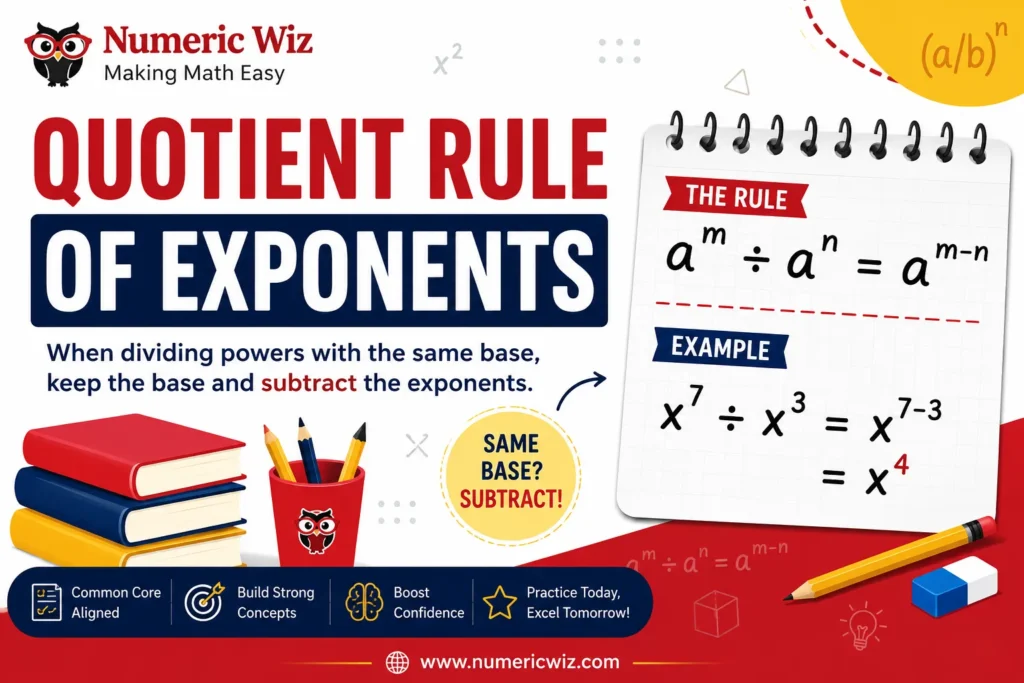
The Quotient Rule of Exponents says that when dividing powers with the same base, keep the base the same and subtract the exponents.
For example, x⁷ ÷ x³ = x⁴
This works because four x’s remain after the common factors are cancelled. The rule only works when both expressions have the same base. Many students wonder whether they should divide the exponents or subtract them.This particular question pops up all the time in algebra classes The good news is that once you understand why the rule works, solving exponent division problems becomes much easier.
In this guide, you’ll learn:
- What the Quotient Rule of Exponents is.
- Why the rule works.
- When to use it.
- Step-by-step solved examples.
- Common mistakes to avoid.
- Practice questions with answers.
By the end of this lesson, you’ll be able to simplify exponent division problems with confidence.
What Is the Quotient Rule of Exponents?
The Quotient Rule of Exponents is used when dividing two powers that have the same base. Instead of writing the same number or variable many times, we use a simple shortcut.
Quotient Rule Formula
aᵐ ÷ aⁿ = aᵐ⁻ⁿ
This rule tells us to:
- Keep the base the same.
- Subtract the exponents.
- Write the answer as one power.
For example: m⁹ ÷ m⁴
Keep the base m. Subtract the exponents: 9 − 4 = 5
Answer: m⁵
Why Does the Quotient Rule Work?
Instead of memorizing the rule, let’s understand it.
Look at this expression: x⁷ ÷ x³
Expand both powers.
x⁷ = x × x × x × x × x × x × x
x³ = x × x × x
Now cancel the common factors: x × x × x
Four x’s remain. So, x⁷ ÷ x³ = x⁴
Notice what happened.
The first expression had 7 x’s.
The second expression removed 3 x’s.
That leaves: 7 − 3 = 4
This is why we subtract the exponents.
Once you understand this idea, the Quotient Rule becomes easy to remember.
When Should You Use the Quotient Rule?
Use this rule only when:
- You are dividing powers.
- Both powers have the same base.
Correct Examples
a⁸ ÷ a³ = a⁵
7⁶ ÷ 7² = 7⁴
y⁹ ÷ y = y⁸ (Remember that y = y¹.)
Do NOT Use the Quotient Rule Here
x⁵ ÷ y², When the bases are different. The Quotient Rule cannot be used.
Step-by-Step Solved Examples
Example 1
Simplify: b⁹ ÷ b⁴
Same base? Yes
Subtract the exponents: 9 − 4 = 5
Answer: b⁵
Example 2
Simplify: 10⁷ ÷ 10³
Keep the base.
Subtract: 7 − 3 = 4
Answer: 10⁴
Example 3
Simplify: m⁶ ÷ m
Remember: m = m¹
Subtract: 6 − 1 = 5
Answer: m⁵
Example 4
Simplify: x¹² ÷ x⁷
12 − 7 = 5
Answer: x⁵
Example 5
Simplify: p⁸ ÷ q²
Different bases.
The Quotient Rule cannot be used.
Answer: p⁸ ÷ q²
Common Mistakes Students Make
Mistake 1: Dividing the Exponents
x⁸ ÷ x² = x⁴
Students divide 8 ÷ 2.
Correct: 8 − 2 = 6
Answer: x⁶
Mistake 2: Changing the Base
a⁷ ÷ a³ = 4
The base stays the same.
Correct: a⁴
Mistake 3: Using Different Bases
x⁶ ÷ y² = x⁴
Wrong. Different bases mean the rule cannot be used.
Mistake 4: Forgetting the Hidden Exponent
Remember: k = k¹
So, k⁸ ÷ k = k⁷
Teacher Tip
Ask students to expand small exponent expressions before using the formula. When they cancel common factors themselves, they understand why the exponents are subtracted instead of simply memorizing the rule.
Parent Tip
Encourage your child to check the bases before solving the problem. If the bases are not the same, the Quotient Rule does not apply. This simple habit helps prevent many mistakes.
Where Is the Quotient Rule Used ?
The Quotient Rule is used in many areas of mathematics and science, including:
- Algebra
- Scientific notation
- Physics
- Engineering
- Computer programming
- Data science
Learning this rule prepares students for more advanced math topics.
Practice Questions
- x⁸ ÷ x² = _______
- a⁷ ÷ a³ = _______
- 5⁶ ÷ 5² = _______
- y⁹ ÷ y = _______
- p⁵ ÷ p² = _______
- m¹² ÷ m⁷ = _______
- b¹⁵ ÷ b⁹ = _______
- 10⁸ ÷ 10⁴ = _______
- c¹⁰ ÷ c = _______
- k¹⁴ ÷ k⁶ = _______
- x²⁰ ÷ x⁸ = _______
- a²⁵ ÷ a¹⁰ = _______
- y⁹ ÷ z³ = _______
- p¹⁸ ÷ p⁹ = _______
- n³⁰ ÷ n = _______
Answer Key
- x⁶
- a⁴
- 5⁴
- y⁸
- p³
- m⁵
- b⁶
- 10⁴
- c⁹
- k⁸
- x¹²
- a¹⁵
- y⁹ ÷ z³
- p⁹
- n²⁹
Quick Summary
| Remember | Rule |
| Same base | Keep the base |
| Division | Subtract the exponents |
| Different bases | Do not use the Quotient Rule |
Conclusion
The Quotient Rule of Exponents makes dividing powers much easier. Remember one simple idea: if the bases are the same, keep the base and subtract the exponents.
Instead of memorizing the formula, practice expanding and cancelling the factors yourself. This helps you understand why the rule works and makes solving exponent problems much easier.
Continue practicing with different examples, and you’ll soon be ready to learn the Power of a Power Rule, the next important law of exponents.
Explore More: Product Rule of Exponents: Easy Explanation with Examples & Practice Questions
Frequently Asked Questions
What is the Quotient Rule of Exponents?
The Quotient Rule of Exponents states that when dividing powers with the same base, keep the base the same and subtract the exponents. This rule makes it easy to simplify exponent expressions without writing repeated division.
Why do we subtract the exponents?
Subtracting the exponents shows how many factors remain after cancelling the common factors in the numerator and denominator. It is a simple shortcut that makes dividing powers much faster.
Can the Quotient Rule be used with different bases?
No. The Quotient Rule only works when both expressions have the same base. If the bases are different, the expression cannot be simplified using this rule.
What if there is no exponent written?
If a number or variable has no visible exponent, its exponent is 1. For example, m = m¹. Always remember this hidden exponent when applying exponent rules.
What happens if both exponents are equal?
If both exponents are the same, the answer becomes 1 (as long as the base is not zero). For example, x⁵ ÷ x⁵ = x⁰ = 1. This is called the Zero Exponent Rule, which students usually learn after mastering the Quotient Rule.
Is the Quotient Rule part of the Common Core curriculum?
Yes. The Quotient Rule of Exponents is taught in middle school as part of the Common Core Mathematics Standards. It helps students develop a strong understanding of algebra and prepares them for advanced exponent concepts.
How can Numeric Wiz help students learn exponents?
Numeric Wiz helps students succeed in algebra through Learning Gap Assessments, Personalized Learning Roadmaps, Common Core-aligned Worksheets, Free Printable Math Resources, Guided Workbooks, Expert One-on-One Tutoring, and Personalized Feedback. Our mission is to help every student strengthen their math skills, build confidence, and enjoy learning mathematics.