
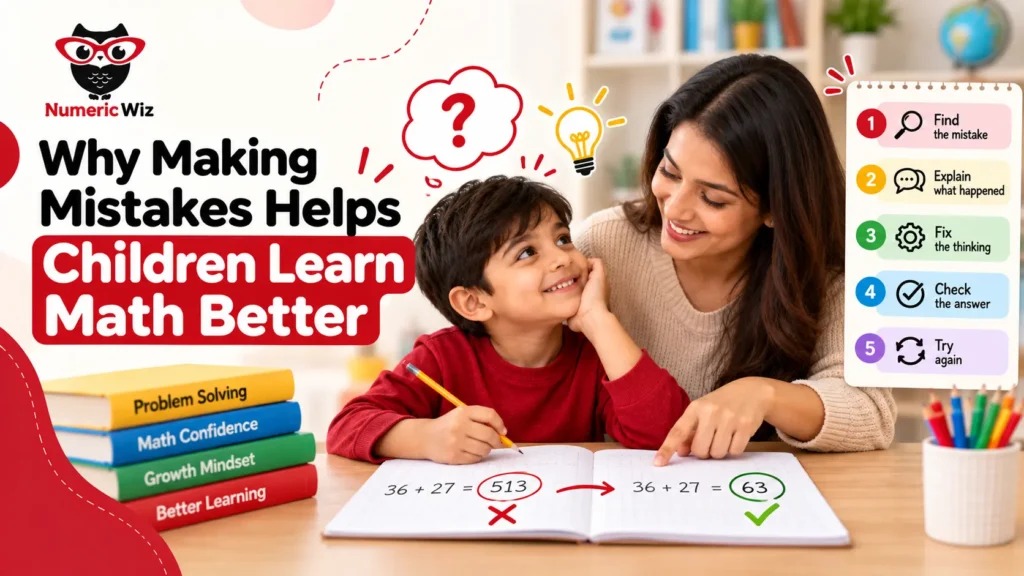
Your child writes: 36 + 27 = 513
Your first instinct may be: “No, that’s wrong. Try again.”
But the wrong answer may tell you something the correct answer never could.
Did your child misunderstand place value? Did they join the digits instead of adding the quantities? Did they forget a procedure? Or were they simply rushing?
A math mistake can give you a window into how your child is thinking. The real learning happens when the child finds the error, understands why it happened, corrects it, and uses that understanding on the next problem.
That distinction matters.
Mistakes aren’t automatically helpful. Repeating the same incorrect method without examining it won’t build understanding.
The useful process is:
Mistake → Find → Explain → Fix → Check → Try Again
That turns a wrong answer into information.
Why Are Mistakes Important in Learning Math?
Mistakes can show exactly where a child’s mathematical thinking has gone off track. When children examine an error instead of simply replacing it with the correct answer, they have an opportunity to clarify the concept and improve their reasoning.
Suppose your child writes: 3/4 + 2/5 = 5/9
The answer is incorrect, but it tells you something.
The child probably knows that fractions contain numerators and denominators. The problem is that they are treating fraction addition like whole-number addition.
That is useful information.
You now know that simply assigning 20 more fraction questions may not solve the problem. The child needs to understand why unlike fractions cannot be added by adding the denominators.
Tarheel State Teacher similarly argues that conceptual mistakes can expose ideas students appear to understand but haven’t yet understood deeply, giving teachers an opportunity to examine the thinking behind the answer. A wrong answer can therefore become a starting point for a better question:
“What were you thinking here?”
That question tells you much more than: “What’s the correct answer?”
Are All Math Mistakes Useful?
No. A mistake becomes useful when the child does something with it.
Consider two children who make the same multiplication error.
Both write: 7 × 8 = 54
The first child sees the correct answer, erases 54, writes 56, and moves on.
The second child asks: “Why did I write 54?”
They compare nearby facts: 7 × 7 = 49
7 × 8 = 56
Then they solve another related question: 7 × 9 = 63
Both children corrected the page.
But the second child examined the relationship.
That distinction is important.
A useful math mistake has four parts
| Stage | Child’s Thinking |
| Notice | “Something isn’t right.” |
| Investigate | “Where did my thinking change?” |
| Correct | “What should I do instead?” |
| Apply | “Can I use this on another problem?” |
Simply marking an answer wrong doesn’t complete this process.
What Is the Difference Between a Math Error and a Misconception?
Not every wrong answer has the same cause.
This is one of the most important distinctions for parents to understand.
A calculation or attention error
The child understands the concept but makes a slip.
For example: 48 + 21 = 68
The child may understand addition perfectly but accidentally calculate 8 + 1 as 8.
A conceptual misconception
The child is following an incorrect mathematical idea.
For example: 1/3 + 1/3 = 2/6
This isn’t simply a slip.
The child may believe that adding fractions means adding both numerators and denominators.
Tarheel State Teacher specifically distinguishes conceptual misunderstandings from ordinary computational errors and argues that the former can provide particularly useful information about students’ mathematical thinking.
That means parents shouldn’t respond to every wrong answer in exactly the same way.
A slip may need: “Check that calculation again.”
A misconception may need: “Show me what 1/3 means first.”
What Can a Wrong Answer Tell You About Your Child’s Thinking?
A wrong answer can tell you where the reasoning changed direction.
Suppose your child solves: 3 × (4 + 2)
As: 3 × 4 + 2 = 14
Don’t begin with the answer.
Ask: “What did the 3 multiply?”
Your child may say: “The 4.”
Now you can see the actual issue.
The child hasn’t fully understood that the parentheses represent one grouped quantity.
Compare that with a child who writes: 3 × (4 + 2) = 3 × 6 = 16
Here the structure is understood. The multiplication fact is wrong.
Same final status:
❌ Incorrect.
Different learning need.
This is why children’s working steps can matter as much as the final answer.
Oodles also identifies failure to show working as a common problem because it makes errors harder to trace and correct.
Why Does My Child Keep Making the Same Math Mistakes?
Repeated mistakes often mean that the cause of the error hasn’t been addressed. Correcting the final answer alone may leave the child’s original thinking unchanged.
Imagine your child repeatedly writes: 402 − 178 = 376
You show the correct subtraction. Tomorrow, the same type of error appears.
The problem may not be lack of practice.
Your child might have a gap in place value or regrouping.
More questions using the same misunderstood procedure can simply give the child more opportunities to repeat it.
Try asking:
“Show me what 402 means using hundreds, tens, and ones.”
Now you’re investigating the mathematical idea underneath the procedure.
Oodles similarly notes that repeated mistakes can reflect gaps in understanding and argues for identifying weaknesses rather than treating every error as an isolated event.
What Are the Most Common Math Mistakes Children Make?
Children’s mistakes change as mathematics becomes more complex, but several patterns appear frequently.
| Common Mistake | What May Be Happening |
| Misreading the question | Rushing or difficulty identifying important information |
| Wrong operation | Weak understanding of the situation |
| Calculation slip | Attention or fact-recall error |
| Incorrect formula | Formula remembered without knowing when it applies |
| Place-value error | Weak understanding of digit value |
| Fraction error | Whole-number thinking applied to fractions |
| Skipping steps | Trying to calculate too much mentally |
| Not checking | Child assumes finishing means being done |
| Copying numbers incorrectly | Attention or organization problem |
| Correct answer, faulty reasoning | Chance or an unreliable method |
Oodles identifies weak basic arithmetic, misunderstanding word problems, incorrect formula use, skimming questions, unnecessary complication, and failure to show working among common student errors.
But don’t stop at naming the category.
Ask: “Why did this particular mistake happen?”
Two children can produce the same wrong answer for completely different reasons.
Why Can Fear of Making Mistakes Make Math Harder?
When children believe every wrong answer means they are “bad at math,” they may become less willing to attempt unfamiliar problems, explain uncertain ideas, or try another strategy.
This can create a difficult cycle:
Fear of being wrong → Avoid difficult questions → Less meaningful practice → Lower confidence → More fear
Maths Australia notes that students can come to view mistakes as failures and emphasizes that adult reactions can affect how students perceive them.Tarheel State Teacher also connects a healthier response to mistakes with students’ willingness to take mathematical risks and work through problems that require independent thinking.
That doesn’t mean telling children: “Wrong answers don’t matter.”
Accuracy matters in mathematics.
A better message is: “The answer isn’t correct yet. Let’s find where your thinking changed.”
Now accuracy and learning can exist together.
Why Giving the Correct Answer Isn’t Enough
Suppose your child writes: 6 × 7 = 48
You say: “No, it’s 42.”
Problem fixed?
Only on the page.
You still don’t know why the child chose 48.
Maybe they confused 6 × 8 with 6 × 7.
Maybe multiplication facts aren’t secure.
Maybe they counted in sixes and skipped a number.
Giving the answer removes the immediate error but may leave the cause untouched.
Instead ask: “Can you use a fact you already know to check it?”
Perhaps the child knows: 5 × 7 = 35
One more group of 7 gives: 35 + 7 = 42
Now the correction is connected to mathematical reasoning.
The NumericWiz Mistake Routine
When your child gets a math problem wrong, try this five-step routine.
1. Find
Ask: “Where does your work first stop making sense?”
Don’t begin by pointing to the exact error.
Give your child a chance to find it.
2. Explain
Ask: “What were you thinking at this step?”
Listen before correcting.
You are trying to identify the child’s reasoning.
3. Fix
Once the cause is clear, correct the idea, not merely the answer.
4. Check
Ask: “How can we check that this answer makes sense?”
The child might use estimation, an inverse operation, a visual model, substitution, or another strategy.
5. Try Again
Give a similar but new problem.
If the original question was: 3/4 + 1/8
Try: 2/3 + 1/6
Now you can see whether the child learned from the correction.
This final step is often missing.
A corrected problem shows that the child can follow a correction.
A new problem gives better evidence that the underlying idea is becoming clearer.
How Should Parents Respond When a Child Gets Math Wrong?
Your first response matters.
Instead of immediately saying: “Wrong.”
Try: “Show me how you got that.”
Instead of: “You know this!”
Try: “Which step are you most sure about?”
Instead of: “I already explained this.”
try: “Let’s find where it started to feel confusing.”
Instead of: “Be more careful.”
try: “What could you check before you finish?”
Maths Australia similarly recommends letting students walk through the steps used to reach an answer, because reviewing the process can sometimes allow them to locate the error themselves.
Your goal isn’t to pretend mistakes don’t matter.
It is to make correction part of learning rather than the end of learning.
Questions to Ask Instead of “Why Did You Get This Wrong?”
Some questions invite thinking better than others.
Try:
- What were you thinking here?
- Which step would you check first?
- What do you know for sure?
- Can you show this with a picture or model?
- Does your answer make sense?
- Can you estimate the answer first?
- What changed between these two steps?
- Can you solve it another way?
- What rule did you use? Why does it apply here?
- What will you do differently on the next problem?
Questions like these move attention from embarrassment toward mathematical reasoning.
Three Examples of Learning From Math Mistakes
Example 1: Place Value
A child writes: 306 + 42 = 726
Don’t simply demonstrate column addition.
Ask the child to represent: 306 = 3 hundreds + 0 tens + 6 ones
And:42 = 4 tens + 2 ones
Then compare the representation with the written calculation.
The mistake becomes evidence about place value.
Example 2: Fractions
A child writes: 2/5 + 1/5 = 3/10
Ask: “If you have two fifths and add one more fifth, did the size of each piece change?”
No. The pieces are still fifths.
So: 2/5 + 1/5 = 3/5
A fraction model can make the error easier to see than another verbal rule.
Example 3: Word Problems
A question says:
Mia has 24 stickers. She puts 6 stickers in each bag. How many bags can she fill?
The child calculates: 24 × 6 = 144
Before saying “divide,” ask:
“Are we making 6 groups of 24, or finding how many groups of 6 fit into 24?”
Now the child must think about the meaning of the operation.
Misinterpreting word problems is one of the common error categories identified by Oodles.
Is a “Careless Mistake” Always Careless?
No. A repeated careless mistake deserves a closer look.
One arithmetic slip may simply be a slip.
But suppose your child repeatedly:
- reverses operations,
- loses negative signs,
- misaligns place values,
- copies numbers incorrectly,
- confuses area with perimeter,
- chooses the wrong operation in word problems,
- or uses formulas in the wrong situations.
Calling everything “careless” doesn’t explain the pattern.
Ask three questions:
Does it happen repeatedly?
Does it happen only with one concept?
Can my child explain the correct idea afterward?
If the same error keeps appearing, investigate the concept or habit underneath it.
How Does Error Analysis Build Mathematical Reasoning?
Error analysis asks children to explain why a solution is wrong, not simply identify that it is wrong.
Try giving your child this fictional student’s work: 4 × (3 + 5) = 12 + 5 = 17
Ask: Where is the first mistake?
Why is it a mistake?
What should happen instead?
How could you prove it?
Now your child isn’t simply calculating.
They are examining an argument.
Should Children Correct Every Wrong Answer?
Children should understand important errors, but correction shouldn’t become mindless rewriting.
If a child has 15 incorrect questions caused by the same misconception, correcting all 15 without understanding the cause may add little value.
Instead:
Find the pattern in the mistakes.
Correct one carefully.
Explain why.
Try two or three new examples.
Then check whether the idea transfers.
The aim is not to produce a perfectly corrected worksheet.
The aim is to improve the child’s mathematical understanding.
How Can Children Stop Repeating the Same Math Mistakes?
Use a simple cycle:
Identify → Understand → Practise → Recheck
Suppose your child repeatedly forgets to distribute a negative sign:
−(x − 4) = −x − 4
First, identify the pattern.
Next, revisit what multiplying the entire expression by −1 means.
Then practise a small number of targeted examples.
Finally, return to the concept later rather than assuming one successful correction means it is secure.
More practice isn’t always the answer. Better-targeted practice often is.
Try a Math Mistake Notebook
A simple mistake notebook can help older children notice repeated patterns.
Don’t copy entire worksheets.
Use four short columns:
| Problem | My Mistake | Why It Happened | What I’ll Check Next Time |
| 3/4 + 1/2 | Added denominators | Forgot fractions need equal-sized parts | Check denominators first |
| −3(x − 2) | Sign error | Didn’t multiply both terms | Circle the negative sign |
| Area question | Used perimeter | Read too quickly | Write what the question asks |
Reviewing this occasionally can help a child see that “I’m bad at math” is too vague.
A more useful conclusion might be:
“I understand equations, but I often lose negative signs.”
That’s a problem a child can actually work on.
Homework Mistakes and Test Mistakes Are Not Always the Same
A child may understand mathematics during homework and still make more mistakes during a test.
Why?
The environment changes.
There may be:
- time pressure,
- less opportunity to ask questions,
- several topics mixed together,
- longer periods of concentration,
- unfamiliar question wording,
- pressure to finish quickly.
So when reviewing a test, don’t look only at the score.
Sort errors into categories:
Concept error
Calculation error
Question-reading error
Strategy error
Checking error
You may find that the child doesn’t need to relearn the entire unit.
They may need a better checking routine or more practice deciding which method a problem requires.
When Should Parents Step In?
Don’t correct every error immediately.
If your child is still thinking, give them a little space.
A useful sequence is:
Wait → Ask → Hint → Model if needed
For example: “Check the operation.”
If that isn’t enough: “What does the question ask you to find?”
Then: “Could you draw it?”
Only provide a full explanation when the child needs it.
The goal isn’t to leave children stuck indefinitely.
It is to give them a chance to notice and repair their own thinking before taking over.
When Do Repeated Math Mistakes Need More Support?
Repeated errors may need additional attention when they continue after clear explanation and targeted practice, appear across several related skills, or prevent the child from moving on to new mathematics.
Look for patterns rather than one difficult homework session.
For example, repeated trouble with:
- place value,
- basic number relationships,
- interpreting mathematical symbols,
- fractions,
- choosing operations,
- following multi-step reasoning,
may point to an underlying learning gap that deserves closer investigation.
Parents can begin by discussing the pattern with the child’s teacher. The important question isn’t:
“Why does my child make mistakes?”
It is:
“What kind of mistakes are they making, and what do those mistakes tell us?”
A Simple Parent Routine for Math Homework
When you see a wrong answer tonight, resist the urge to correct it immediately.
Try:
1. Ask:
“Can you show me how you got this?”
2. Locate:
“Which step should we check?”
3. Understand:
“What were you thinking here?”
4. Correct:
“What should change?”
5. Check:
“How can you tell the new answer makes sense?”
6. Transfer:
“Can you try one similar problem?”
That final question matters.
The goal isn’t merely to repair yesterday’s mistake.
It’s to help your child handle tomorrow’s problem more independently.
Frequently Asked Questions
Are mistakes good for learning math?
Mistakes can support math learning when children examine why an answer is incorrect, correct the underlying thinking, and then apply the corrected idea to another problem. Simply making or correcting a mistake does not guarantee learning.
Why does my child keep making the same mistakes in math?
Repeated mistakes can come from an unresolved misconception, weak foundational knowledge, rushing, difficulty interpreting questions, or an unreliable calculation habit. Look for a pattern in the errors rather than treating each wrong answer separately.
Should I correct my child’s math mistakes immediately?
Not always. Give your child a chance to find the error first. Ask them to explain their steps, check the answer, or try another representation. Step in with a hint or explanation when they cannot move forward independently.
What is error analysis in math?
Error analysis means examining an incorrect solution to identify where the reasoning went wrong, why it was incorrect, and how it can be corrected. It shifts attention from simply obtaining the answer to understanding the mathematical thinking behind it.
What is the difference between a careless mistake and a misconception?
A careless mistake may occur even when the child understands the underlying concept, such as copying a number incorrectly. A misconception involves an incorrect mathematical idea, such as believing that denominators should always be added when adding fractions.
How can I help my child stop making careless math mistakes?
Teach a short checking routine. Your child can reread the question, estimate the expected answer, check signs and operations, review written steps, and compare the final answer with the original question. If the same “careless” error keeps returning, investigate whether there is a deeper misunderstanding.
Can mistakes affect a child’s confidence in math?
Yes. Children may begin avoiding difficult questions if they interpret mistakes as proof that they are poor at mathematics. Adults can maintain expectations for accuracy while helping children view errors as information that can be examined, understood, and corrected.
Need Practice material?
Explore our Common Core aligned Worksheets designed by the experts.