Finding the highest common factor or least common multiple can become confusing when students work with larger numbers or need to choose the correct method. Many students can list factors and multiples but struggle to understand when to use HCF, when to use LCM, and how prime factorization or division can help them find the answer.
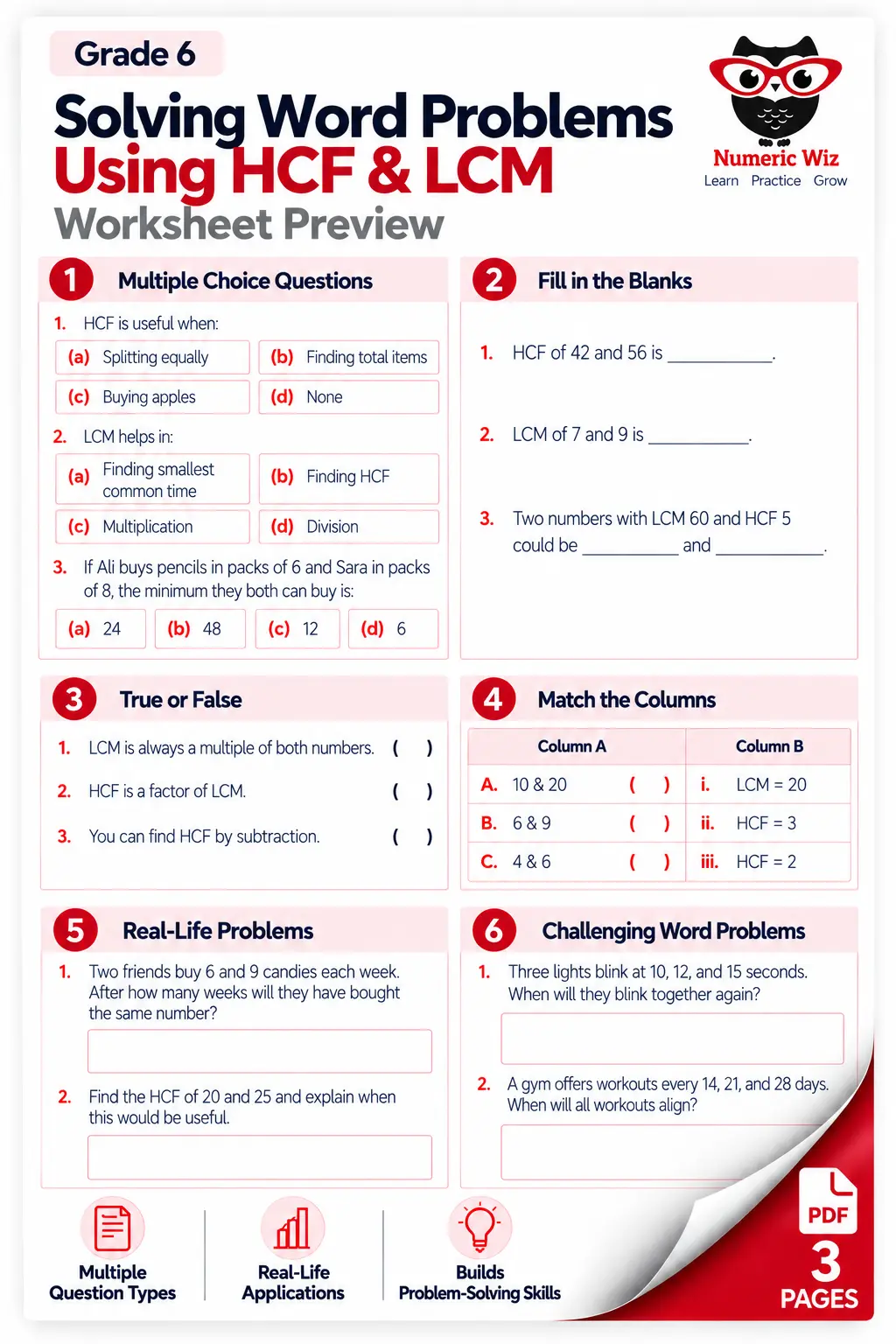
These Grade 6 HCF and LCM worksheets from NumericWiz provide structured practice that helps students explore common factors and multiples, apply calculation methods, and solve problems involving number relationships and repeating events.
The Highest Common Factor (HCF), also called the Greatest Common Factor (GCF), is the largest positive whole number that divides two or more numbers exactly.
For example, consider 12 and 18.
Factors of 12: 1, 2, 3, 4, 6, 12
Factors of 18: 1, 2, 3, 6, 9, 18
Their common factors are 1, 2, 3, and 6.
Therefore:
HCF of 12 and 18 = 6
The Least Common Multiple (LCM) is the smallest positive number that is a multiple of two or more given numbers.
For example, consider 4 and 6.
Multiples of 4: 4, 8, 12, 16, 20, 24...
Multiples of 6: 6, 12, 18, 24, 30...
The smallest positive multiple shared by both numbers is 12.
Therefore:
LCM of 4 and 6 = 12
Understanding this distinction helps students recognize that HCF is useful when finding the largest possible equal group size, while LCM is useful when finding the earliest point at which repeating patterns coincide.
Prime factorization involves expressing a number as a product of prime numbers. It provides a systematic way to identify common factors and multiples.
For example, consider 24 and 36.
First, write their prime factorizations:
24 = 2 × 2 × 2 × 3 = 2³ × 3
36 = 2 × 2 × 3 × 3 = 2² × 3²
To find the HCF, identify the prime factors shared by both numbers and select the smallest exponent for each common prime.
HCF = 2² × 3 = 12
Therefore: HCF of 24 and 36 = 12
To find the LCM, include every prime factor appearing in either number, using the highest exponent for each prime.
LCM = 2³ × 3²
LCM = 8 × 9 = 72
Therefore:
LCM of 24 and 36 = 72
This method helps students organize prime factors and understand how HCF and LCM are connected to the multiplicative structure of numbers.
The division method, also known as the Euclidean algorithm when used for finding HCF, provides another way to determine the highest common factor.
For example, find the HCF of 24 and 36.
Divide the larger number by the smaller number: 36 ÷ 24 = 1 remainder 12
Next, divide 24 by the remainder: 24 ÷ 12 = 2 remainder 0
When the remainder becomes zero, the last nonzero remainder is the HCF.
Therefore: HCF of 24 and 36 = 12
This method gives students an alternative to listing factors or using prime factorization, particularly when working with larger numbers.
HCF and LCM are useful when mathematical problems involve equal grouping, common divisors, repeated intervals, or events occurring together.
HCF can help determine the largest possible equal group size without leftovers.
LCM can help identify when different repeating patterns will coincide.
For example, if one activity repeats every 6 minutes and another repeats every 8 minutes, their common multiples indicate when both activities will happen together again.
Multiples of 6: 6, 12, 18, 24...
Multiples of 8: 8, 16, 24, 32...
LCM of 6 and 8 = 24
Both activities will occur together again after 24 minutes, assuming they started at the same time.
These connections help students understand why finding common factors and multiples matters beyond classroom calculations.
This 3-page printable math worksheet focuses on finding HCF and LCM using prime factorization and the division method.
Students begin with questions that check their understanding of HCF, LCM, and common prime factors. They then move into fill-in-the-blank exercises, true-or-false statements, and matching activities.
The written problem-solving section asks students to find the HCF of 24 and 36 using the division method and calculate the LCM of 9 and 12 using prime factorization.
The final section introduces challenging word problems involving repeating distances and time intervals, allowing students to apply common-multiple reasoning.
These Grade 6 HCF and LCM worksheets combine different types of mathematical questions to support concept recognition, calculation, and application.
Multiple-Choice Questions: Students identify the HCF or LCM of given numbers and recognize common prime factors.
Fill in the Blanks: Students calculate HCF and LCM values and identify prime factors shared by different numbers.
True or False: Students evaluate mathematical statements about HCF, LCM, and prime factors, helping them recognize common misconceptions.
Match the Columns: Students connect number pairs with corresponding HCF or LCM values.
Written Calculations: Students use the division method to calculate HCF and prime factorization to determine LCM while showing their working.
Challenging Word Problems: Students apply common-multiple reasoning to problems involving running laps and repeating preparation intervals.
These activities give students opportunities to practice mathematical procedures while developing a clearer understanding of the relationships between factors, multiples, and prime numbers.
HCF and LCM become more meaningful when students use them to solve problems involving repeated quantities and schedules.
For example, imagine three activities repeat every 18, 24, and 36 minutes. To determine when all three activities will happen together again, students can find their least common multiple.
18 = 2 × 3²
24 = 2³ × 3
36 = 2² × 3²
Select the highest power of each prime factor:
LCM = 2³ × 3²
LCM = 8 × 9 = 72
Therefore, all three activities will occur together again after 72 minutes, provided they began simultaneously.
The worksheet explores a similar situation involving muffin preparation at different time intervals. It also includes a challenging question involving lap distances of 20, 24, and 30 meters.
These problems encourage students to connect numerical calculations with practical situations involving repeated events.
This NumericWiz resource provides 3 printable pages of focused HCF and LCM practice.
The worksheet combines foundational concept checks with written calculations and challenging word problems, giving students opportunities to work with both methods.
It can support:
The resource is particularly useful for Grade 6 students who have already learned factors, multiples, and basic prime factorization and are ready to apply these ideas to HCF and LCM.
Understanding HCF and LCM requires more than memorizing calculation steps. Students need to recognize number relationships, choose appropriate methods, and connect their answers to the situations being described.
Through concept questions, matching exercises, written calculations, and challenging applications, these Grade 6 HCF and LCM worksheets provide opportunities to develop more organized mathematical reasoning and independent problem-solving skills.
Add this NumericWiz printable math resource to your Grade 6 practice collection and help students build a stronger understanding of HCF, LCM, prime factorization, and the division method.
For a limited time