This free printable PDF is a gentle first step into algebra for Grade 6. It teaches variables, constants and coefficients in order, then shows your child how to write a first expression. Print it and start with the letter, not the fear.
We use a letter when a number is unknown or when it can change, so one short expression can stand for many different sums at once. Think of a letter as a box with a number inside it that we have not opened yet.
Most pages jump straight to drills. I never do. A child who does not know why the letter is there will guess at every step.
Once they see the box idea, the rest of the page feels fair.
A variable is a letter that stands for a number that can change, a constant is a fixed number that stays the same, and a coefficient is the number multiplied by a variable, like the 3 in 3x every time.
I teach three traps out loud before any drill. First, 3x means 3 times x, never 3 plus x. Second, a letter does not always mean the same number.
Third, the coefficient is the number in front, not the fixed number at the end. Children who hear these traps once make them far less.
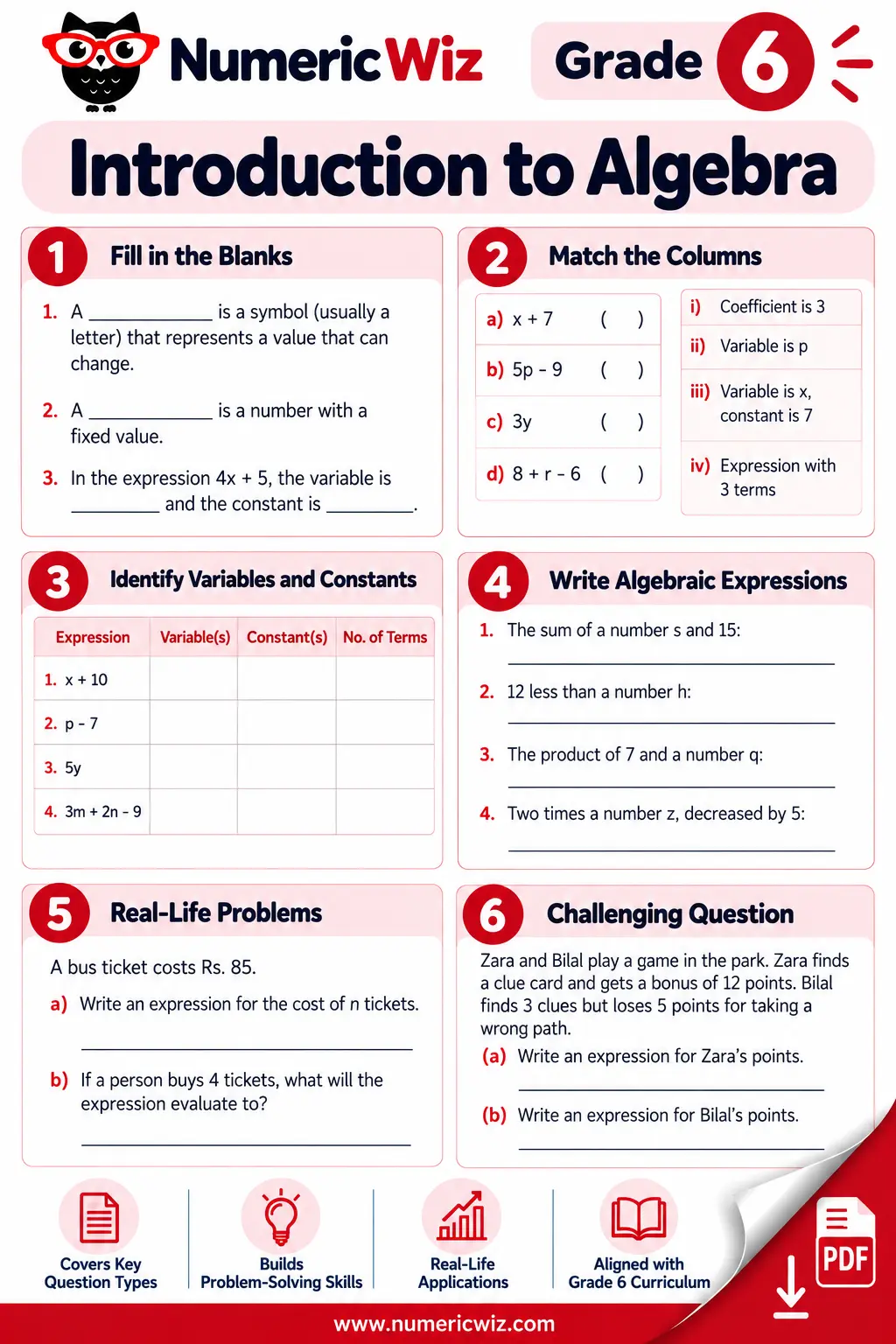
This is a 6-page printable PDF. It opens with first letters and builds to writing expressions from words, then asks children to take expressions apart again.
Section E includes a bus ticket problem: a ticket costs Rs. 85, and children write the cost of n tickets, then work out 4 tickets. Section G asks children to judge two claims: Hina writes "5 less than a number n" as 5 - n, and 3x versus x + 3.
The Challenging section is a Treasure Hunt where each clue is worth c points, with a bonus of 10 points, and children work out total points, compare c = 15 cases, and name the variable, coefficient and constant in Zara's expression.
Reading "less than" backwards, so "5 less than n" becomes 5 - n instead of n - 5. Treating 3x as x + 3. Swapping the coefficient with the constant.
I drill "less than" with small numbers first: 5 less than 9 is 4, so 5 less than n is n - 5.
Yes. It starts with what a letter means before any drill.
It treats a letter as a box holding a number we do not know yet. That picture takes the fear out of the first page.
Yes, and it pairs writing with taking expressions apart, so children learn both directions.
"Less than" phrases, which read backwards. The worksheet judges claims like Hina's so children learn to spot the trap.
This worksheet aligns with Standard 6.EE.A.2. For more Grade 6 practice, visit the Grade 6 hub.
For a limited time