This free printable worksheet helps Grade 6 students understand ratios with confidence. A ratio compares two numbers, like 3 girls to 2 boys, and shows how they stand next to each other. Your child practises reading ratios, writing them in three ways, simplifying them, and using them in real-life problems, from recipes to class groups.
A ratio compares two quantities and shows how big one is next to the other, like 3 girls to 2 boys in a class. You can write it as 3:2, with the word to as 3 to 2, or as a fraction as 3/2. All three ways say the same thing.
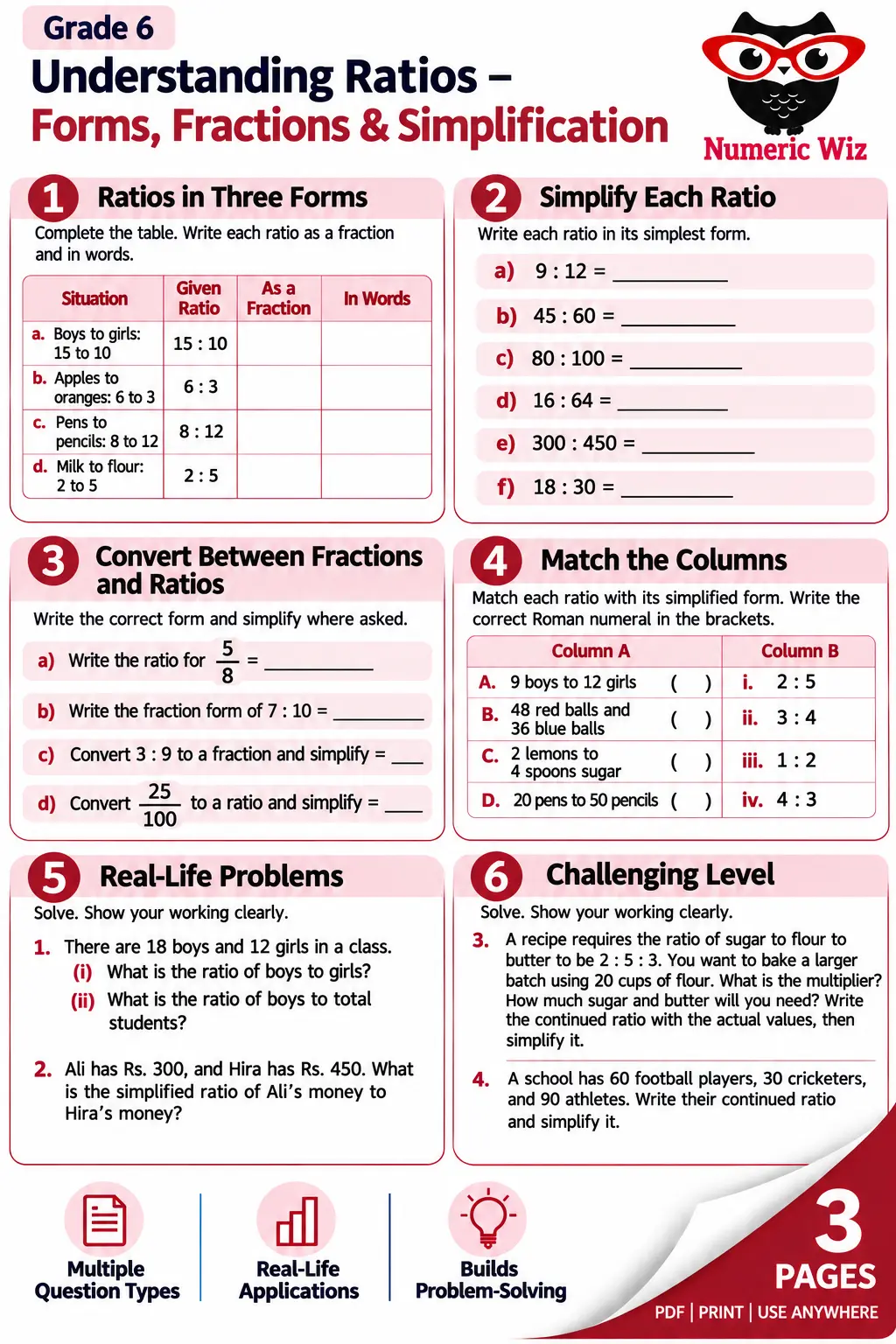
I tell children to read a ratio out loud before they write it, because the words keep the order straight. On this page your child meets ratios like 15:10, 6:3, 8:12 and 2:5, and reads each one in words first. The first number always belongs to the first thing named, and swapping the numbers changes the ratio.
This is the skill Common Core standard 6.RP.A.1 asks for: understand the concept of a ratio and use ratio language to describe a ratio relationship between two quantities.
To simplify a ratio, divide both numbers by the same number until no number except 1 divides both. For 9:12, divide both by 3 to get 3:4. For 45:60, divide both by 15 to get 3:4. The two ratios look different, but they mean the same thing.
I teach children to hunt for the biggest number that divides both sides, because one big step beats three small ones. On this page, 80:100 becomes 4:5, 16:64 becomes 1:4, 300:450 becomes 2:3, and 18:30 becomes 3:5. If your child divides by a small number first, that is fine too: 18:30 divided by 2 is 9:15, and divided by 3 again it is 3:5.
A fraction can be written as a ratio, and a ratio can be written as a fraction. On this page, 5/8 becomes 5:8, 7:10 becomes 7/10, 3:9 simplifies to 1:3, and 25/100 simplifies to 1:4. The numbers stay in the same order, so nothing gets swapped by mistake.
This is a printable PDF with ratios to read and write, ratios to simplify, fractions written as ratios, a matching activity, word problems and challenging questions. In the matching activity, your child pairs four ratios with their simplest forms: A pairs with ii (3:4), B pairs with iv (4:3), C pairs with iii (1:2), and D pairs with i (2:5).
The word problems ask for the ratio 18:12, which is 3:2, and the ratio 18:30, which is 3:5, and for 300:450, which is 2:3. The challenging questions use a recipe with a multiplier of 4, so the sugar is 8 cups and the butter is 12 cups, and a three-part ratio 60:30:90, which simplifies to 2:1:3.
I teach ratios in three steps, and I never let a child skip step one. Step one: read the ratio out loud in words. Step two: write it with a colon, keeping the order. Step three: simplify by dividing both numbers by the same number. We check each answer by asking one question only: do both numbers still stand for the same things, in the same order? If the order is right and both sides were divided the same way, the answer is right.
Use this worksheet after students can read and write fractions, as homework, for homeschool or one-to-one tutoring, or as a quick check before ratio problems with money and speed. Because every question ends with a ratio in order, it quickly shows whether a student owns the ratio idea or still swaps the numbers round. A child who finishes this page can read a ratio out loud, write it three ways, and simplify it, and those habits carry into every ratio problem that follows.
For more free practice at this level, browse our Grade 6 math worksheets page. Every sheet is free to print.
A ratio compares two quantities and shows how big one is next to the other. For example, 3 girls to 2 boys is a ratio of 3:2, and it can also be written as 3 to 2 or as the fraction 3/2.
3:4. Divide both numbers by 3 to get 3:4. The number 3 is the biggest number that divides both 9 and 12.
5:8. Write the fraction with a colon instead of the line, keeping the numbers in the same order: 5:8.
2:1:3. Divide all three numbers by 30 to get 2:1:3. The number 30 is the biggest number that divides 60, 30 and 90.
For a limited time