
Building a number from digits is a sorting game. You get a handful of digits, and you line them up to make the largest number you can, or the smallest. No adding, no multiplying, just sorting. This guide shows the two moves you need, with the digits from our Grade 4 sheets.
What Does Building a Number Mean, in Plain Words?
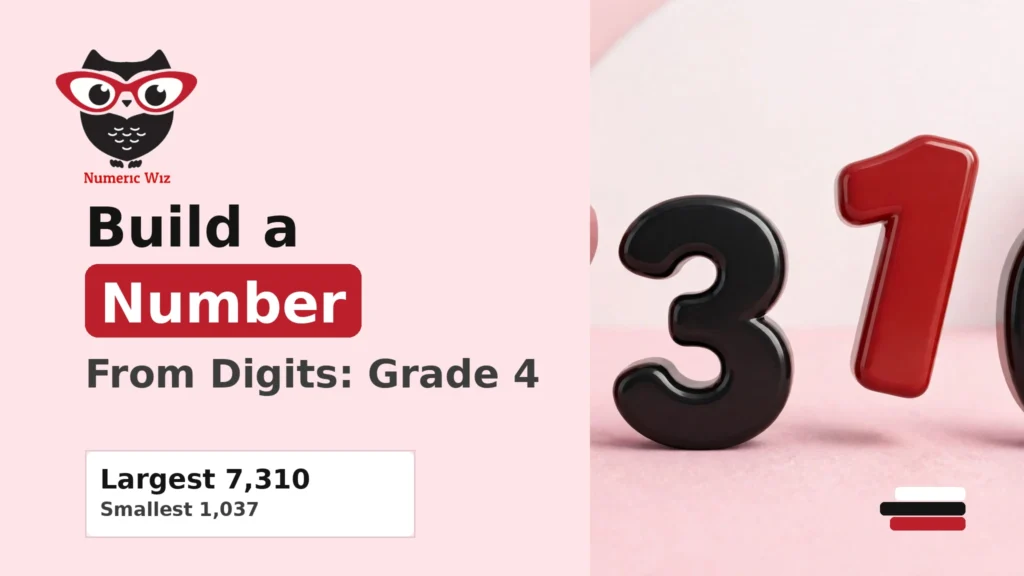
Building a number means taking a set of digits and lining them up to make a number. With the digits 3, 0, 7 and 1, you can make 7,310, or 1,037, or many more. The digits never change, only their order does, and the order decides how big the number is.
This game rests on place value. The first digit decides most of the size, because the first place carries the most weight. If place value still feels new, start with my What Is Place Value? guide first.
I hand children four digit cards and ask them to build the biggest number they can. They shuffle, they swap, they argue. Then I ask for the smallest. The same four cards make both answers, and that surprise is the whole lesson.
The Largest Number: Biggest Digit First
For the largest number, sort the digits from biggest to smallest and write them in that order. With the digits 3, 0, 7 and 1, the order is 7, 3, 1, 0, so the largest number is 7,310. The biggest digit always leads, because the first place carries the most weight.
Think of lining up for a photo, tallest first. The tallest child stands at the front, and everyone else falls in behind. Digits work the same way. The biggest digit takes the front place, and the rest follow in size order.
Try it with any set of digits. Sort them down, write them down, and you have the largest number that set can make. No digit is left out, and no digit is used twice.
The Smallest Number: Smallest First, but Never 0 First
For the smallest number, sort the digits from smallest to biggest, but never start with 0. With the digits 3, 0, 7 and 1, the smallest number is 1,037, not 0137. A number cannot start with 0, so the smallest digit that is not 0 leads, and 0 goes second.
This is the one rule children forget. They put the 0 first, because 0 is the smallest digit. But a number that starts with 0 loses a digit. 0137 is really just 137, a 3-digit number, and the game asks for a 4-digit number.
So the smallest number starts with the smallest digit that is not 0. Then the 0 goes second, right behind it. With 3, 0, 7 and 1, the smallest lead is 1, then 0, then 3, then 7. That gives 1,037.
Building a 5-Digit and a 6-Digit Number
The same two moves work for any size of number. With the digits 2, 5, 9, 4 and 8, the largest number is 98,542 and the smallest is 24,589. With six digits, 1, 6, 0, 3, 7 and 2, the largest is 763,210 and the smallest is 102,367.
These are the digits from our Grade 4 number sheets, the same ones going out in our TikTok posts this week. The 5-digit set has no 0, so the smallest number starts with the smallest digit, 2. The 6-digit set has a 0, so the smallest number starts with 1 and puts the 0 second.
Count the digits before you start. Five digits means a 5-digit answer, and six digits means a 6-digit answer. If your answer has fewer digits than the set, a 0 slipped into the front by mistake.
Largest and Smallest, Side by Side
The largest and smallest numbers from the same digits are partners: one sorts down, the other sorts up. The only difference is where the 0 goes, first is never allowed, second is the rule for the smallest. Check both answers by reading each number back, digit by digit.
Lay the two answers next to each other. With 3, 0, 7 and 1, you get 7,310 and 1,037. With 2, 5, 9, 4 and 8, you get 98,542 and 24,589. The same digits, two very different numbers.
I make children read each answer back out loud. If a digit is missing, the reading catches it. If the 0 sits in front, the reading sounds wrong. The ear catches what the eye misses.
Try It Yourself: 3 Practice Questions
Cover the answers, try all three, then check.
- Digits 4, 8, 1, 6. What is the largest number you can make? The smallest?
- Digits 9, 0, 5. What is the largest number? The smallest?
- Digits 7, 2, 0, 4, 1. What is the largest number? The smallest?
Answers
- Largest 8,641, smallest 1,468.
- Largest 950, smallest 509. The 0 cannot lead, so the smallest starts with 5 and puts the 0 second.
- Largest 74,210, smallest 10,247. The 0 cannot lead, so the smallest starts with 1 and puts the 0 second.
Key Takeaways
- Largest: sort digits biggest to smallest.
- Smallest: sort smallest to biggest, but never start with 0.
- The first digit carries the most weight.
- The same digits can make many numbers: order decides size.
- Check by reading the number back, digit by digit.
If your child answered all three questions, she can build any number from its digits. For more free practice at this level, browse our Grade 4 math worksheets page. If you like number games, my How to Learn Times Tables Fast guide is the next game to try.
Frequently Asked Questions
How do you make the largest number from given digits?
Sort the digits from biggest to smallest and write them in that order. With 3, 0, 7 and 1, the largest number is 7,310.
How do you make the smallest number from given digits?
Sort the digits from smallest to biggest, but never start with 0. With 3, 0, 7 and 1, the smallest number is 1,037.
Can a number start with 0?
No. A number cannot start with 0, because 0137 is really just 137, a 3-digit number. Put the smallest digit that is not 0 first, and 0 second.
What if two digits are the same?
Use both, one after the other. With 5, 5 and 2, the largest number is 552 and the smallest is 255.