
Comparing two numbers is a place-by-place race from the left. The first place where the digits differ decides which number is bigger. Ordering uses the same idea again and again. I teach the left-to-right race first, and the > and < signs only after that idea is clear.
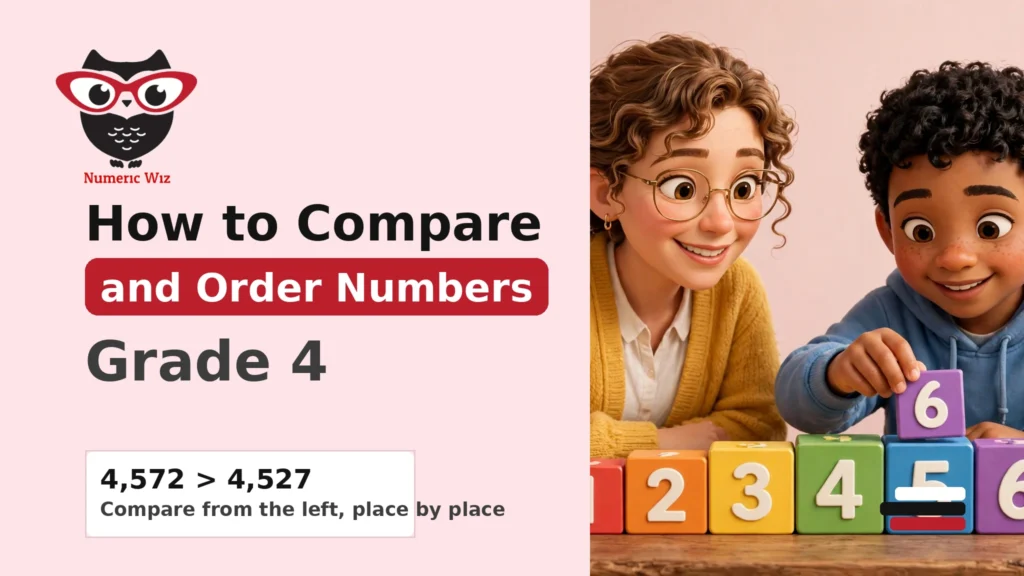
How Do You Compare Two Numbers, in Plain Words?
To compare two numbers, line them up and read from the left. The first place where the digits differ decides which number is bigger. If the first digits match, move one place right and compare again. The bigger digit at that first different place wins the race.
Think of two runners side by side. You do not judge the race by the last step. You watch from the start, and the first step where one runner pulls ahead tells you who is in front.
Place value is what makes this work. The leftmost digit is worth the most, so it gets the first say. If you need a refresher, What Is Place Value? walks through it with real numbers.
Start from the Left: The First Different Digit Decides
Compare 4,572 and 4,527 from the left. The thousands digits match at 4, and the hundreds digits match at 5. The tens digits differ: 7 against 2. Since 7 is bigger, 4,572 is the bigger number, so 4,572 > 4,527.
Notice what did not matter. The ones digits, 2 and 7, never got a vote. The tens place decided the race before the ones place was even reached.
I make children point at each place as they compare. Thousands. Hundreds. Tens. The finger stops at the first different digit, and that digit gives the answer.
Comparing Numbers with the Same First Digit
When the first digits match, keep moving right until the digits differ. Compare 60,204 and 62,004: the ten-thousands digits match at 6, but the thousands digits differ, 0 against 2. Since 0 is smaller, 60,204 < 62,004.
The 0 in 60,204 still counts as a digit to compare. It is a real digit holding the thousands place. A 0 against a 2 loses, and that one place decides the whole comparison.
A child who jumps to the last digits will get this one wrong. The last digits of 60,204 look bigger, but the race was already decided at the thousands place.
Ordering Numbers: Ascending and Descending
Ascending order runs from smallest to largest. Descending order runs from largest to smallest. Order 2,896, 3,721, 4,523, 5,912 and 6,845 by comparing the thousands digits first: 2, 3, 4, 5, 6. Ascending: 2,896, 3,721, 4,523, 5,912, 6,845. Descending is the same list backwards.
To order a set, compare the numbers two at a time from the left. The smallest goes first in ascending order. The largest goes first in descending order.
Write the ascending list first, then read it backwards for descending. One careful list gives you both answers, and you can check them against each other.
Ordering 5-Digit and 6-Digit Numbers Without Getting Lost
Line the numbers up by place before you compare. Count the digits first: a number with more digits is bigger. For numbers with the same count, compare from the left, one place at a time, until the digits differ. The first different place decides every pair.
Bigger numbers scare children only because the row of digits looks long. The method never changes. Left to right, place by place, first difference wins.
Splitting a number into its parts helps you see each place clearly. What Is Expanded Form? shows how to pull a number apart digit by digit.
Try It Yourself: 3 Practice Questions
Cover the answers, try all three, then check.
1. Compare 8,405 and 8,045. Which is bigger?
2. Order 5,309, 5,930 and 5,039 in ascending order.
3. Order 71,240, 17,420 and 70,124 in descending order.
Answers: 1) 8,405 > 8,045, because the hundreds digits differ: 4 against 0. 2) 5,039, 5,309, 5,930. 3) 71,240, 70,124, 17,420.
Key Takeaways
- Compare numbers from the left, one place at a time.
- The first place where the digits differ decides which number is bigger.
- A 0 still counts as a digit when you compare.
- Ascending means smallest to largest. Descending means largest to smallest.
- Write the ascending list first, then read it backwards for descending.
For more Grade 4 practice, see our Grade 4 worksheets.
Frequently Asked Questions
How do you compare two numbers in Grade 4?
Line the numbers up and read from the left. The first place where the digits differ decides which number is bigger. For example, 4,572 > 4,527 because the tens digits differ, 7 against 2, and 7 is bigger.
What do ascending and descending order mean?
Ascending order runs from smallest to largest, like 2,896, 3,721, 4,523. Descending order runs from largest to smallest, like 6,845, 5,912, 4,523. The descending list is the ascending list read backwards.
Which number is bigger, 60,204 or 62,004?
62,004 is bigger. The ten-thousands digits match at 6, but the thousands digits differ: 0 against 2. The 0 still counts as a digit, so 60,204 < 62,004.
What if two numbers have the same first digit?
Keep moving right, one place at a time, until the digits differ. The bigger digit at that first different place decides which number is bigger. The digits after that place do not change the answer.