
Equivalent Ratios: A Grade 6 Guide
Equivalent ratios describe the same comparison with different numbers, like 2:3 and 8:12. You build one by multiplying or dividing both parts by the same number, never by adding. If both parts get the same treatment, the comparison stays fair, and that fair scaling is the whole skill. I once watched a girl scale a […]
How Ratios Work in Real Life: A Grade 6 Guide
Ratios compare two amounts, and they run daily life: cooking, shopping, maps, and travel all work on ratios. A ratio tells you how two amounts fit together, like 2 cups of flour for every 1 cup of sugar, or 1 centimetre on a map for every 10 kilometres outside. I have taught Grade 6 math […]
Unit Rates: A Grade 6 Guide
A unit rate tells you the price, speed, or amount for one single unit, so you can compare two options fairly. If 4 notebooks cost 12 dollars, the unit rate is 3 dollars per notebook. That one number ends the guesswork at the shop shelf, on the road, and in the kitchen. I have taught […]
Practical Ratio Examples for Grade 6
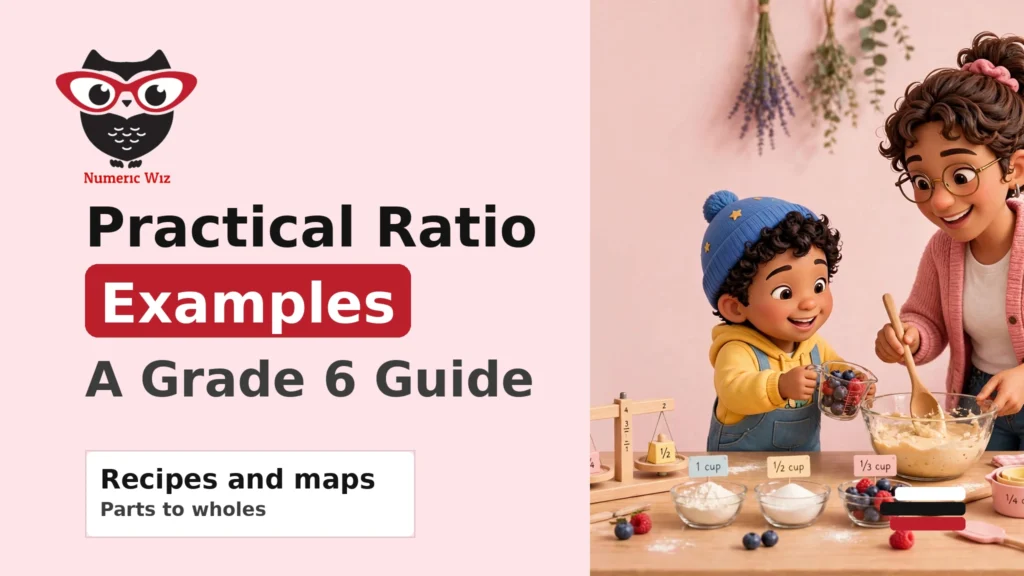
Practical ratio examples are everywhere once you start looking: pocket money split between two children, a recipe doubled for guests, and boys and girls counted in a class. A ratio simply compares two quantities, and Grade 6 is where that comparison turns into a tool your child can use daily. I have taught Grade 6 […]