Name the commutative, associative and distributive laws
Group numbers to simplify a sum
Spot the law behind an expression
Apply the laws to real-life packing and sharing problems
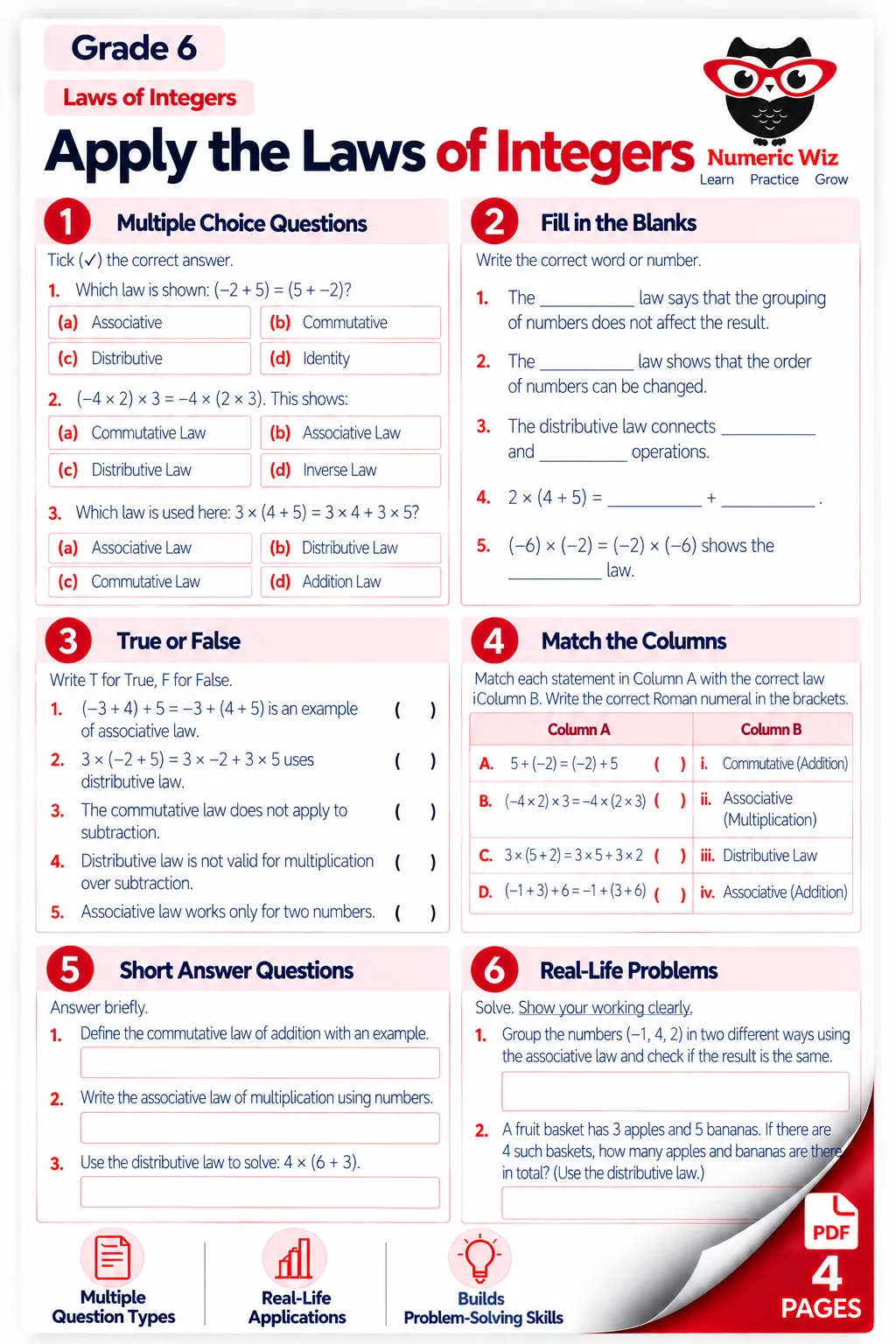
The laws of integers are the rules that let us reorder and regroup numbers safely. The commutative law says order does not change the result, so (-2 + 5) equals (5 + -2). The associative law says grouping does not change the result, so (-4 x 2) x 3 equals -4 x (2 x 3). The distributive law connects multiplication with addition, so 3 x (5 + 2) equals 3 x 5 + 3 x 2. I teach these as shortcuts that are always honest, never tricks.
A student who knows the laws can pick the easy path through a hard sum. Group (-1, 4, 2) one way and you struggle; group them another way and the answer falls out. In this worksheet your child practises exactly that choice, with a fruit basket of 3 apples and 5 bananas in 4 baskets and a shopkeeper packing boxes of pens, pencils and erasers. I always say: the law does not do the sum for you, it just hands you the simplest version of it.
This is a 4-page printable PDF. Section A has 5 multiple-choice questions that name the law behind each sum. Section B has 5 fill-in-the-blanks questions, including 2 x (4 + 5) and (-6) x (-2) = (-2) x (-6). Section C has 5 true-or-false statements, including whether the commutative law applies to subtraction. Section D matches 4 statements to their laws. Section E has 5 short-answer questions, including solving 4 x (6 + 3) with the distributive law. Section F has 4 real-life problems, with the last two marked Challenging Level.
Students first name the law in each sum, then fill in missing steps and judge statements true or false. Only after that do they match statements to laws, explain a law in their own words, and solve real problems with it. I find this order stops the classic mistake of naming every law "commutative" and hoping for the best.
Use this worksheet after students can add and multiply integers, as homework, for homeschool or one-to-one tutoring, or as a quick check before algebra-style thinking. Because each question names the law it tests, it quickly shows which law a student truly owns and which one still needs work. It is a useful next step after a first lesson in Grade 6.
The commutative law says the order of the numbers does not change the result in addition and multiplication. For example, (-2 + 5) equals (5 + -2), and both give 3. It does not work the same way for subtraction: 5 - 2 is 3, but 2 - 5 is -3.
The associative law says the grouping of the numbers does not change the result in addition and multiplication. For example, (-4 x 2) x 3 equals -4 x (2 x 3), and both give -24. Pick the grouping that makes the sum easiest.
The distributive law connects multiplication with addition: multiply each number inside the brackets by the number outside, then add. For example, 5 x (4 + 6) equals 5 x 4 + 5 x 6, which is 20 + 30 = 50.
For a limited time