Why do so many students stumble when they reach the “harder” times tables? The jump from 6 to 9 feels intimidating — but this worksheet transforms that fear into confidence! With colorful visuals and clear patterns, learners begin to see multiplication not as memorization, but as logical repetition.
Learning multiplication facts for 6, 7, 8, and 9 builds a bridge between simple arithmetic and higher-level algebra. It helps students develop mental math agility, recognize patterns, and strengthen number sense. Through repeated practice and real-world examples, students begin to internalize these facts until recall becomes effortless.
Multiplication is repeated addition — it tells us how many times to add a number to itself. For example, 6 × 4 means “add 6 four times,” or 6 + 6 + 6 + 6 = 24. Knowing these facts for 6, 7, 8, and 9 helps students move beyond basic counting and prepares them for fractions, division, algebra, and problem-solving.
Historically, multiplication tables have been part of mathematics for thousands of years. Ancient Egyptian and Greek scholars used arrays, lines, and grids to explain repeated addition visually — much like the way we now use area models and multiplication charts in classrooms. Today, these same principles appear in interactive digital tools and printable worksheets designed to make learning engaging and intuitive.
If Ali has 6 baskets with 8 apples in each, how many apples does he have in total?
Solution:
6 × 8 = 48
So, Ali has 48 apples in all.
This simple question uses multiplication to connect everyday counting to mathematical reasoning — the heart of number fluency.
Have you ever tried solving a long math problem and got stuck because you couldn’t recall a basic fact?
That’s exactly why mastering multiplication tables is so important. It’s not just about speed — it’s about freeing your brain to focus on more complex ideas.
When students can quickly recall 7 × 8 = 56 or 9 × 6 = 54, they save mental energy for higher-order thinking. It also helps in fractions, area, algebra, and real-life problem-solving. These are the foundational facts that every student must know — and this worksheet provides a fun, step-by-step way to master them.
Step 1: Recognize the Pattern
Start by skip-counting by 6s, 7s, 8s, and 9s. Notice the rhythm and repetition — every multiplication table follows a pattern!
Step 2: Visualize with Arrays or Groups
Use drawings, arrays, or blocks to see how multiplication repeats.
Example: 7 × 3 can be shown as 3 rows of 7 dots each.
Step 3: Practice with Real-World Examples
Think: 8 people with 7 candies each → 8 × 7 = 56 candies.
Real connections make memory stronger.
Step 4: Fill in Missing Factors
Turn learning into a puzzle — what number times 8 gives 64? (Answer: 8).
Finding missing factors builds logical thinking.
Step 5: Test and Challenge Yourself
Use timed drills or games to practice. The more you play, the faster you recall!
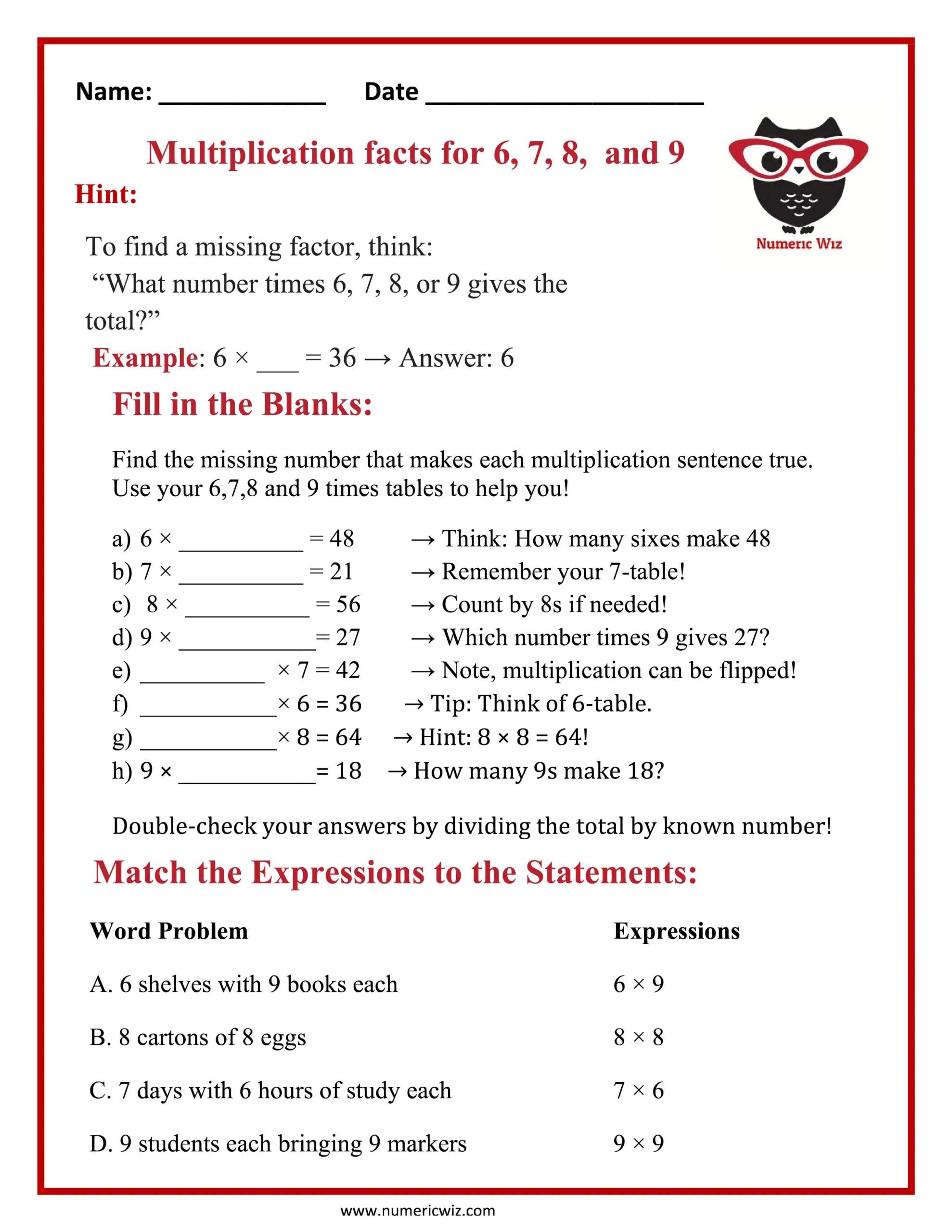
This worksheet begins with guided examples — showing how 6 × 4 = 24 or 9 × 3 = 27 — then gradually moves to missing-factor problems, matching expressions, and mini word problems. Students move from recognition to recall to application, building confidence one step at a time.
Each section strengthens both memory and reasoning:
Fill in the blanks → fact recall
Missing factors → logical deduction
Matching expressions → real-world connection
By the end, students not only memorize their tables but truly understand what multiplication means.
Multiplication isn’t just for worksheets — it’s a life skill.
Here’s where students use these facts every day:
Shopping: 8 items at 7 rupees each → total cost = 8 × 7 = 56
Cooking: 6 trays with 9 muffins each → 54 muffins
Sports: 7 players each playing 8 matches → 56 total games
Budgeting: 9 days earning Rs. 6 per day → Rs. 54 total
These examples connect numbers to reality, helping learners see that math truly is everywhere.
If a classroom has 9 rows of 8 chairs each and 3 more chairs are added, how many chairs are there in total?
Solution:
9 × 8 = 72, and 72 + 3 = 75
Total chairs = 75
“Multiplication Facts for 6, 7, 8, and 9” isn’t just another worksheet — it’s a pathway to confidence.
Through patterns, visuals, and real-life practice, students gain mastery over these essential facts, making every future math topic easier to understand.
So, get your pencils ready — and multiply your confidence, one fact at a time!
Think you’ve cracked it?
Download the worksheet, solve it, and upload your answers to our “Evaluate Your Work” page. Our awesome teachers will check it and send feedback just for you! Homework has never been this fun—or this helpful!