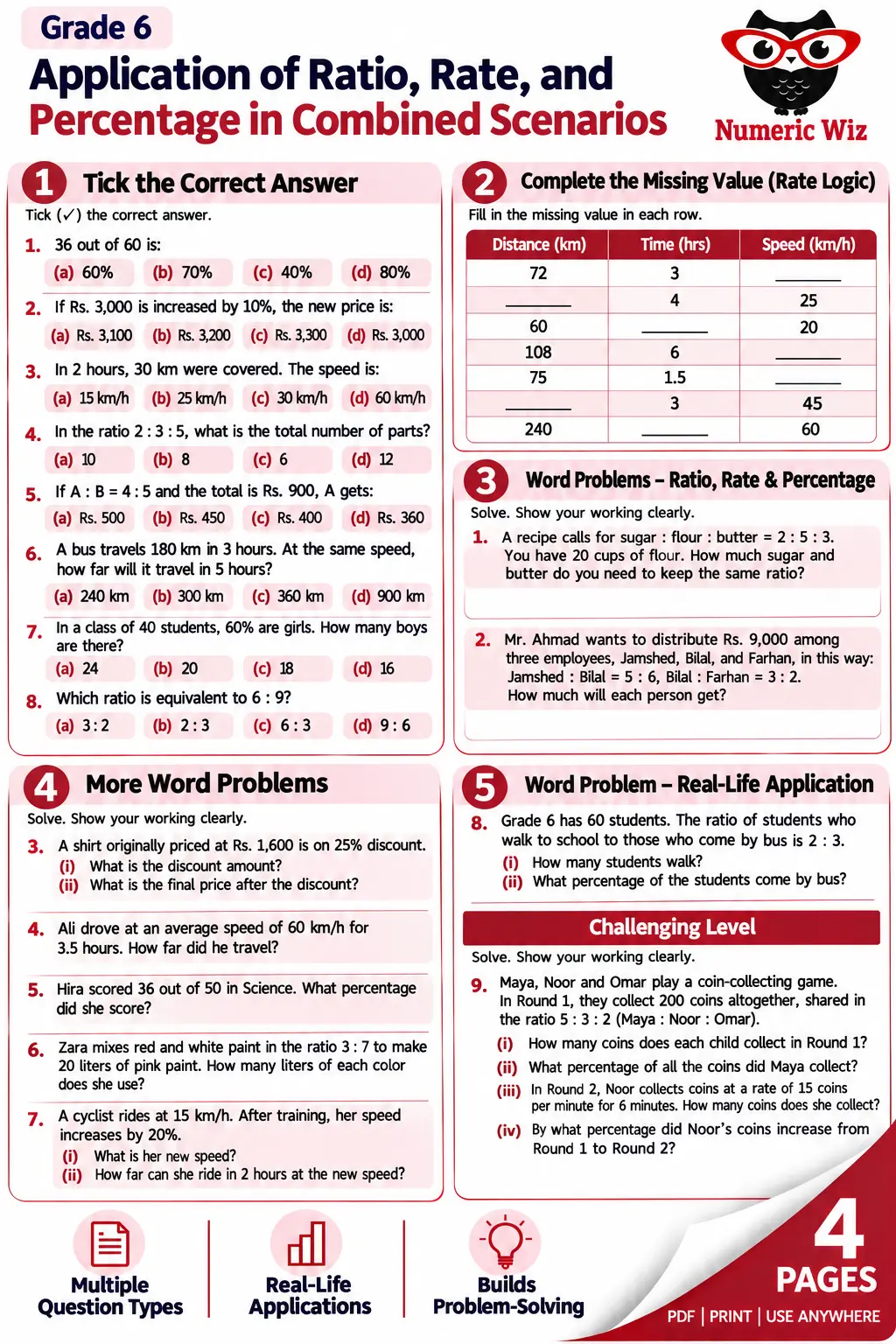
This free printable worksheet helps Grade 6 students use ratios, rates and percentages on real-life problems. Your child splits money in a ratio, works out a discount, finds a speed, and turns marks into a percentage. Every question uses rupees, kilometres and everyday numbers, so the maths always means something your child can picture.
To split money in a ratio, add the parts, divide the total by that number, then multiply by each part. Mr. Ahmad splits Rs. 9,000 in the ratio 5:6:4. The parts add to 15, so one part is Rs. 600, and the shares are Rs. 3,000, Rs. 3,600 and Rs. 2,400.
I tell children to count the parts first, before they touch the money. Five plus six plus four is 15 parts, and Rs. 9,000 divided by 15 is Rs. 600 for one part. Jamshed takes 5 parts, which is Rs. 3,000. Bilal takes 6 parts, which is Rs. 3,600. Farhan takes 4 parts, which is Rs. 2,400. Add the three shares back up, and you get Rs. 9,000, so the split is right.
To find a percentage, write the part over the whole, then multiply by 100. Hira scores 36 out of 50, so 36 divided by 50 is 0.72, and 0.72 times 100 is 72%. A percentage is just a rate per 100, so the whole always stands for 100.
The same move works for every percentage on this page. In the coin game, Maya wins 100 coins out of 200, so she wins 50%. Noor goes from 60 coins to 90 coins, which is an increase of 50%. On the school trip, 24 students walk and 60% travel by bus. I ask children to find the whole first, because a percentage means nothing until you know what 100% stands for.
This is the skill Common Core standard 6.RP.A.3 asks for: use ratio and rate reasoning to solve real-world and mathematical problems, by reasoning about tables of equivalent ratios, unit rate problems, and finding a percent of a quantity.
This is a printable PDF with multiple choice questions, a rate table, a recipe, a money split, a discount, speeds and a coin game. The multiple choice answers run through the whole page: 60%, Rs. 3,300, 15 km per hour, 10 parts, Rs. 400, 300 km, 16 boys, and the ratio 2:3.
The rate table has seven missing values to fill in: 24, 100, 3, 18, 50, 135 and 4. A recipe question uses a multiplier, so the sugar is 8 cups and the butter is 12 cups. Mr. Ahmad splits Rs. 9,000 between Jamshed, Bilal and Farhan in the ratio 5:6:4, so the shares are Rs. 3,000, Rs. 3,600 and Rs. 2,400. A shirt has a discount of Rs. 400, so the final price is Rs. 1,200.
Ali travels at 60 km per hour for 3.5 hours, which is 210 km. Hira scores 36 out of 50, which is 72%. Zara mixes 6 litres of red paint with 14 litres of white paint. A cyclist rides at a new speed of 18 km per hour and covers 36 km in 2 hours. In the coin game, Maya wins 100 coins, Noor wins 60 and Omar wins 40 in Round 1, so Maya wins 50%, and in Round 2 Noor wins 90 coins, which is an increase of 50%.
I teach it in three steps, and I never let a child skip step one. Step one: name the whole, the part and the rate, in words. Step two: write the numbers down with their units, like km per hour or rupees. Step three: do one small sum at a time, and check it against the story. We check each answer by asking one question only: does the number fit the story? If the units are right and the story still makes sense, the answer is right.
Use this worksheet after students can simplify ratios and find unit rates, as homework, for homeschool or one-to-one tutoring, or as a quick check before harder problems with money and speed. Because every question ends with a labelled answer, like rupees, kilometres per hour or a percentage, it quickly shows whether a student owns the idea or still mixes up the part and the whole. A child who finishes this page can split money in a ratio, work out a discount, find a speed, and turn marks into a percentage, and those habits carry into every real-life problem that follows.
For more free practice at this level, browse our Grade 6 math worksheets page. Every sheet is free to print.
Rs. 3,000. The parts add to 15, so one part is Rs. 600, and Jamshed takes 5 parts. Bilal takes 6 parts, which is Rs. 3,600, and Farhan takes 4 parts, which is Rs. 2,400.
72%. Divide 36 by 50 to get 0.72, then multiply by 100 to get 72%.
210 km. Multiply 60 by 3.5 to get 210.
Rs. 1,200. The discount is Rs. 400, and the final price after the discount is Rs. 1,200.
For a limited time