
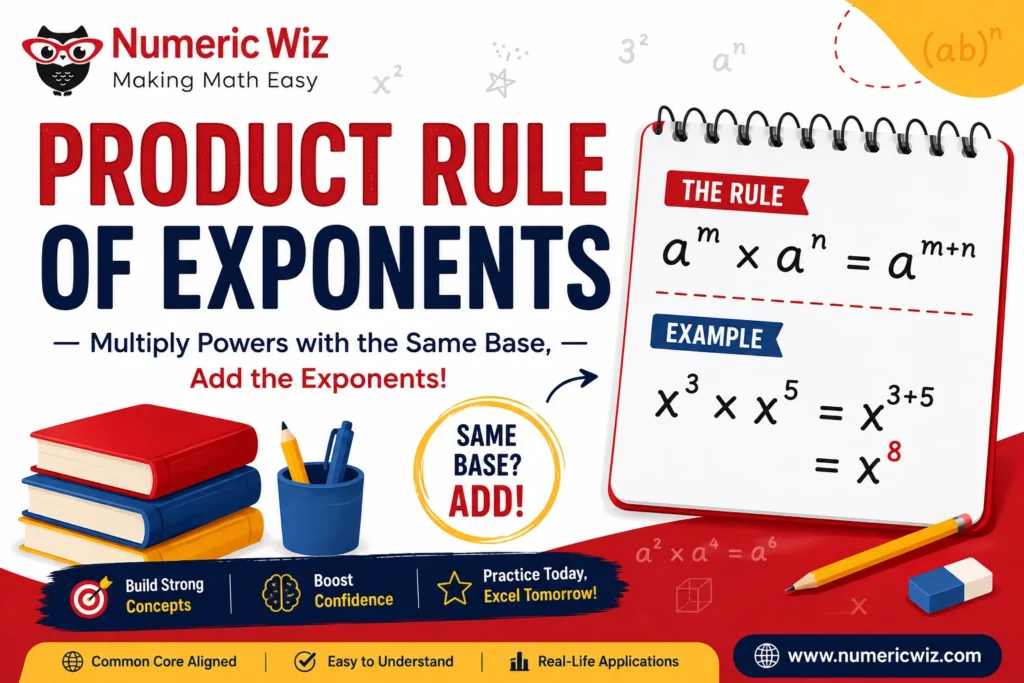
The Product Rule of Exponents says that when multiplying powers with the same base, keep the base the same and add the exponents.
For example:
x³ × x² = x⁵
This works because there are five x’s being multiplied together. The rule only works when the bases are the same.
Many students find exponent questions confusing because they aren’t sure whether to add, subtract, or multiply the exponents. The good news is that once you understand one simple idea, these problems become much easier.
In this guide, you’ll learn:
- What the Product Rule of Exponents is.
- Why this rule works.
- When you should use it.
- Step-by-step solved examples.
- Common mistakes students make.
- Practice questions to build confidence.
By the end of this lesson, you’ll be able to solve exponent multiplication problems correctly without guessing.
What Is the Product Rule of Exponents?
The Product Rule of Exponents is one of the most important rules in algebra. It helps us simplify expressions when two powers with the same base are multiplied together.
Instead of writing the same number or variable many times, mathematicians use a simple shortcut.
Product Rule Formula
aᵐ × aⁿ = aᵐ⁺ⁿ
This formula tells us three simple things:
- Keep the base the same.
- Add the exponents.
- Write the answer as one power.
For example, m⁴ × m²
The base is m, so it stays the same.
Now add the exponents. 4 + 2 = 6
The answer is: m⁶
It really is that simple!
Why Does the Product Rule Work?
Many students memorize the Product Rule without understanding it. That often leads to mistakes later.
Instead of memorizing, let’s discover why the rule works.
Imagine you have this expression: x³ × x²
Let’s expand both powers.
x³ = x × x × x
x² = x × x
Now multiply them together. x × x × x × x × x
Count how many x’s you have. There are five.
Instead of writing five x’s every time, we use exponent notation.
So, x × x × x × x × x = x⁵
Notice what happened. We didn’t change the base.
We simply counted how many times x appeared.
The first expression gave us 3 x’s.
The second expression gave us 2 x’s.
Together, we have: 3 + 2 = 5
That’s why the Product Rule tells us to add the exponents.
Once you understand this idea, you don’t have to rely on memory. You’ll know exactly why the rule works.
When Should You Use the Product Rule?
The Product Rule is useful, but it does not work in every situation.
You should only use it when both powers have the same base: a⁵ × a² = a⁷
Both expressions have the same base (a), so we add the exponents: 8³ × 8⁴ = 8⁷
The base is 8, so we keep it the same and add the exponents: y⁶ × y = y⁷
Remember that y has an invisible exponent of 1: So, y = y¹
Now add the exponents. 6 + 1 = 7
Answer: y⁷
When You Should NOT Use the Product Rule
Look at this example: x² × y²
Can we add the exponents? No.
The bases are different. One base is x and the other is y.
Since the bases do not match, the Product Rule cannot be used.
The expression stays: x² × y²
This is one of the most common mistakes students make, so always check the base before adding the exponents.
Quick Rule to Remember
Before solving any exponent multiplication problem, ask yourself this question:
“Are the bases the same?”
- ✅ Yes? Retain the base and sum the exponents
- ❌ No? Do not use the Product Rule.
This simple question can help you avoid many mistakes.
Examples
Now that you know the Product Rule, let’s solve a few examples together.
Example 1
Simplify: x⁴ × x³
Step 1: Check the bases. Both bases are 5.
Step 2: Add the exponents. 4 + 3 = 7
Answer: x⁷
Example 2
Simplify: 5² × 5⁶
Step 2: Add the exponents. 2 + 6 = 8
Final Answer: 5⁸
Step 1: Check the bases. Both bases are 5.
Example 3
Simplify: a⁷ × a
Remember that a = a¹.
Now add the exponents: 7 + 1 = 8
Final Answer: a⁸
Example 4
Simplify: m⁹ × m⁴
Same base? ✔ Yes
Add the exponents: 9 + 4 = 13
Final Answer: m¹³
Example 5
Simplify: b⁵ × c⁵
Can we use the Product Rule? ❌ No.
The bases are different.
Final Answer: b⁵ × c⁵
Common Mistakes Students Make
Learning from mistakes helps you become a better mathematician. Here are some common errors to avoid.
Mistake 1: Multiplying the Exponents
Incorrect: x² × x³ = x⁶
Correct: x² × x³ = x⁵
Remember, add the exponents, don’t multiply them.
Mistake 2: Changing the Base
Incorrect: a⁴ × a² = 2a⁶
Correct: a⁶
The base stays exactly the same.
Mistake 3: Using the Rule with Different Bases
Incorrect: x³ × y² = x⁵
Correct: x³ × y²
The Product Rule only works when the bases are the same.
Mistake 4: Forgetting the Hidden Exponent
Remember: k = k¹ So, k⁵ × k = k⁶
Teacher Tip
Instead of asking students to memorize the rule, encourage them to expand simple expressions first.
For example: x² × x³
becomes x × x × x × x × x
When students count the repeated factors themselves, they understand why the exponents are added. This builds lasting understanding instead of short-term memorization.
Parent Tip
If your child struggles with exponent rules, ask them one simple question before solving each problem:
“Are the bases the same?”
If the answer is yes, they can use the Product Rule.
If the answer is no, they need a different strategy.
This simple habit prevents many common mistakes.
Where Is the Product Rule Used in Real Life?
You may wonder why students learn exponent rules.
The Product Rule is used in many fields, including:
- Computer Science for storing and processing digital data.
- Engineering when solving mathematical equations.
- Physics to calculate measurements and scientific values.
- Scientific Notation to write very large or very small numbers.
- Higher Mathematics such as algebra, calculus, and trigonometry.
Learning this rule now prepares students for many advanced topics later.
Practice Questions
- x² × x⁵ = ________
- a³ × a⁴ = ________
- 6² × 6³ = ________
- y⁵ × y = ________
- p⁴ × p² = ________
- m⁸ × m⁵ = ________
- b⁷ × b³ = ________
- 10⁴ × 10² = ________
- n⁹ × n = ________
- k¹² × k⁶ = ________
- x¹⁵ × x⁹ = ________
- a²⁰ × a⁵ = ________
- y⁷ × z⁷ = ________
- p¹⁰ × p¹⁰ = ________
- c²⁵ × c = ________
Answer Key
- x⁷
- a⁷
- 6⁵
- y⁶
- p⁶
- m¹³
- b¹⁰
- 10⁶
- n¹⁰
- k¹⁸
- x²⁴
- a²⁵
- y⁷ × z⁷
- p²⁰
- c²⁶
Quick Summary
Before solving any multiplication problem with exponents, remember these three simple steps:
Check whether the bases are the same.
Keep the base unchanged.
Add the exponents.
Formula:
aᵐ × aⁿ = aᵐ⁺ⁿ
This rule works only when the bases are the same.
Frequently Asked Questions
What is the Product Rule of Exponents?
The Product Rule of Exponents states that when multiplying powers with the same base, you keep the base the same and add the exponents. This rule makes it easier to simplify exponent expressions without writing repeated multiplication.
Why do we add the exponents?
Adding the exponents tells us the total number of times the base is multiplied after combining both expressions. It is simply a shortcut for repeated multiplication and helps simplify expressions quickly.
Can I use the Product Rule when the bases are different?
No. The Product Rule only works when both expressions have the same base. If the bases are different, you cannot add the exponents, and the expression cannot be simplified using this rule.
What if there is no exponent written?
If a number or variable has no visible exponent, its exponent is 1. For example, m = m¹. This hidden exponent is important when applying exponent rules.
Is the Product Rule part of the Common Core curriculum?
Yes. The Product Rule of Exponents is taught as part of the Common Core Mathematics Standards. It helps students build a strong understanding of algebra and prepares them for more advanced exponent concepts.
How can I remember the Product Rule easily?
A simple trick is to remember: Same Base = Add the Exponents. Before solving any exponent problem, first check whether the bases are the same. If they are, keep the base and add the exponents.
How can Numeric Wiz help students learn exponents?
Numeric Wiz helps students master exponent rules through Learning Gap Assessments, Personalized Learning Roadmaps, Common Core-aligned Worksheets, Free Printable Math Resources, Guided Workbooks, Expert One-on-One Tutoring, and Personalized Feedback. Our goal is to help every student build confidence, strengthen algebra skills, and enjoy learning mathematics.
Conclusion
The Product Rule of Exponents is one of the most important building blocks in algebra. Once you understand that you keep the base the same and add the exponents, exponent multiplication becomes much easier.
Instead of memorizing the formula, try expanding a few expressions to see why the rule works. Understanding the concept will help you solve problems more confidently and prepare you for more advanced topics like the Quotient Rule, Power of a Power Rule, and Scientific Notation.
Keep practicing, learn from your mistakes, and remember that every great mathematician started by learning one rule at a time.
Ready to practice more? Explore Numeric Wiz’s free Common Core-aligned worksheets, guided workbooks, and personalized math support to continue building your algebra skills with confidence.
Explore More: Why Students Struggle with Math Word Problems (And How to Help)