
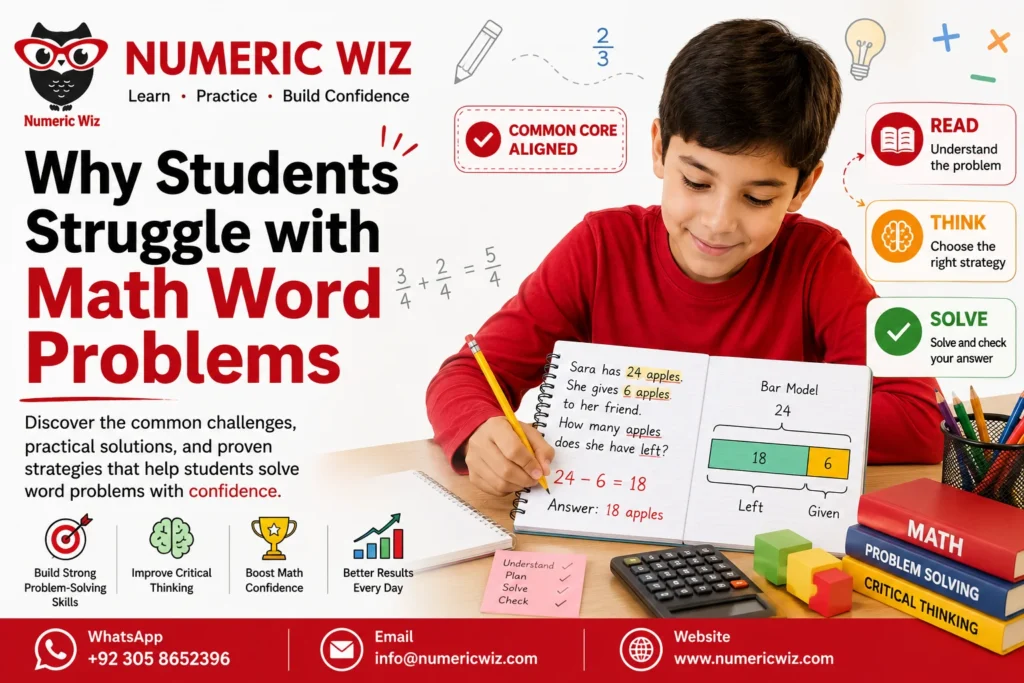
Introduction
“My child can solve multiplication and division problems easily, but as soon as they see a word problem, they get completely stuck.”
If this sounds familiar, you’re not alone. It is one of the most common concerns parents and teachers have about mathematics. Many students who perform well on basic calculations suddenly lose confidence when they face a math word problem. They may know how to add, subtract, multiply, or divide, but they struggle to decide which operation to use or where to begin.
The surprising truth is that math word problems are about much more than numbers. They require students to combine several important skills at the same time. A child must carefully read the question, understand the situation, identify the important information, ignore unnecessary details, choose the correct mathematical operation, solve the problem accurately, and finally check whether the answer makes sense.
That can feel overwhelming, especially for younger learners.
Over the years, I have noticed that many students believe they are “bad at math” simply because they struggle with word problems. In reality, the issue is often not mathematics itself. Instead, students may have difficulty with reading comprehension, math vocabulary, critical thinking, or understanding how mathematics applies to real-life situations. Once these underlying challenges are addressed, many students begin solving word problems with much greater confidence.
The good news is that word problem skills can be learned. With the right strategies, regular practice, and clear explanations, every student can improve. Parents and teachers also play an important role by helping children think through problems instead of rushing to find the answer.
In this comprehensive guide, you’ll discover:
- What math word problems are and why schools use them
- Why students struggle with word problems
- The most common mistakes children make
- Simple, proven strategies that improve problem-solving skills
- Practical ways parents and teachers can help at home and in the classroom
By the end of this article, you’ll understand why word problems feel difficult and, more importantly, how to help children solve them with confidence.
What Are Math Word Problems?
A math word problem is a question written as a short story or real-life situation that requires students to use mathematics to find the answer. Instead of simply asking students to perform a calculation, word problems encourage them to think about what information is given, what needs to be found, and which mathematical operation will solve the problem.
For example, compare these two questions:
Regular Math Question
8 × 6 = ?
Math Word Problem
Emma bought 8 packs of pencils. Each pack contains 6 pencils. How many pencils did Emma buy altogether?
Both questions require the same multiplication fact, but the second question asks students to read carefully, understand the situation, identify the important numbers, and decide that multiplication is the correct operation.
This extra thinking is what makes word problems more challenging—and more valuable.
Why Do Schools Use Word Problems?
Many students ask,
“Why can’t teachers just give us the numbers?”
The answer is simple.
Real life rarely gives us problems in the form of neat equations. When adults shop for groceries, calculate discounts, plan a vacation, compare phone plans, or create a monthly budget, they first need to understand the situation before deciding which calculations to perform.
That is exactly what math word problems teach.
Instead of memorizing procedures, students learn how to apply mathematics in everyday situations. This helps them become better problem solvers, stronger critical thinkers, and more confident learners.
Word problems also support the goals of the Common Core State Standards, which encourage students to explain their thinking, analyze information, and solve real-world mathematical problems rather than simply memorizing formulas.
How Math Word Problems Build Real-Life Skills
One of the biggest benefits of word problems is that they show students that mathematics is useful beyond the classroom.
Children encounter situations involving math every day without even realizing it. For example, they might:
- Compare prices while shopping.
- Calculate how much money they have saved.
- Share pizza equally among friends.
- Measure ingredients while cooking.
- Estimate travel time for a family trip.
- Keep score during a sports game.
- Calculate discounts during holiday sales.
Each of these situations requires the same thinking process used to solve math word problems.
As students practice solving real-life scenarios, they begin to recognize patterns, think logically, and make better decisions. These skills are valuable not only in mathematics but also in science, technology, business, engineering, and everyday life.
Regular Math Questions vs. Math Word Problems
| Regular Math Question | Math Word Problem |
| 9 + 7 = ? | Sophia has 9 stickers. Her friend gives her 7 more. How many stickers does she have now? |
| 12 × 5 = ? | A classroom has 12 rows of chairs with 5 chairs in each row. How many chairs are there altogether? |
| 24 ÷ 6 = ? | Twenty-four candies are shared equally among 6 children. How many candies does each child receive? |
| 18 − 9 = ? | Liam had 18 slabs and gave 9 to his brother. How many slabs does he have left? |
Notice that the mathematical operation stays the same, but word problems require students to understand the context before solving the equation.
That is why many children find them more challenging than regular math questions.
Fortunately, once students learn how to read carefully, identify key information, and follow a simple problem-solving strategy, word problems become much less intimidating.
Why Students Struggle with Math Word Problems
Many students find math word problems difficult because they involve much more than solving equations. A child must read the question carefully, understand the situation, identify the important information, choose the correct mathematical operation, solve the problem, and then check whether the answer makes sense. If a student struggles with even one of these skills, word problems can quickly become confusing.
The good news is that these challenges are common and can be overcome with the right support and consistent practice.
1. Weak Reading Comprehension
Before solving the math, students must understand the story. Some children read too quickly or miss important details, which leads them to choose the wrong operation. Improving reading comprehension often improves word problem performance as well.
2. Difficulty Identifying Important Information
Many students try to use every number they see in a question. However, some word problems include extra information that is not needed. Learning to identify the important facts helps students solve problems more accurately.
3. Confusing Math Vocabulary
Math vocabulary can be challenging, especially for younger learners. Words such as sum, difference, product, quotient, altogether, and shared equally provide clues about which operation to use. Students who are unfamiliar with these terms often become confused before they even begin solving the problem.
4. Math Anxiety
Some students become nervous as soon as they see a word problem. Previous struggles may cause them to lose confidence and doubt their abilities. This anxiety makes it harder to think clearly and solve problems correctly.
5. Weak Number Sense
Students with weak number sense may know how to calculate but struggle to judge whether an answer is reasonable. For example, if a student calculates that each child receives 250 cookies, they should recognize that the answer is unrealistic and check their work.
6. No Problem-Solving Strategy
Many children start calculating as soon as they see numbers instead of taking time to understand the question. Following a simple, step-by-step strategy helps students stay organized and avoid careless mistakes.
7. Rushing Through the Question
Trying to finish quickly often leads to errors. Students may skip important words, overlook key details, or forget to check their answers. Slowing down and reading carefully usually improves accuracy.
8. Misunderstanding the Question
Sometimes students solve the correct calculation but answer the wrong question. They may stop after finding a number without checking what the question is actually asking. Reading the final sentence carefully helps prevent this mistake.
Common Challenges and Solutions
| Challenge | How to Help |
| Weak reading comprehension | Read the problem twice and explain it in your own words. |
| Difficulty identifying important information | Underline key facts and ignore unnecessary details. |
| Confusing math vocabulary | Learn common math terms with real-life examples. |
| Math anxiety | Practice regularly and celebrate progress, not perfection. |
| Weak number sense | Estimate the answer before solving and check if it makes sense. |
| No problem-solving strategy | Follow the same step-by-step process for every problem. |
| Rushing | Slow down and check your work before writing the final answer. |
| Misunderstanding the question | Circle what the question is asking before solving. |
The important thing to remember is that struggling with word problems does not mean a child is bad at math. Most students simply need guidance in reading, thinking, and organizing their approach
10 Common Mistakes Students Make When Solving Math Word Problems
Even students who understand addition, subtraction, multiplication, and division can make mistakes when solving math word problems. The good news is that most of these mistakes are easy to fix once students recognize them. Here are the ten most common errors and simple ways to avoid them.
1. Reading the Problem Too Quickly
Many students rush through the question and miss important details. Reading the problem slowly at least twice helps students understand what is happening before they begin solving.
2. Using Every Number in the Problem
Some word problems include extra information that is not needed. Students often think every number must be used, which leads to incorrect answers. They should first identify which facts are actually important.
3. Choosing the Wrong Mathematical Operation
Students sometimes add when they should subtract or multiply when they should divide. Instead of looking only for keywords, they should focus on understanding what the problem is asking.
4. Ignoring Math Vocabulary
Words such as sum, difference, product, quotient, and shared equally provide helpful clues. Not understanding these terms can make word problems much more difficult.
5. Forgetting to Write an Equation
Trying to solve everything mentally often leads to mistakes. Writing a simple equation helps students organize their thinking and makes it easier to check their work.
6. Making Careless Calculation Errors
Sometimes students understand the problem perfectly but make simple arithmetic mistakes. Taking a moment to review calculations can prevent unnecessary errors.
7. Not Checking Whether the Answer Makes Sense
Students often stop as soon as they get an answer. Before finishing, they should ask themselves, “Is this answer reasonable?” If the result seems unrealistic, they should check their work again.
8. Answering the Wrong Question
Some students solve the calculation correctly but forget to answer the actual question. Reading the final sentence again before writing the answer helps avoid this mistake.
9. Giving an Incomplete Answer
Many word problems require more than just a number. Students should include the correct units, such as dollars, miles, minutes, or books, so their answer is complete.
10. Giving Up Too Quickly
Word problems can seem challenging at first, but every problem becomes easier when it is broken into smaller steps. Encouraging students to stay calm and keep trying builds both confidence and problem-solving skills.
Common Mistakes and How to Fix Them
| Common Mistake | Simple Solution |
| Reading too quickly | Read the problem twice before solving. |
| Using every number | Identify only the information needed. |
| Choosing the wrong operation | Understand the situation before calculating. |
| Ignoring math vocabulary | Learn common math terms and their meanings. |
| Not writing an equation | Organize the information with an equation first. |
| Calculation errors | Check each step carefully. |
| Not checking the answer | Ask, “Does my answer make sense?” |
| Answering the wrong question | Read the final question again. |
| Forgetting units | Include the correct unit in the final answer. |
| Giving up too soon | Break the problem into smaller, manageable steps. |
Every student makes mistakes while learning. The important thing is to learn from those mistakes instead of becoming discouraged. With regular practice and a clear strategy, students can improve their problem-solving skills, build confidence, and solve math word problems more accurately.
Step-by-Step Strategy to Solve Math Word Problems
Following the same simple process every time makes solving word problems much easier.
Step 1: Read the Problem Carefully
Read the entire question without trying to solve it immediately. Make sure you understand what is happening in the story.
Step 2: Identify the Important Information
Underline the important numbers and facts. Ignore details that are not needed to solve the problem.
Step 3: Find the Question
Circle or highlight the sentence that tells you exactly what you need to find.
Step 4: Choose the Correct Operation
Decide whether you need addition, subtraction, multiplication, or division. Think about the situation instead of relying only on keywords.
Step 5: Write an Equation
Turn the information into a simple mathematical equation. This helps organize your thinking and reduces mistakes.
Step 6: Solve the Problem
Work through the calculation carefully. Take your time and show your work whenever possible.
Step 7: Check Your Answer
Ask yourself:
- Does my answer make sense?
- Did I answer the correct question?
- Did I include the correct unit?
Following these seven steps every time helps students become more accurate and confident when solving math word problems.
| Step | What to Do |
| Read | Understand the story. |
| Identify | Underline important information. |
| Find | Circle the question. |
| Choose | Select the correct operation. |
| Write | Create an equation. |
| Solve | Complete the calculation carefully. |
| Check | Make sure the answer makes sense. |
Real-Life Word Problems: Math Is Everywhere
One reason students ask, “Why do we need word problems?” is because they don’t always see how math is used outside the classroom.
The truth is that we solve word problems every day without realizing it.
For example:
- Shopping: Comparing prices and calculating discounts.
- Cooking: Measuring ingredients and adjusting recipes.
- Travel: Estimating travel time and fuel costs.
- Sports: Keeping score and calculating averages.
- Money: Saving allowance and creating a budget.
- Home Projects: Measuring furniture or painting a room.
When students recognize that mathematics is part of everyday life, word problems become more meaningful and less intimidating.
How Parents and Teachers Can Help
Children improve their problem-solving skills when they receive encouragement and consistent practice.
Tips for Parents
- Read word problems together.
- Encourage your child to explain their thinking.
- Focus on understanding instead of speed.
- Practice with everyday situations like shopping or cooking.
- Praise effort, even when mistakes happen.
Tips for Teachers
Teachers play an important role in helping students become confident problem solvers. By modeling each step of the solution, using visual tools like diagrams and bar models, and encouraging students to explain their thinking, teachers create a classroom where learning feels less overwhelming. Connecting math to everyday experiences and providing consistent practice with increasingly challenging problems helps students develop the skills they need to solve word problems independently.
Small improvements each week can make a big difference in a child’s confidence.
How Numeric Wiz Can Help
At Numeric Wiz, we believe every child can become a confident problem solver with the right guidance.
Our learning approach focuses on understanding concepts instead of memorizing answers.
We provide:
Learning Gap Assessments to identify areas that need improvement.
Personalized Learning Roadmaps designed for each student’s needs.
Common Core-Aligned Worksheets for focused practice.
Free Printable Math Resources that make learning engaging.
Expert One-on-One Tutoring with experienced math educators.
Personalized Feedback to help students understand their mistakes and improve step by step.
Whether your child struggles with math word problems, fractions, algebra, or problem-solving strategies, Numeric Wiz provides the support they need to build confidence and succeed.
Explore More: Algebra in Daily Life: 25 Real-Life Examples That Show Why Learning Algebra Matters
Conclusion
Many students believe they are “bad at math” simply because they struggle with math word problems. In reality, word problems require several skills working together, including reading comprehension, critical thinking, and problem solving. These skills take time to develop, but every child can improve with the right support.
By following a simple step-by-step strategy, practicing regularly, and applying math to real-life situations, students can become more confident and accurate problem solvers.
If your child needs extra support, Numeric Wiz is here to help. From Common Core-aligned worksheets and personalized learning plans to expert one-on-one tutoring, we provide the tools students need to overcome challenges, strengthen their math skills, and enjoy learning with confidence.
Frequently Asked Questions
Why are math word problems harder than regular math?
Unlike regular math questions, word problems require students to use several skills at the same time. They must read carefully, understand the situation, think critically, decide which mathematical operation to use, and then solve the problem accurately.
How can my child improve at solving word problems?
The best way to improve is through consistent practice using a simple step-by-step strategy. Encourage your child to read the problem carefully, identify the important information, choose the correct operation, solve the equation, and check whether the final answer makes sense.
What is the biggest mistake students make when solving word problems?
One of the most common mistakes is rushing through the question. Many students focus on the numbers instead of understanding the story. Taking a little extra time to read carefully can prevent many simple errors.
Are word problems part of the Common Core curriculum?
Yes. The Common Core State Standards encourage students to apply mathematics to real-life situations, explain their reasoning, and develop strong problem-solving skills. Word problems are an important part of this learning approach.
How often should children practice word problems?
Short, consistent practice is more effective than long study sessions. Solving two or three word problems a few times each week helps students strengthen their skills, improve accuracy, and build confidence over time.
How does Numeric Wiz help students with word problems?
Numeric Wiz helps students build confidence through Learning Gap Assessments, Personalized Learning Roadmaps, Common Core-aligned worksheets, Free Printable Math Resources, Expert One-on-One Tutoring, and Personalized Feedback. Our goal is to help every student understand math concepts, strengthen problem-solving skills, and become an independent learner.