Finding factors is one skill, but breaking numbers into their prime factors and expressing repeated multiplication using index notation requires a deeper understanding of number relationships. Students may recognize prime numbers but still struggle to f
ind complete prime factorizations, identify repeated prime factors, or express their answers using exponents.
These Grade 6 prime factorization worksheets from NumericWiz provide structured mathematical practice that helps students explore prime factors, understand index notation, and apply these concepts to larger numbers through varied exercises and problem-solving activities.
A prime number is a whole number greater than 1 that has exactly two positive factors: 1 and itself. Examples include 2, 3, 5, 7, and 11.
A prime factor is a prime number that divides another number exactly, without leaving a remainder.
For example, consider the number 60:
60 = 2 × 2 × 3 × 5
Since 2, 3, and 5 are all prime numbers, this expression represents the prime factorization of 60.
Prime factorization means expressing a composite number as a product of prime numbers. Every whole number greater than 1 has a unique prime factorization, apart from the order in which its factors are written.
Understanding prime factors helps students recognize how numbers are constructed and prepares them for future topics such as the greatest common factor (GCF), least common multiple (LCM), simplifying fractions, and working with exponents.
When the same number appears repeatedly in multiplication, index notation, also called exponential notation, provides a shorter and more organized way to represent it.
For example:
2 × 2 × 2 × 2 = 2⁴
Here:
Index notation is especially useful when expressing prime factorizations that contain repeated factors.
For example, consider 72:
72 = 2 × 2 × 2 × 3 × 3
Using index notation:
72 = 2³ × 3²
Instead of writing every prime factor separately, students can group repeated factors and express them using powers.
This skill makes prime factorization more organized, particularly when working with larger numbers.
Prime factorization reveals the prime-number building blocks of a composite number, while index notation provides a compact way to represent repeated multiplication.
Together, these concepts help students:
For Grade 6 students, learning to move between expanded prime factorization and index notation strengthens number sense and supports more advanced mathematical learning.
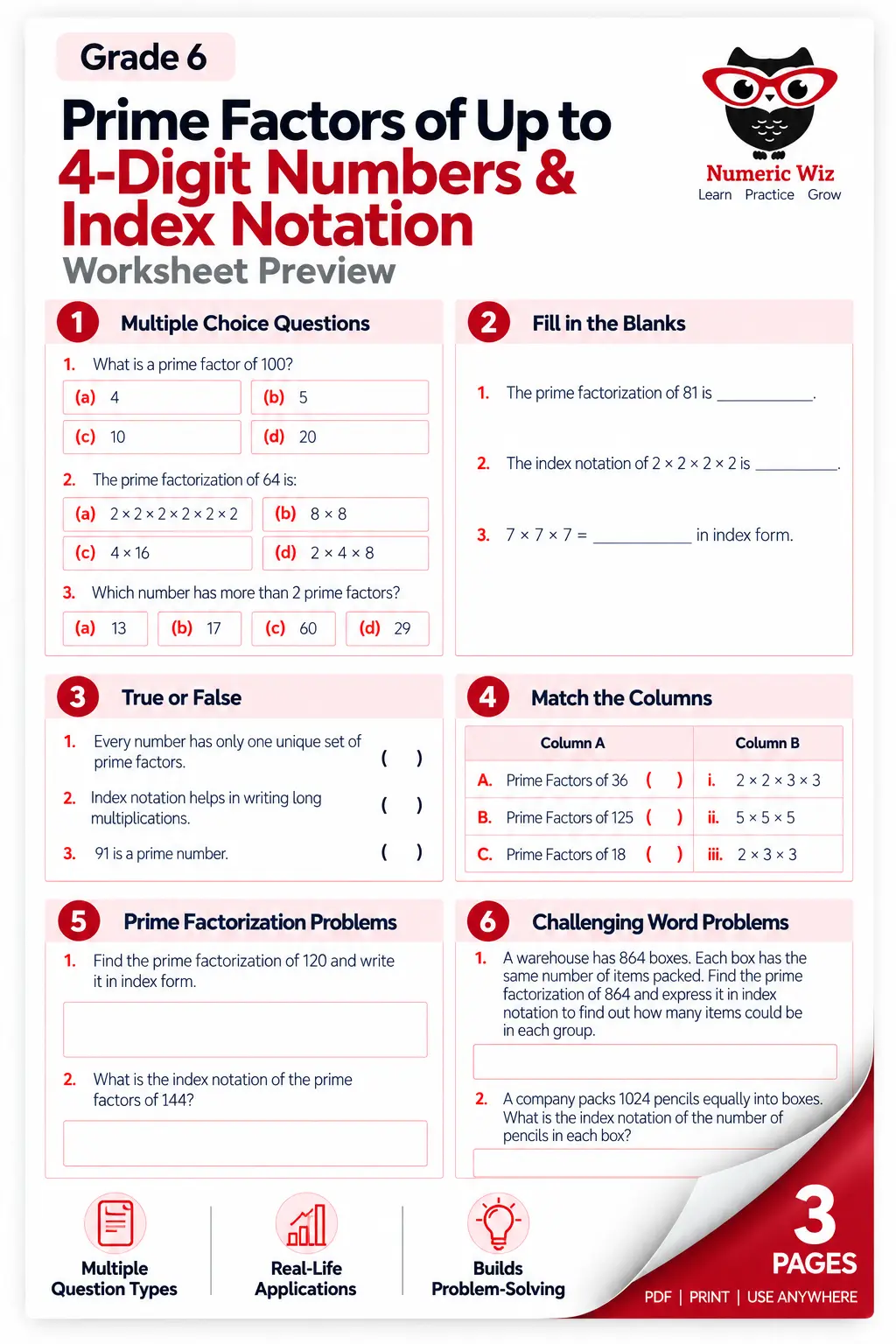
This 3-page printable math worksheet is part of NumericWiz's Grade 6 Factors and Multiples chapter. It focuses on identifying prime factors, finding prime factorizations, and representing repeated factors using index notation.
Students begin with foundational questions that assess their understanding of prime factors and correct prime factorizations. They then move into activities involving exponential notation, conceptual statements, matching exercises, and written calculations.
The resource includes prime factorization problems involving numbers such as 120 and 144, followed by challenging questions featuring larger values, including 864 and 1024.
This progression gives students opportunities to move from recognizing mathematical relationships to applying factorization methods independently.
Rather than relying on repetitive calculations, these Grade 6 prime factorization worksheets use different question formats to help students explore the topic from multiple perspectives.
Multiple-Choice Questions: Students identify prime factors, recognize correct prime factorizations, and distinguish prime factors from composite factors.
Fill in the Blanks: Students complete prime factorization expressions and convert repeated multiplication into index notation.
True or False: Concept-checking statements encourage students to examine properties of prime numbers, unique factorization, and index notation.
Match the Columns: Students connect numbers such as 36, 125, and 18 with their corresponding prime factorizations.
Prime Factorization Problems: Students find the prime factorization of 120 and express the prime factors of 144 using index notation while showing their working.
Challenging Word Problems: Students work with larger numbers in warehouse and packaging contexts, applying prime factorization and index notation.
These varied activities encourage students to recognize number relationships, organize repeated factors, and communicate their mathematical working clearly.
Prime factorization becomes particularly useful when students work with larger numbers containing several repeated prime factors.
For example, consider the number 144:
144 = 2 × 2 × 2 × 2 × 3 × 3
In index notation:
144 = 2⁴ × 3²
This representation shows that 144 contains four factors of 2 and two factors of 3.
The worksheet extends this understanding through questions involving 864 and 1024, encouraging students to apply prime factorization and index notation to larger values.
Working with these numbers helps students develop a systematic approach to factorization instead of relying on guessing or incomplete calculations.
This NumericWiz resource provides 3 printable pages of focused mathematical practice, combining foundational questions with written calculations and more challenging applications.
The different question formats allow students to practice prime factorization in several ways, while dedicated working spaces encourage organized solutions.
These printable worksheets can support:
The resource is suitable for students who have been introduced to prime numbers and need further opportunities to practice prime factorization and index notation.
Understanding prime factorization allows students to see how composite numbers are constructed, while index notation helps them express repeated factors in a clear and efficient way.
Through concept checks, matching exercises, written calculations, and challenging problems, these Grade 6 prime factorization worksheets provide meaningful opportunities to strengthen mathematical understanding and develop more systematic problem-solving strategies.
Add this NumericWiz printable math resource to your Grade 6 practice materials and help students explore prime factors, master index notation, and approach larger numbers with greater confidence.
For a limited time