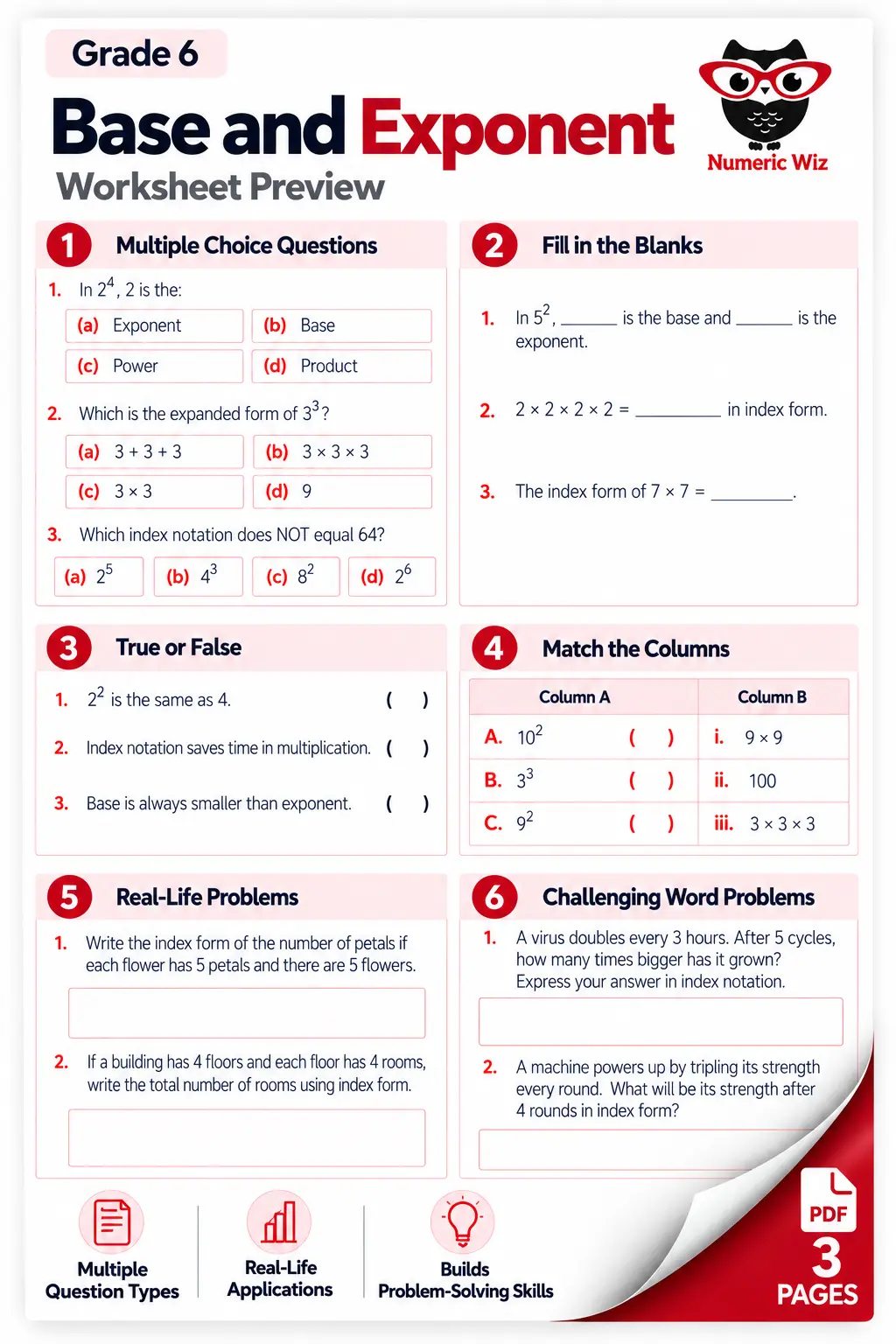
Understanding exponents is an important step in developing stronger mathematical thinking. Students may be comfortable with multiplication but struggle when numbers are written using powers. Questions such as “What does the exponent tell us?”, “How is a base different from an exponent?”, and “How do we expand a number written in index form?” can become confusing without clear explanations and meaningful practice.
These Grade 6 base and exponent worksheets from NumericWiz help students explore exponential notation, recognize the relationship between repeated multiplication and powers, and apply their understanding through varied exercises and real-life problems.
An exponent tells us how many times a number, called the base, is used as a factor in repeated multiplication.
For example:
2⁴ = 2 × 2 × 2 × 2 = 16
In this expression:
The expression 2⁴ is read as “two to the power of four.”
Understanding the difference between a base and an exponent helps students interpret exponential expressions correctly and avoid common mistakes.
For example, 2⁴ does not mean 2 × 4. Instead, it means multiplying four factors of 2.
Index notation, also known as exponential notation, is a shorter way of representing repeated multiplication of the same number.
Consider the expression:
3 × 3 × 3 = 27
Instead of writing 3 three times, we can express it as:
3³ = 27
Here, 3 is the base and 3 is the exponent.
Another example is:
5 × 5 = 5² = 25
Index notation helps students write repeated multiplication more efficiently, recognize number patterns, and work with powers.
Students also learn that different exponential expressions can sometimes have the same value.
For example:
4³ = 4 × 4 × 4 = 64
8² = 8 × 8 = 64
2⁶ = 2 × 2 × 2 × 2 × 2 × 2 = 64
Although the bases and exponents are different, all three expressions have the same value.
Recognizing these relationships helps students develop a more flexible understanding of numbers and powers.
Exponents allow us to express repeated multiplication in a compact and organized form. They are especially useful when numbers increase through repeated multiplication.
Learning about bases and exponents helps students:
These concepts provide a foundation for more advanced mathematical learning.
This 3-page printable math worksheet focuses on the meaning of bases and exponents, expanded form, index notation, and evaluating powers.
Students begin by identifying the base in an exponential expression and recognizing the correct expanded form of a power.
They then practice converting repeated multiplication into index notation, evaluating statements about exponents, and matching exponential expressions with their expanded forms or values.
The resource gradually moves toward real-life situations and challenging problems involving repeated multiplication.
These Grade 6 exponent worksheets use different question formats to help students understand the concept rather than simply memorize rules.
Multiple-Choice Questions: Students identify the base in an exponential expression, recognize expanded multiplication, and compare powers to determine their values.
Fill in the Blanks: Students identify bases and exponents and convert repeated multiplication into index notation.
True or False: Students examine statements about powers and index notation, helping them identify misconceptions and check their conceptual understanding.
Match the Columns: Students connect exponential expressions such as 10², 3³, and 9² with their corresponding values or expanded forms.
Real-Life Problems: Students represent repeated quantities using index notation through examples involving flower petals and rooms in a building.
Challenging Word Problems: Students explore repeated doubling and tripling in situations involving a virus and a machine.
These activities provide opportunities to recognize, interpret, calculate, and apply exponential expressions while showing mathematical working.
Exponents become more meaningful when students understand how repeated multiplication appears in practical situations.
For example, imagine a building with 4 floors and 4 rooms on each floor.
The total number of rooms is: 4 × 4 = 16
Using index notation: 4² = 16
This shows how a repeated multiplication expression can be represented using a power.
The worksheet also introduces more challenging situations involving repeated growth.
For example, suppose a quantity doubles during each cycle. After five cycles, its multiplication factor is:
2 × 2 × 2 × 2 × 2 = 2⁵ = 32
This means the final quantity is 32 times the starting quantity.
Similarly, if a quantity triples during each of four rounds, its multiplication factor is:
3 × 3 × 3 × 3 = 3⁴ = 81
These examples help students connect exponent notation with repeated multiplication and growth patterns.
This NumericWiz resource provides 3 printable pages of focused practice on bases, exponents, and index notation.
The combination of concept questions, matching exercises, written calculations, and application problems allows students to explore exponential expressions in several ways.
These worksheets can support:
The resource is suitable for Grade 6 students who are beginning to work with powers or need additional practice interpreting exponential expressions.
Understanding bases and exponents helps students move beyond repeated multiplication toward more efficient mathematical notation and stronger number reasoning.
Through concept checks, expanded-form exercises, matching activities, real-life applications, and challenging word problems, these Grade 6 base and exponent worksheets give students opportunities to interpret powers, recognize patterns, and develop confidence with exponential expressions.
Add this NumericWiz printable worksheet to your Grade 6 math resources and help students strengthen their understanding of bases, exponents, and index notation through meaningful practice.
For a limited time