Extend a number sequence and fill in missing terms
Find one-operation and two-operation rules
Use a position-to-term rule to find any term, including far terms
Check a rule against a table of values before trusting it
Explain a pattern rule in plain words
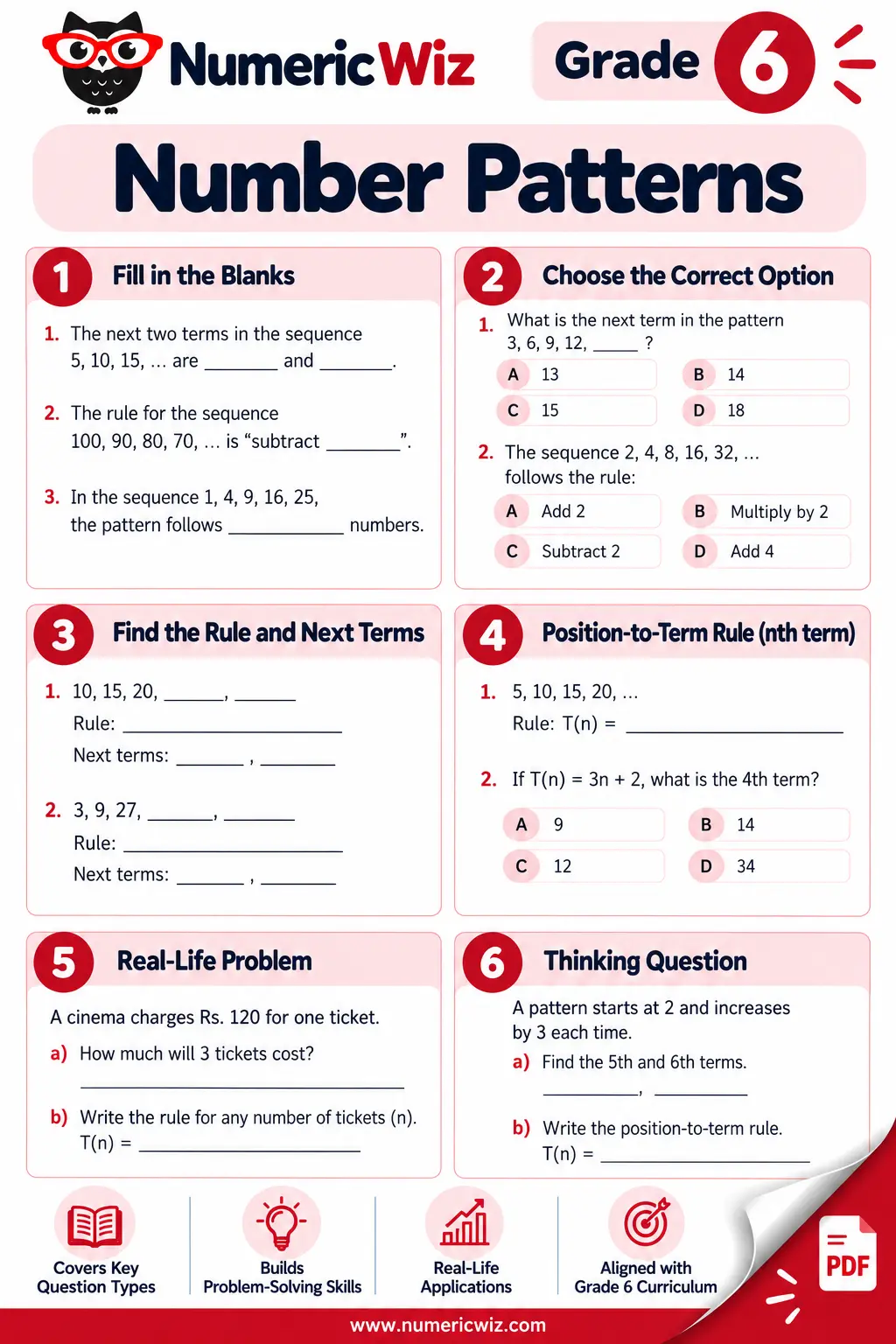
This free printable PDF gives your Grade 6 child focused practice with number patterns. It covers extending sequences, finding missing terms and finding the rule, right up to the position-to-term rule. Print it, hand it over and let the practice start.
A number pattern is a list of numbers that follows a fixed rule, so each new term comes from the one before it or from its position in the list. Once your child spots the rule, the next terms write themselves.
I start every pattern lesson the same way. I write 3, 6, 9, 12 on the board and ask one question: what stays the same from step to step? Children see the jump of 3 at once.
Then I ask for the 10th term, and the room splits. Half the class wants to keep adding 3s. The other half wants a shortcut. That split is the whole lesson, because the shortcut is the rule.
Find the rule by checking the gap between terms first, then test whether one operation explains every step, and check the rule against the table of values before you trust it. A rule that fails one term is not the rule.
Most drills stop at add 5 or double it. I always push one step further. Some rules need two steps, like multiply by 3 then take away 1.
I teach children to test a two-step guess on the second and third terms, not just the first. One term can flatter a wrong rule. Three terms cannot.
The position-to-term rule tells you any term straight from its position, without writing out all the terms before it. If the rule is 3n plus 1, the 10th term is 31, because 3 times 10 plus 1 equals 31 every time.
This is the part most pages skip. They ask children to continue a sequence and stop. I ask for far terms too, like the 20th or 100th term.
That jump from listing to ruling is what turns pattern work into algebra.
This is a 6-page printable PDF with Sections A to E plus a Challenging section. The work moves from extending sequences and filling missing terms to finding rules and using the position-to-term rule.
No answers sit on the student page, so children must test each rule themselves.
Guessing a rule from one gap only. Forgetting to test the rule on later terms. Writing out terms one by one for far terms instead of using the rule.
I name these three errors before practice starts, because naming them takes their power away.
What age is this worksheet for?
Grade 6, ages 10 to 12. It suits classwork, homework and home practice.
Does it cover the position-to-term rule, or only continuing sequences?
Both. Children continue sequences and fill missing terms first, then learn to write the rule and use it for any term.
How do I check my child's answers?
Test the rule against every term. If one term breaks the rule, the rule is wrong. That check is the real skill.
What should my child learn next?
Using letters for rules, which is worksheet 6.2, Introduction to Algebra.
This worksheet aligns with Standard 6.EE.C.9.
For more Grade 6 practice, visit the Grade 6 hub.
For a limited time