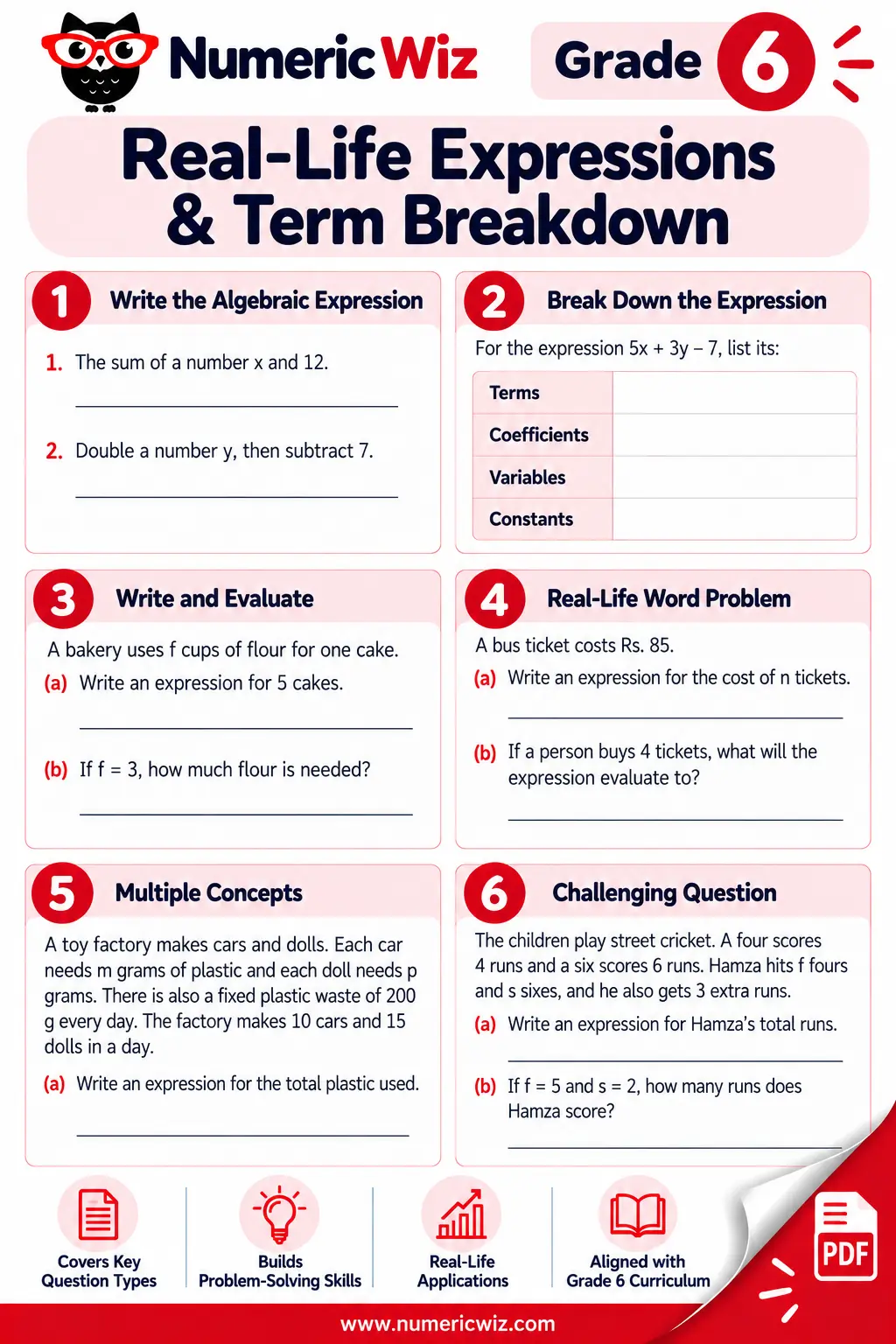
This free printable PDF turns everyday situations into algebraic expressions for Grade 6. Your child writes an expression for each situation, then breaks it into terms, coefficients, variables and constants. Print it and watch letters start to make sense.
A real-life situation becomes an expression when you name the unknown number with a letter, then write the operations in the same order the story gives them. The story does the talking, and the letters just keep score for you.
Most pages stop at one step, like twice as many apples. Real life rarely stops there. A taxi fare has a fixed charge plus a charge per kilometre.
A party bill has a hall fee plus a cost per guest. I stretch strong students with these two-part situations, because they are the ones that appear in later years.
Break an expression into parts by splitting it at each plus or minus sign, then name each part: its terms, the number in front of each variable, which letters can change, and which numbers stay fixed for the whole problem.
I teach this as a four-column check: term, coefficient, variable, constant. Children who can fill four columns for one expression can read any expression on the page.
The split-at-plus-and-minus rule is the whole trick. Signs belong to the term that follows them, and that one habit prevents most sign errors later.
This is a 5-page printable PDF. Each problem starts with an everyday situation, and your child turns it into an expression before breaking that expression into its parts.
The two jobs sit side by side: write it, then take it apart. No answers sit on the student page, so the working must stand on its own.
Writing operations in the wrong order when a story says "less than". Forgetting the fixed part of a two-part bill. Splitting terms at the wrong sign, so a minus lands on the wrong term.
I make children read each finished expression back as a story, because a story that sounds wrong means an expression that is wrong.
A letter feels pointless until it stands for something real, like a fare or a bill. Stories give letters a job.
Splitting an expression at plus and minus signs, then naming each term, coefficient, variable and constant.
Read the expression back as a story. If the story matches the situation, the expression is right.
Grouping and naming terms, which is worksheet 6.4.
This worksheet aligns with Standard 6.EE.B.6. For more Grade 6 practice, visit the Grade 6 hub.
For a limited time