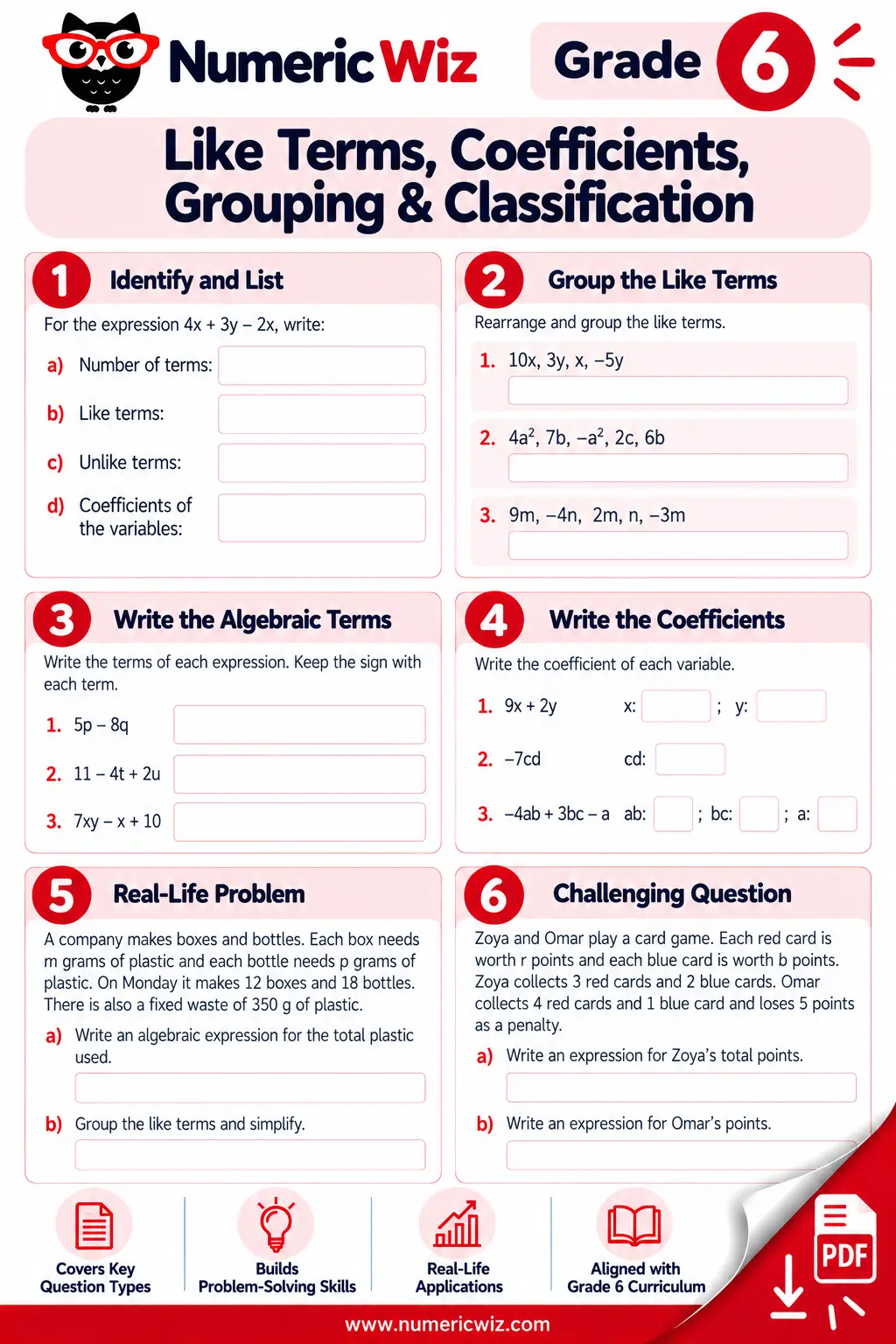
This free printable PDF teaches Grade 6 children to sort, group and name algebraic terms with confidence. It covers like and unlike terms, grouping, coefficients and classifying expressions by their number of terms. Print it and let the sorting start.
Like terms are terms with exactly the same letters raised to exactly the same powers, so 3x and 7x are like terms, but x and x squared are not like terms, even though they both use only the letter x.
I teach grouping with circles, not lists. Children circle each group of like terms in a different colour, then combine one colour at a time. The page gives the same habit: sort first, combine second.
The classic trap is xy versus x squared y, which look alike but fail the same-powers test.
Classify an expression by counting its terms after grouping like terms together: one term makes a monomial, two terms make a binomial, three terms make a trinomial, and four or more terms make a polynomial. Count only after grouping, because ungrouped terms can fool you.
Classification is the main event here, not an afterthought. Children group first and name second, so the name always matches the grouped form.
A child who names before grouping will call 3x + 2x + 5 a trinomial, when it is really a binomial, 5x + 5.
This is a 6-page printable PDF. It moves from spotting like and unlike terms to grouping them and naming expressions by type.
One problem follows a recycling collection over two days: Tuesday brings 8 boxes and 10 bottles, and 350 kg of waste is collected over two days, giving 20m + 28p + 350. Another problem follows Zoya's two rounds of game cards with a 5-point penalty, and part (v) asks for Omar's points as 6r + 4b.
The Wrap-Up asks children to judge Asim's claim that 3a + 2b = 5ab.
Adding unlike terms, like turning 3a + 2b into 5ab. Treating x and x squared as like terms. Forgetting coefficients when grouping, so 3x + 2x becomes x instead of 5x.
I ask one question after every grouping: do the letters and powers match exactly?
Like terms share the same letters with the same powers. Unlike terms do not, so they cannot be combined.
Because a and b are unlike terms. The sum keeps both terms: 3a + 2b stays as it is.
Group like terms first, then count the terms: one is a monomial, two a binomial, three a trinomial.
x and x squared. They share a letter but not a power, so they are unlike.
This worksheet aligns with Standard 6.EE.A.3. For more Grade 6 practice, visit the Grade 6 hub.
For a limited time