Multiplication facts are only the beginning of understanding multiples. As students progress, they need to recognize how multiples form patterns, determine whether a number belongs to a particular sequence, identify numbers shared by two sequences, and use these relationships to solve problems.
This Grade 6 printable resource gives students varied opportunities to explore multiples of numbers up to two digits, moving from straightforward concept checks to real-life and challenging applications. 2_Multiples-of-Up-to-2-Digit-Nu…
When a number is multiplied by 1, 2, 3, 4, and so on, the answers form its sequence of multiples.
For example, multiplying 7 by consecutive whole numbers gives:
7, 14, 21, 28, 35, 42...
So, 35 is the fifth multiple of 7.
Recognizing this pattern helps students answer more than multiplication questions. They can decide whether a number belongs to a sequence, continue a pattern, locate a particular multiple, and compare the multiples produced by different numbers.
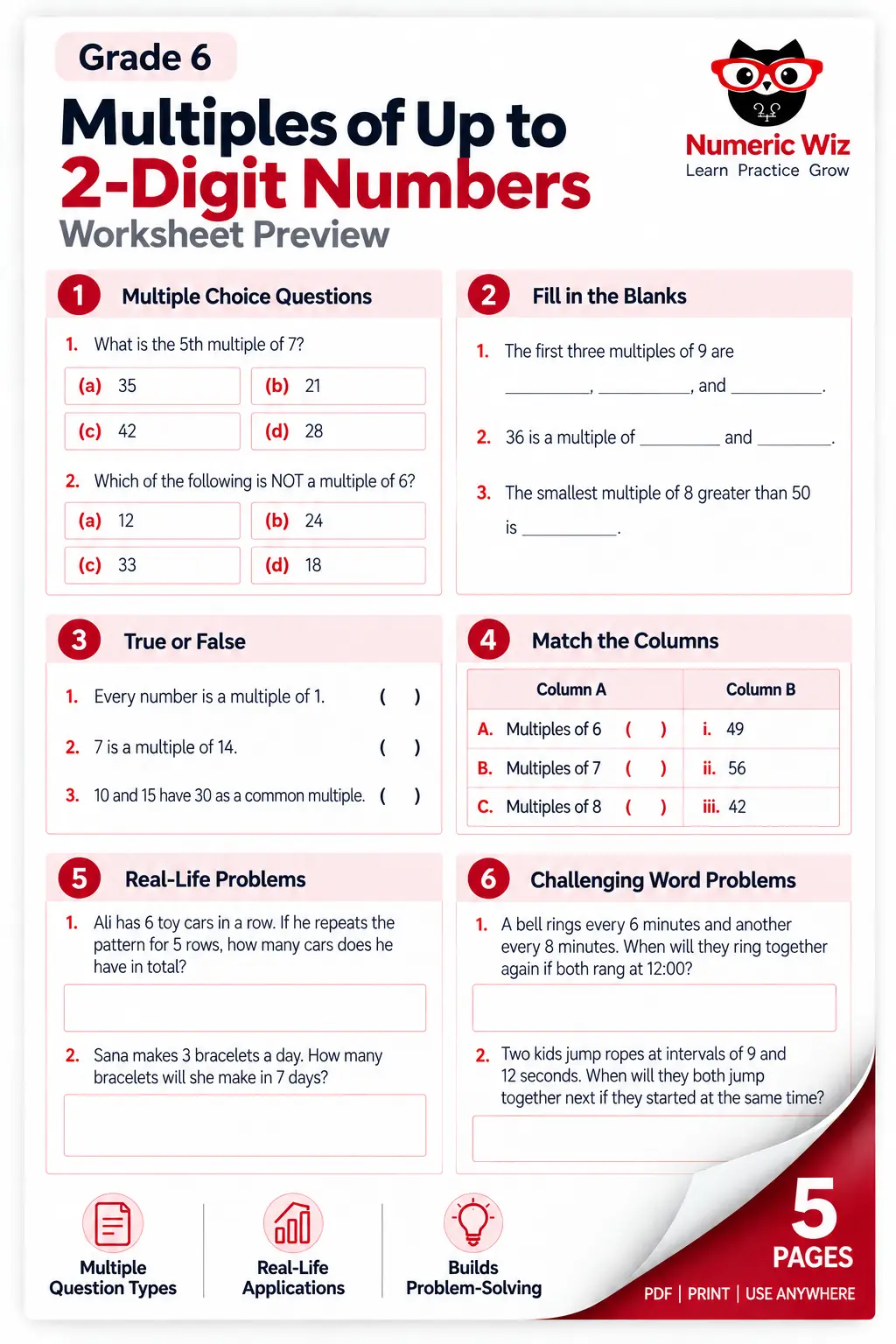
The worksheet develops these ideas through questions that ask students to find a particular multiple, identify a number that is not a multiple, generate the first few multiples, and find a multiple beyond a given value. 2_Multiples-of-Up-to-2-Digit-Nu…
Two different numbers can have some of the same multiples.
Consider 4 and 5:
Multiples of 4: 4, 8, 12, 16, 20, 24, 28...
Multiples of 5: 5, 10, 15, 20, 25, 30...
Because 20 occurs in both sequences, it is a common multiple of 4 and 5.
Students encounter common-multiple thinking directly in the worksheet, including identifying a common multiple of 4 and 5 and considering whether 30 is shared by the multiples of 10 and 15. 2_Multiples-of-Up-to-2-Digit-Nu…
The activities are arranged to let students work with multiples in several ways rather than repeatedly completing the same calculation.
Students answer multiple-choice, fill-in-the-blank, true-or-false, and matching questions. They recognize multiples of 6, 7, and 8 before moving into situations that require them to apply their understanding. 2_Multiples-of-Up-to-2-Digit-Nu… 2_Multiples-of-Up-to-2-Digit-Nu…
This variety encourages students to notice number relationships and explain the mathematics behind repeated quantities.
Multiples appear naturally when quantities or events repeat.
Students apply this idea by working with repeated rows of toy cars and daily bracelet production. These problems connect multiplication patterns with quantities that increase in equal groups. 2_Multiples-of-Up-to-2-Digit-Nu…
The final problems introduce another useful application: repeating intervals. Students determine when two bells ringing every 6 and 8 minutes will ring together again and when two children jumping at 9- and 12-second intervals will next jump together. 2_Multiples-of-Up-to-2-Digit-Nu…
These questions encourage students to recognize when common multiples can help solve a practical problem.
Explore our complete guide on multiples of Up to 2-digit numbers:
Multiples of Up to 2-Digit Numbers: Easy Guide with Examples
This NumericWiz worksheet can support classroom learning, homework, tutoring, homeschool practice, revision, intervention, or independent work. Students can use it after learning the concept or as additional practice when they need more experience recognizing and applying multiples.
The PDF identifies the resource as Grade 6, Chapter 1: Factors and Multiples, with this set devoted specifically to Multiples of Up to 2-Digit Numbers. 2_Multiples-of-Up-to-2-Digit-Nu…
A strong understanding of multiples helps students see multiplication as a network of connected number patterns rather than isolated facts. By moving from recognition and matching to real-life situations and recurring-event problems, this resource gives students several ways to explore and apply those relationships.
Add this NumericWiz Grade 6 printable worksheet to your math resources for focused practice with multiples and common multiples.
For a limited time