Knowing how to calculate the Highest Common Factor (HCF) and Least Common Multiple (LCM) is one thing, but deciding which method to use in a word problem can be more challenging. Students often struggle to recognize whether a situation involves dividing quantities equally, finding common group sizes, or identifying when repeating events will occur together.
These Grade 6 HCF and LCM word problems worksheets from NumericWiz help students connect mathematical concepts with practical situations. Through concept-checking questions, calculations, and real-life applications, students practice interpreting problems, identifying relevant number relationships, and developing logical problem-solving strategies.
The Highest Common Factor (HCF), also known as the Greatest Common Factor (GCF), is the largest positive whole number that divides two or more numbers exactly without leaving a remainder.
For example, consider 18 and 24.
Factors of 18: 1, 2, 3, 6, 9, 18
Factors of 24: 1, 2, 3, 4, 6, 8, 12, 24
The common factors are 1, 2, 3, and 6.
Therefore:
HCF of 18 and 24 = 6
The Least Common Multiple (LCM) is the smallest positive number that is a multiple of two or more given numbers.
For example, consider 6 and 8.
Multiples of 6: 6, 12, 18, 24, 30, 36...
Multiples of 8: 8, 16, 24, 32, 40...
The smallest positive number shared by both sequences is 24.
Therefore:
LCM of 6 and 8 = 24
Understanding these two concepts helps students recognize different mathematical situations and select an appropriate problem-solving approach.
One of the most important skills in solving HCF and LCM word problems is determining which concept applies to the situation.
HCF is useful when a problem asks students to divide quantities into the largest possible equal groups without leftovers.
For example, imagine a teacher has 20 pencils and 25 erasers and wants to prepare identical supply packs using all the items.
To find the greatest number of identical packs, calculate:
HCF of 20 and 25 = 5
The teacher can prepare 5 identical packs, each containing 4 pencils and 5 erasers.
LCM is useful when two or more events repeat at different intervals and students need to determine when they will happen together again.
For example, suppose one light flashes every 6 seconds and another flashes every 8 seconds.
Multiples of 6: 6, 12, 18, 24...
Multiples of 8: 8, 16, 24, 32...
LCM of 6 and 8 = 24
If both lights flash together initially, they will flash together again after 24 seconds.
Learning to distinguish these situations helps students move beyond memorized procedures toward understanding how mathematics can solve practical problems.
HCF and LCM are useful in everyday situations involving equal distribution, grouping, repeated schedules, and common intervals.
Understanding these applications helps students:
These skills support students as they progress toward more complex mathematical applications.
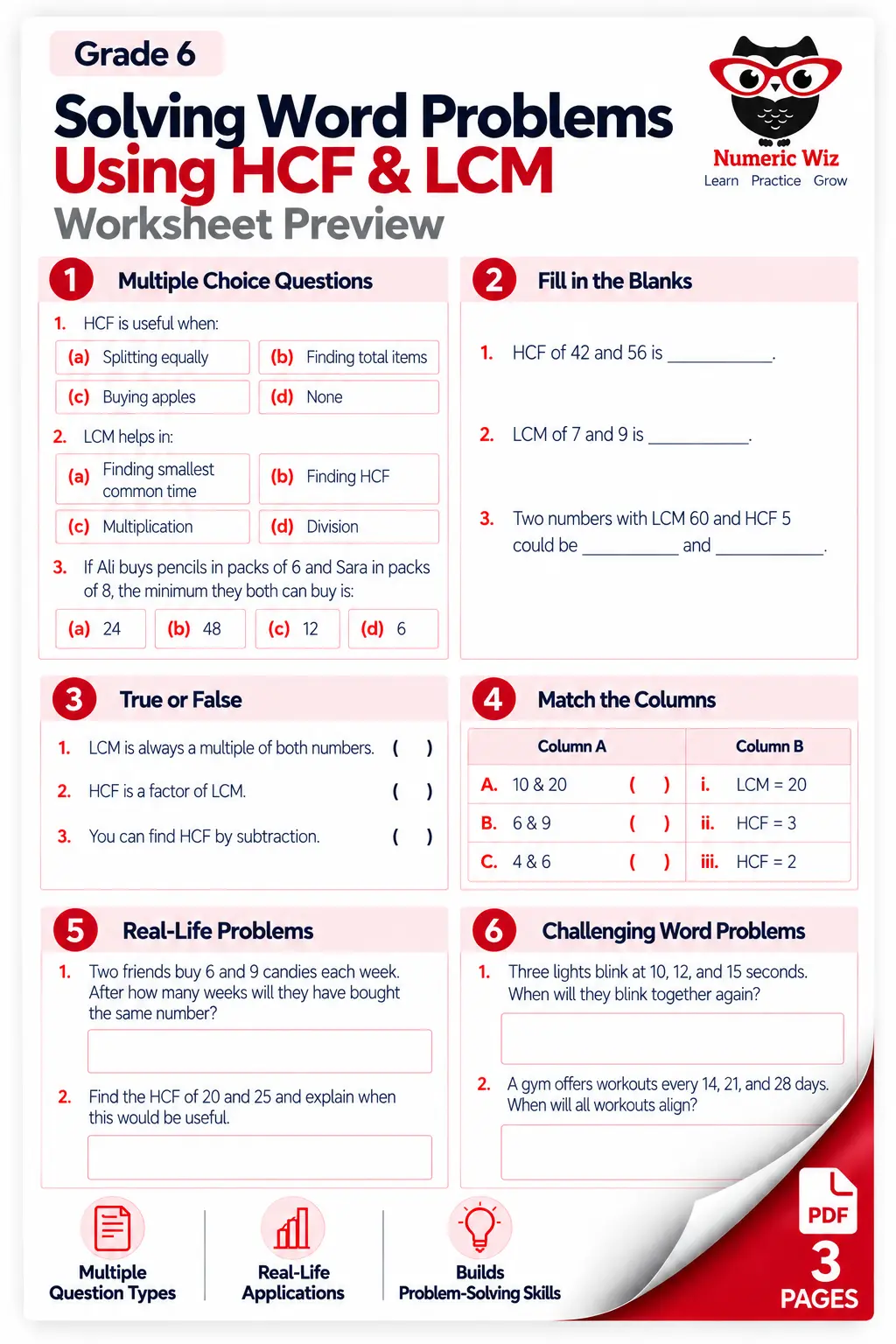
This 3-page printable math worksheet focuses on applying HCF and LCM to mathematical questions and practical situations.
Students begin by identifying when HCF or LCM is useful. Multiple-choice questions introduce equal splitting, common times, and quantities sold in different pack sizes.
They then complete numerical questions involving the HCF of 42 and 56, the LCM of 7 and 9, and possible pairs of numbers with a specified HCF and LCM.
The following activities check conceptual understanding through true-or-false statements and matching number pairs with their HCF or LCM values.
Students finally move into real-life and challenging word problems involving quantities, repeated events, and schedules.
These Grade 6 HCF and LCM worksheets use different question formats to develop conceptual understanding alongside calculation skills.
Multiple-Choice Questions: Students recognize situations in which HCF or LCM is useful, including equal splitting and finding common quantities.
Fill in the Blanks: Students calculate HCF and LCM values and investigate pairs of numbers with given factor and multiple relationships.
True or False: Students examine statements about HCF, LCM, and mathematical methods, helping them check their understanding of important properties.
Match the Columns: Students connect number pairs such as 10 and 20, 6 and 9, and 4 and 6 with corresponding HCF or LCM values.
Real-Life Problems: Students work with quantities of candies and investigate the HCF of 20 and 25 while explaining a possible application.
Challenging Word Problems: Students solve problems involving blinking lights and recurring workout schedules, applying LCM reasoning to repeated intervals.
The activities encourage students to identify relevant information, choose appropriate calculations, and show their mathematical working.
The worksheet includes problems that connect HCF and LCM with situations involving quantities and repeated schedules.
Three lights blink at intervals of 10, 12, and 15 seconds. Assuming they blink together initially, students can determine when all three will blink together again by finding the LCM.
Prime factorizations:
10 = 2 × 5
12 = 2² × 3
15 = 3 × 5
Select the highest power of each prime factor:
LCM = 2² × 3 × 5
LCM = 4 × 3 × 5 = 60
Therefore, the three lights will blink together again after 60 seconds.
Suppose a gym offers three workouts that repeat every 14, 21, and 28 days.
To determine when all three schedules will align again, find their LCM.
14 = 2 × 7
21 = 3 × 7
28 = 2² × 7
Therefore:
LCM = 2² × 3 × 7
LCM = 4 × 3 × 7 = 84
If all three workouts begin on the same day, they will align again after 84 days.
These problems help students understand how multiples can be used to solve questions involving recurring events.
This NumericWiz resource provides 3 printable pages of focused HCF and LCM practice, combining numerical questions with real-life problem-solving activities.
Students encounter different question formats and have dedicated space to show their working in the application sections.
The worksheets can support:
The resource is especially useful for students who have already learned how to calculate HCF and LCM and need more opportunities to recognize when and how to apply these concepts.
This resource focuses on applying HCF and LCM concepts to numerical and real-life problems within the Grade 6 Factors and Multiples chapter.
Learning HCF and LCM becomes more meaningful when students can recognize where these concepts apply, select suitable methods, and explain how their calculations answer a question.
Through concept checks, numerical practice, matching activities, and challenging real-life applications, these Grade 6 HCF and LCM word problems worksheets provide opportunities to strengthen mathematical reasoning and build greater independence in problem-solving.
Add this NumericWiz printable PDF to your Grade 6 math resources and help students develop the skills to interpret, solve, and explain HCF and LCM word problems.
For a limited time