Simplify ratios to their lowest terms
Read ratio tables and class data
Share quantities in a given ratio
Solve real-life ratio problems in money, marks and recipes
A ratio compares two quantities of the same kind. If a class has 12 boys and 18 girls, the ratio of boys to girls is 12:18, which simplifies to 2:3. I tell my students to read a ratio like a recipe: it tells you how much of one thing goes with another, not how many there are in total. That one idea unlocks every question on this page.
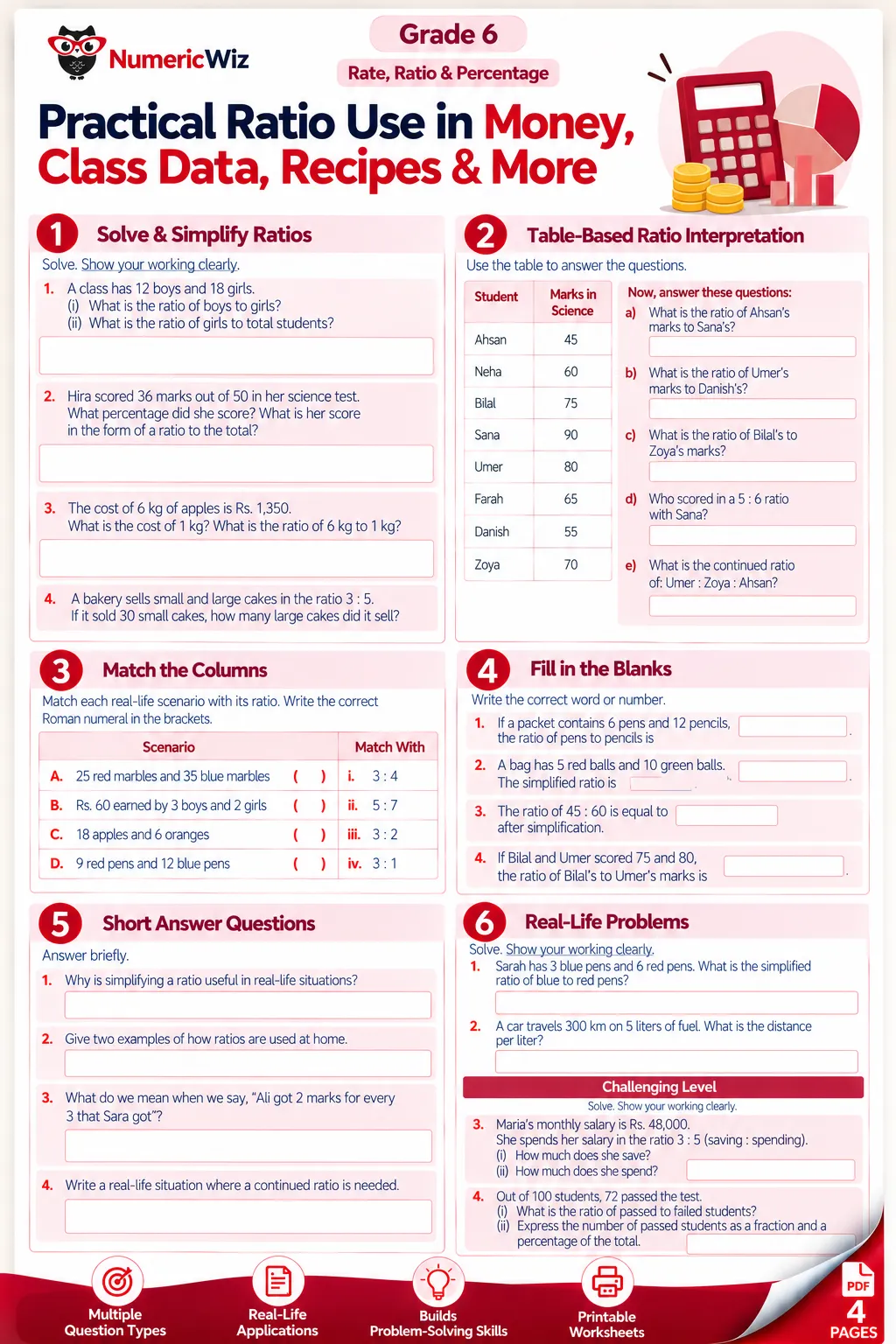
Ratios show up wherever we share, spend or compare. In this worksheet your child works with a class of 12 boys and 18 girls, Hira's score of 36 out of 50, and 6 kg of apples costing Rs. 1,350. I picked these because they feel like real life, not a textbook. When a ratio problem feels stuck, I ask students to write the two numbers down first, then simplify, then answer. That order rarely fails.
This is a 4-page printable PDF. Section A has 4 Solve and Simplify questions. Section B is one table-based question with 5 parts, using a Science marks table. Section C is Match the Columns with 4 everyday scenarios. Section D has 4 fill-in-the-blanks questions. Section E has 4 short-answer questions. Section F has 4 real-life problems, with the last two marked Challenging Level, including Maria's salary shared in the ratio 3:5 and a class where 72 out of 100 students passed.
Students first simplify plain ratios, then read a marks table and match real scenarios to their ratios. Only after that do they write short explanations and solve full real-life problems, showing each step. I find this order builds speed without skipping understanding.
Use this worksheet for a first ratio lesson in Grade 6, as homework, for homeschool or one-to-one tutoring, or as a quick check before rates and percentages. Because every question comes from a real situation, it quickly shows which students can use ratios and which ones are still just writing numbers with a colon between them.
A ratio compares two quantities of the same kind. A class with 12 boys and 18 girls has a ratio of boys to girls of 12:18, which simplifies to 2:3. A ratio tells you how much of one thing goes with another, not how many there are in total.
Divide both numbers in the ratio by the same number until they share no common factor except 1. For 12:18, divide both by 6 to get 2:3. Write the two numbers down first, then simplify, then answer.
Add the parts of the ratio first, then find the value of one part, then multiply. If a salary is shared in the ratio 3:5, there are 8 parts in total. One part is the total divided by 8, and each share is its number of parts times that value.
For a limited time