
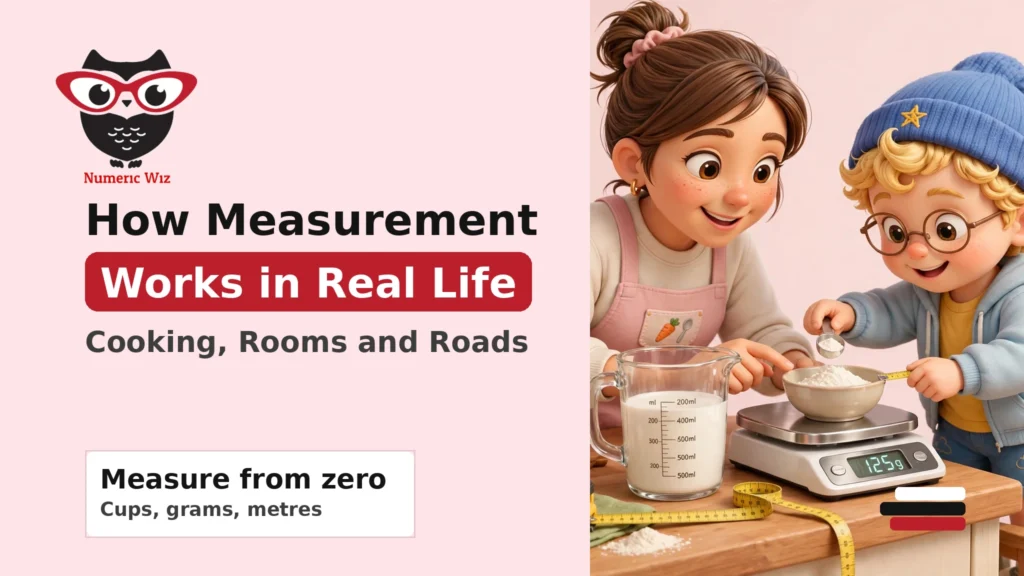
Measurement in real life means matching a number to a real thing: cups of flour in the kitchen, metres across a room, kilometres on the road. Pick the right unit, measure from zero, and read the mark honestly, and the number tells the truth.
I once watched a child measure a table with a ruler that started at 1, not zero. His answer was one centimetre too long, and he could not see why. That one lesson, start at zero, fixed his measuring for good.
How Do You Measure Ingredients in Cooking?
Measure dry ingredients in grams or cups and liquids in millilitres or cups, level off the top with a knife, and read liquid measures at eye level on a flat surface. A recipe works when every measure is full and level, because an extra spoon of flour changes the whole cake.
A metric cup holds 250 millilitres, and 1,000 grams make 1 kilogram. One cup of flour weighs about 120 grams, so a recipe in grams is often more exact than a recipe in cups. I teach children both, because real kitchens use both.
When a recipe doubles, unit rates help you scale each amount fairly. Double the flour, double the sugar, double the milk, and the cake still works.
Cups, Grams and Millilitres
Use a kitchen scale for flour and sugar, and a measuring jug for milk and water. Keep the jug on the table when you read it, and bend down so your eyes are level with the mark. Reading from above is the classic kitchen error.
How Do You Measure a Room?
Measure a room with a tape from one wall to the other, wall to wall, and write metres and centimetres together, like 3 metres 40 centimetres. Measure twice, once each way, because a rug or a bed bought on one careless measure rarely fits the second time.
A room 4 metres long and 3 metres wide covers 12 square metres, so a carpet of 12 square metres fits it. I ask children to measure their own rooms and then check: does the bed fit along the short wall or only along the long one?
Furniture shopping is the best area lesson there is. A child who has measured a room never guesses at a shop again.
Why Do Roads Use Kilometres Instead of Metres?
Roads use kilometres because metres make the numbers too long to read, and 12 kilometres is far easier to follow than 12,000 metres on a sign. One kilometre equals 1,000 metres, so drivers can judge distance, time and fuel in numbers that fit the road ahead.
A trip of 3 kilometres is 3,000 metres. A walk to a school 2 kilometres away is 2,000 metres. I ask children to convert road signs on family trips, and the skill sticks because the numbers mean something real.
Small distances suit metres and centimetres. Long distances suit kilometres. Picking the right unit is half the skill.
What Mistakes Do Children Make When Measuring?
Children most often start at 1 instead of zero, mix up centimetres and millimetres, and forget to convert before they add, so 1 metre 50 centimetres plus 60 centimetres becomes a mess. Teach them to start at zero, name the unit out loud, and convert everything to the same unit first.
Ten millimetres make one centimetre, and 100 centimetres make one metre. I chant these two facts with every class, because every conversion flows from them. A child who knows them never adds metres to centimetres without converting first.
Try These Three Yourself
- A recipe needs 500 g of flour. You have 1 kg. How much flour is left after baking? (Answer: 500 g, because 1,000 g minus 500 g equals 500 g.)
- A room is 5 m long and 4 m wide. What is its area? (Answer: 20 square metres, because 5 times 4 equals 20.)
- A road is 2,500 metres long. How many kilometres is that? (Answer: 2.5 km, because 2,500 divided by 1,000 equals 2.5.)
FAQ
Why does my child start measuring at 1?
Most rulers show big numbers, and children grab the first one they see. Teach them to find the zero mark first, every single time.
How many millimetres are in a centimetre?
Ten. So 5 cm is 50 mm, and 25 mm is 2.5 cm.
Is a cup the same everywhere?
A metric cup is 250 millilitres, but old recipes vary. Use the same cup for the whole recipe and the result stays right.
How do I convert metres to centimetres?
Multiply by 100. So 2 m is 200 cm, and 1.5 m is 150 cm.
What is the best first measuring tool for a child?
A tape measure and a kitchen scale. Real jobs, like measuring a room or baking a cake, beat any page of sums.
Hand your child the tape tonight. Measure one room together, write the numbers down, and let measurement become a home skill, not a school topic. Find more Grade 6 guides on the Grade 6 hub.