
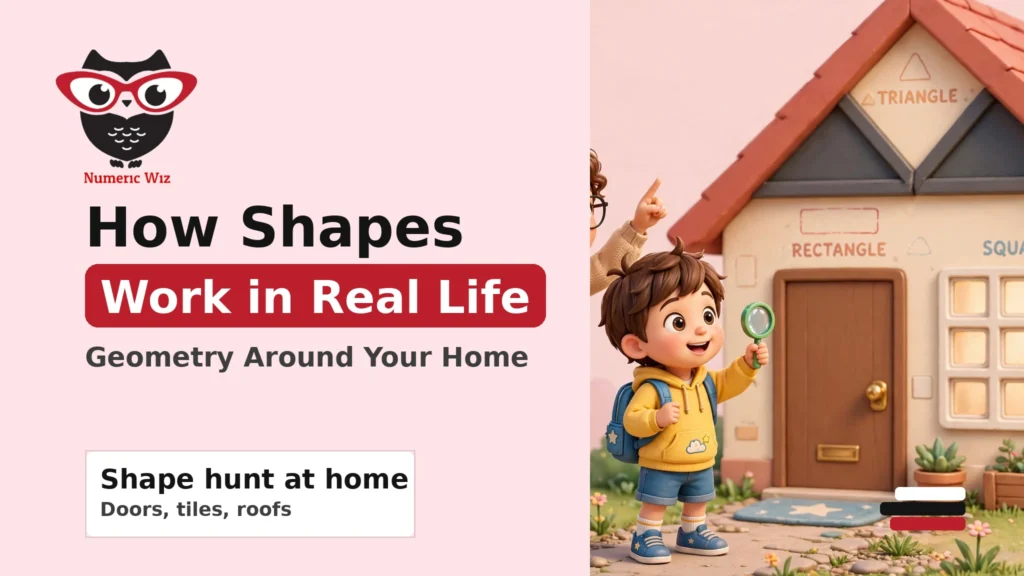
Shapes in your home are not just maths on paper: doors are rectangles, windows are squares or rectangles, tiles repeat in patterns, and roofs rise in triangles. Once your child names the shape, they start to see why it was chosen, and geometry turns into something they can touch.
I ask children to count the rectangles in their own room, and they always stop at the door. Then I point at the bed, the book, the window, and the rug, and the count jumps past ten. Shapes hide in plain sight until someone teaches a child to look.
Why Are Doors and Windows Rectangles?
Doors and windows are rectangles because opposite sides stay equal and every corner is a right angle, which keeps the frame straight and the door swinging clean. A rectangle fits a wall opening neatly, and its straight sides make hinges, locks and glass easy to fix in place.
A square is a special rectangle with all sides equal. Most windows are rectangles, not squares, because a tall window lets in more light while a wide window suits a wide wall. Builders pick the shape that fits the wall, not the shape that looks fanciest.
Ask your child to check the corners of a door with a book corner. A book corner is a right angle, and it fits a door corner exactly.
What Shapes Do Tiles and Floors Use?
Tiles and floors mostly use squares, rectangles and hexagons because these shapes fit together with no gaps and no overlaps, which keeps a floor flat and strong. Try to tile a floor with circles and you get gaps at every join, which is why builders pick shapes that lock together.
A floor 3 metres by 2 metres covers 6 square metres. Tiles of half a metre by half a metre cover a quarter of a square metre each, so the floor needs 24 tiles. I love this example in class, because one room gives a full area lesson.
When a tile is cut in half, fractions show up in the floor itself. Half tiles along the edge of a room are fractions your child can stand on.
Why Do Roofs Rise in Triangles?
Roofs rise in triangles because a triangle holds its shape when pushed, while a square frame can lean sideways and fold. Rain also runs off a sloped triangle fast, which keeps the roof dry, and the strong triangle shape carries the weight of the roof down to the walls.
Bridges use triangles for the same reason. A triangle cannot fold without changing the length of a side, and that stiffness is what builders want. I show children a square frame made of straws and a triangle frame made of straws, and they push both. The square folds, and the triangle holds.
How Can You Spot Geometry on a Walk Around Your Home?
Spot geometry at home by naming one shape in each room and asking what job it does, like round plates that hold food well or a round clock face that suits turning hands. Children who hunt shapes this way remember them far better than children who only label diagrams in a book.
Make it a game: ten points for a hexagon, five for a triangle, one for every rectangle. The kitchen alone usually wins the game, with round plates, rectangular trays and square tiles. The bathroom adds round mirrors and oval sinks, and the garden adds round pots and triangular roof ends.
Try These Three Yourself
- A door is 2 m tall and 1 m wide. Is it a square or a rectangle? (Answer: A rectangle, because its sides are not all equal.)
- How many sides does a hexagon have? (Answer: 6 sides.)
- A square tile has sides of 30 cm. What is its area? (Answer: 900 square centimetres, because 30 times 30 equals 900.)
FAQ
Is a square a rectangle?
Yes. A square is a rectangle with all sides equal, so every square counts as a rectangle, but not every rectangle is a square.
Why are wheels round?
Because a circle rolls smoothly. Corners would bump on every turn, and a wheel with corners would be a very rough ride.
What is the difference between 2D and 3D shapes?
A 2D shape is flat, like a tile or a drawing. A 3D shape is solid, like a box or a ball, and you can hold it.
How many triangles can you see in a roof?
At least one big triangle in the gable end, plus two sloped sides. Look from the side of a house and the triangle is clear.
How can I teach shapes without buying anything?
Play a shape hunt at home. It costs nothing, and your rooms already hold more shapes than any shop-bought set.
Play the shape hunt tonight. Name one shape in each room, ask what job it does, and let geometry become a game your child wants to play. Find more Grade 6 guides on the Grade 6 hub.