This free printable worksheet helps Grade 6 students multiply and divide integers with confidence. Your child practises the sign rules: same signs give a positive answer, different signs give a negative answer, and zero always gives zero. The page has matching columns and short practice sums, so the rules become a habit, not a memory test.
When you multiply two integers, first check the signs: if both signs are the same, the answer is positive, and if the signs are different, the answer is negative. So (-6) × (-3) is 18, because two negatives make a positive, while (-5) × (+2) is -10, because the signs are different.
I teach it in two steps, and I never let a child skip the first one. Step one: look at the signs and decide if the answer is positive or negative. Step two: multiply the numbers as if both were positive. A child who does the sign first almost never loses a mark on the sign, and that is where most marks are lost.
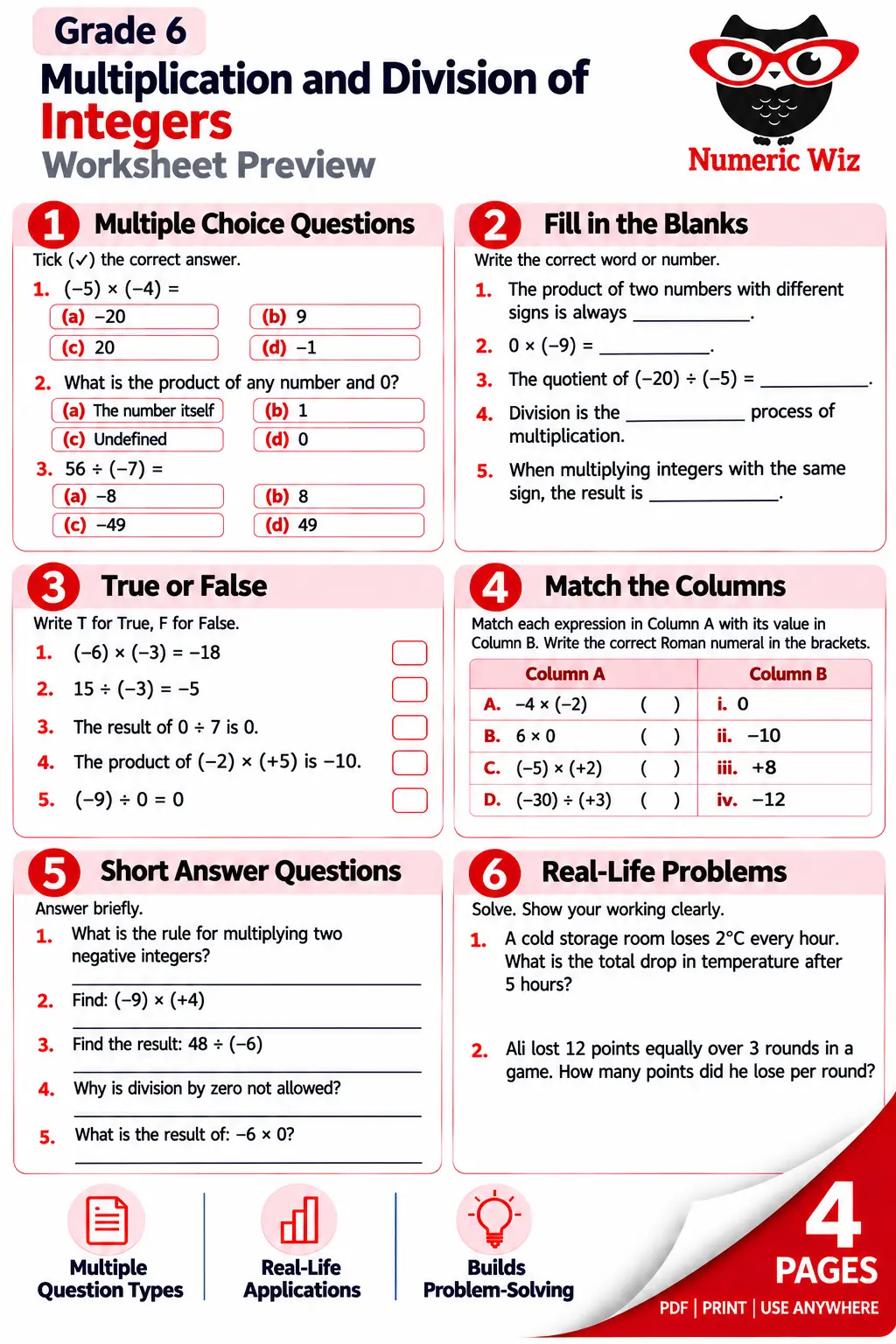
The matching task in this worksheet makes the rule visible. Your child pairs -4 × (-2) with +8, 6 × 0 with 0, (-5) × (+2) with -10, and (-30) ÷ (+3) with -10. Each pair is a small win, and the wins add up to trust in the rule.
Division follows the same sign rule as multiplication: same signs give a positive answer, and different signs give a negative answer. So (-30) ÷ (+3) is -10, because a negative divided by a positive is negative, and the size of the answer comes from 30 divided by 3, which is 10.
Children love this part once they see it, because they only have to learn one rule for two operations. The sign decides the sign of the answer, and the numbers decide the size. I ask them to say the sign out loud before they write anything, and the silly errors drop away fast.
This is a printable PDF with six sections. Section 4 is a Match the Columns task, where your child matches each product or quotient to its value, including -4 × (-2) = +8, 6 × 0 = 0, (-5) × (+2) = -10 and (-30) ÷ (+3) = -10. Section 3 includes (-6) × (-3) = 18, a clean test of the two-negatives rule. The other sections give short multiplication and division sums that use the same sign rules again and again, so the practice builds on itself.
I use one picture that children never forget: same signs are friends, and friends give a positive answer, while different signs are strangers, and strangers give a negative answer. Then I make them work in pairs from the ends of each question: sign first, number second. We check each answer by asking two questions only: is the sign right, and is the size right? If both answers are yes, the sum is right.
Use this worksheet after students can add and subtract integers, as homework, for homeschool or one-to-one tutoring, or as a quick check before algebra-style thinking. Because every question turns on the sign, it quickly shows whether a student owns the sign rules or still guesses them. A child who finishes this page can say the sign before the number, and that habit carries into every integer sum that follows.
For more free practice at this level, browse our Grade 6 math worksheets page. Every sheet is free to print.
18. Two negatives make a positive, and 6 × 3 is 18. This is the sign rule for multiplying integers: same signs give a positive answer.
-10. A negative divided by a positive is negative, and 30 ÷ 3 is 10. Division follows the same sign rule as multiplication.
0. Any number multiplied by zero is zero. In the Match the Columns task, 6 × 0 matches with 0.
It asks your child to match each product or quotient to its value. For example, -4 × (-2) matches with +8, (-5) × (+2) matches with -10, and (-30) ÷ (+3) matches with -10.
For a limited time