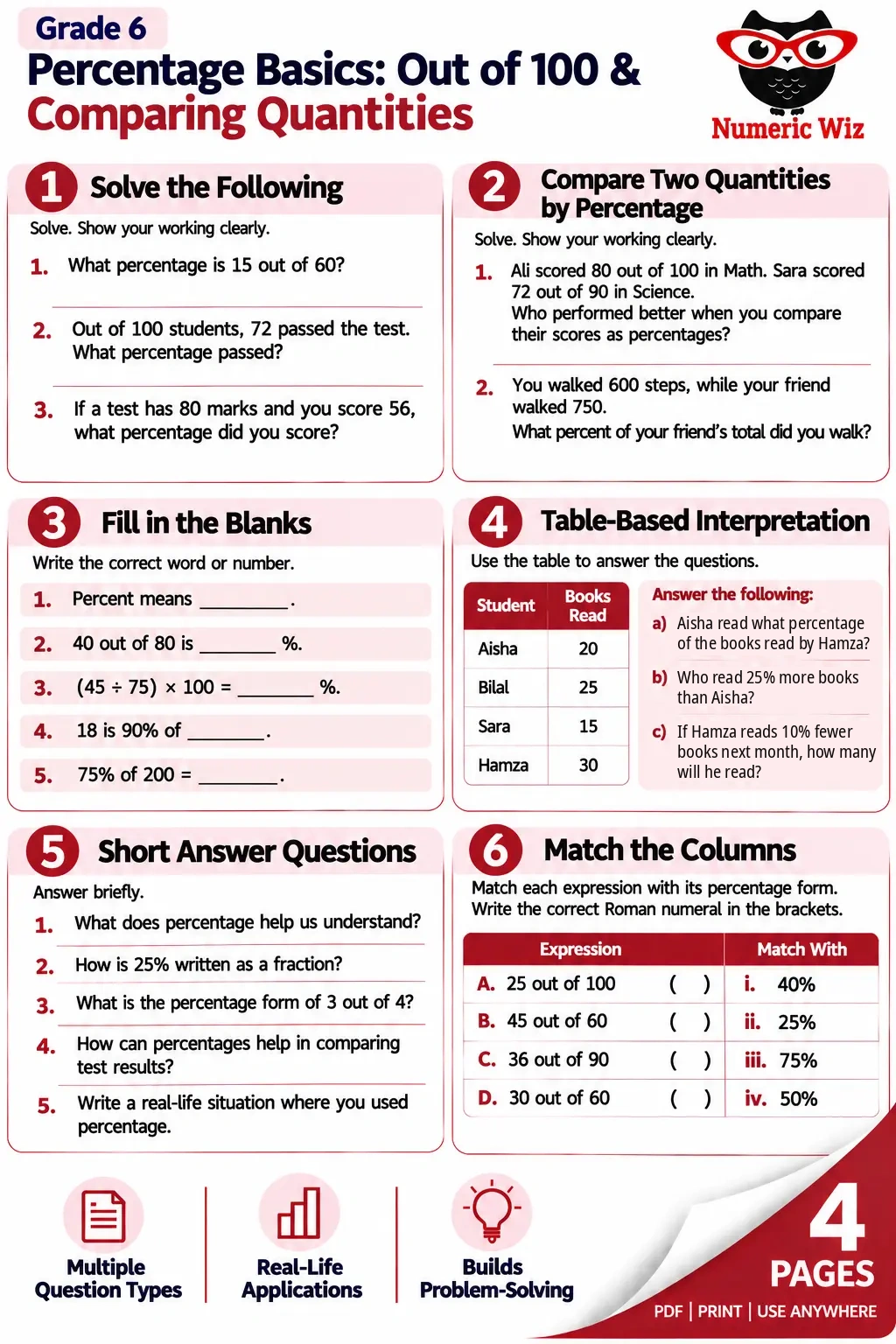
This free printable worksheet helps Grade 6 students work out percentages from a part and a whole. Your child finds what percentage 15 is out of 60, compares two test scores, reads a books table, and matches expressions with their percentage forms. Every question uses test scores, steps, books and everyday numbers, so the maths means something your child can picture.
Percent means out of 100. Fifteen out of 60 is 25%, because 15 divided by 60 is 0.25, and 0.25 times 100 is 25. A percentage is just a part of a whole, written as a rate per 100.
I start every percentage lesson with the words "out of 100". If a test has 80 marks and you score 56, you scored 70%, because 56 divided by 80 is 0.7, and 0.7 times 100 is 70. The whole is always the number after "out of", and the part is the number you scored. Once children name the part and the whole in words, the sum is easy.
If the word percentage still feels new, read my What Is a Percentage? guide first.
To compare two scores fairly, turn both into percentages first. Ali scores 80 out of 100, which is 80%, and Sara scores 72 out of 90, which is also 80%, so they performed exactly the same. Comparing raw marks only would have said Ali did better, and that would be wrong.
Percentages let us compare scores from different totals, and that is their real job. You walked 600 steps while your friend walked 750, so you walked 80% of your friend's total, because 600 divided by 750 is 0.8. The same move works for test scores, steps, marks and money. I ask children to find the whole first, because a percentage means nothing until you know what 100% stands for.
This is the skill Common Core standard 6.RP.A.3 asks for: find a percent of a quantity as a rate per 100.
Here is one table, worked in full, the way I do it in class. Four students read books: Aisha read 20, Bilal read 25, Sara read 15, and Hamza read 30.
First, Aisha read what percentage of the books read by Hamza? Hamza is the whole, so 20 divided by 30 is 0.6667, and times 100 is 66.67%. Second, who read 25% more books than Aisha? Twenty-five percent of 20 is 5, so 20 plus 5 is 25, and Bilal read 25 books. Third, if Hamza reads 10% fewer books next month, how many will he read? Ten percent of 30 is 3, so 30 minus 3 is 27 books.
One table gives three different sums, and each one needs the right whole. If your child can say the whole out loud before she starts, she has the idea. My How to Find a Percentage of a Number guide shows the same steps on money and scores.
This is a printable PDF with solve-the-following questions, a comparison, fill-ins, a table, short answers, matching and word problems. The solve section asks what percentage 15 is out of 60 (25%), what percentage passed when 72 of 100 students passed (72%), and what percentage 56 out of 80 is (70%).
The comparison asks who performed better between Ali's 80 out of 100 and Sara's 72 out of 90 (a tie at 80% each), and what percent 600 steps is of 750 (80%). The fill-ins say percent means out of 100, 40 out of 80 is 50%, (45 divided by 75) times 100 is 60%, 18 is 90% of 20, and 75% of 200 is 150. The table section uses Aisha 20, Bilal 25, Sara 15 and Hamza 30, with answers 66.67%, Bilal with 25 books, and 27 books.
The short answers ask what percentage helps us understand, how 25% is written as a fraction (1/4), what the percentage form of 3 out of 4 is (75%), how percentages help in comparing test results, and for a real-life situation where the child used a percentage. The matching pairs 25 out of 100 with 25%, 45 out of 60 with 75%, 36 out of 90 with 40%, and 30 out of 60 with 50%.
The word problems ask what percentage Hira scored with 36 marks out of 50 (72%), what percentage of 60 students bring their lunch when 45 bring it (75% bring it, 25% do not), and two challenging problems: a dress originally Rs. 2,000 with a 25% discount (the discount is Rs. 500 and the final price is Rs. 1,500), and a candies question where 10% extra gives Sara 11 candies and Sam 22, and Rs. 100 of candies at 25% more costs Rs. 125.
I teach it in three steps, and I never let a child skip step one. Step one: name the whole and the part, in words. Step two: write the part over the whole, divide, then multiply by 100. Step three: check the answer against the story. We check each answer by asking one question only: does the number fit the story? If the whole is right and the story still makes sense, the answer is right.
Use this worksheet after students know what percent means, as homework, for homeschool or one-to-one tutoring, or as a quick check before harder problems with discounts and increases. Because every question ends with a labelled answer, like a percentage or a number of books, it quickly shows whether a student owns the idea or still mixes up the part and the whole. A child who finishes this page can find a percentage from a part and a whole, compare two quantities fairly, and read a table to answer real questions, and those habits carry into every real-life problem that follows.
For more free practice at this level, browse our Grade 6 math worksheets page. Every sheet is free to print.
25%. Divide 15 by 60 to get 0.25, then multiply by 100 to get 25%.
66.67%. Aisha read 20 books and Hamza read 30, so 20 divided by 30 is 0.6667, and times 100 is 66.67%.
Bilal, with 25 books. Twenty-five percent of 20 is 5, so 20 plus 5 is 25.
27 books. Ten percent of 30 is 3, so 30 minus 3 is 27.
For a limited time