This mixed review brings the laws of integers together in one worksheet. The commutative law says that changing the order of the numbers does not change the result, while the associative law says that changing the grouping of the numbers does not change the result. The distributive law connects multiplication with addition and subtraction: the number outside the brackets is multiplied by each number inside the brackets. Students practise recognising each law, choosing the law that fits an expression, and writing expressions in an equivalent form.
The review also covers the rules that are easy to mix up. Division by zero is not allowed, because no number multiplied by zero can give a non-zero result, so a division with zero as the divisor is undefined. By contrast, zero divided by a number is zero, and any number multiplied by zero is zero. Students also use absolute value, the distance of an integer from zero on the number line, and additive inverses, where a number and its opposite add to zero. Together, these rules explain why some results are possible and others are not.
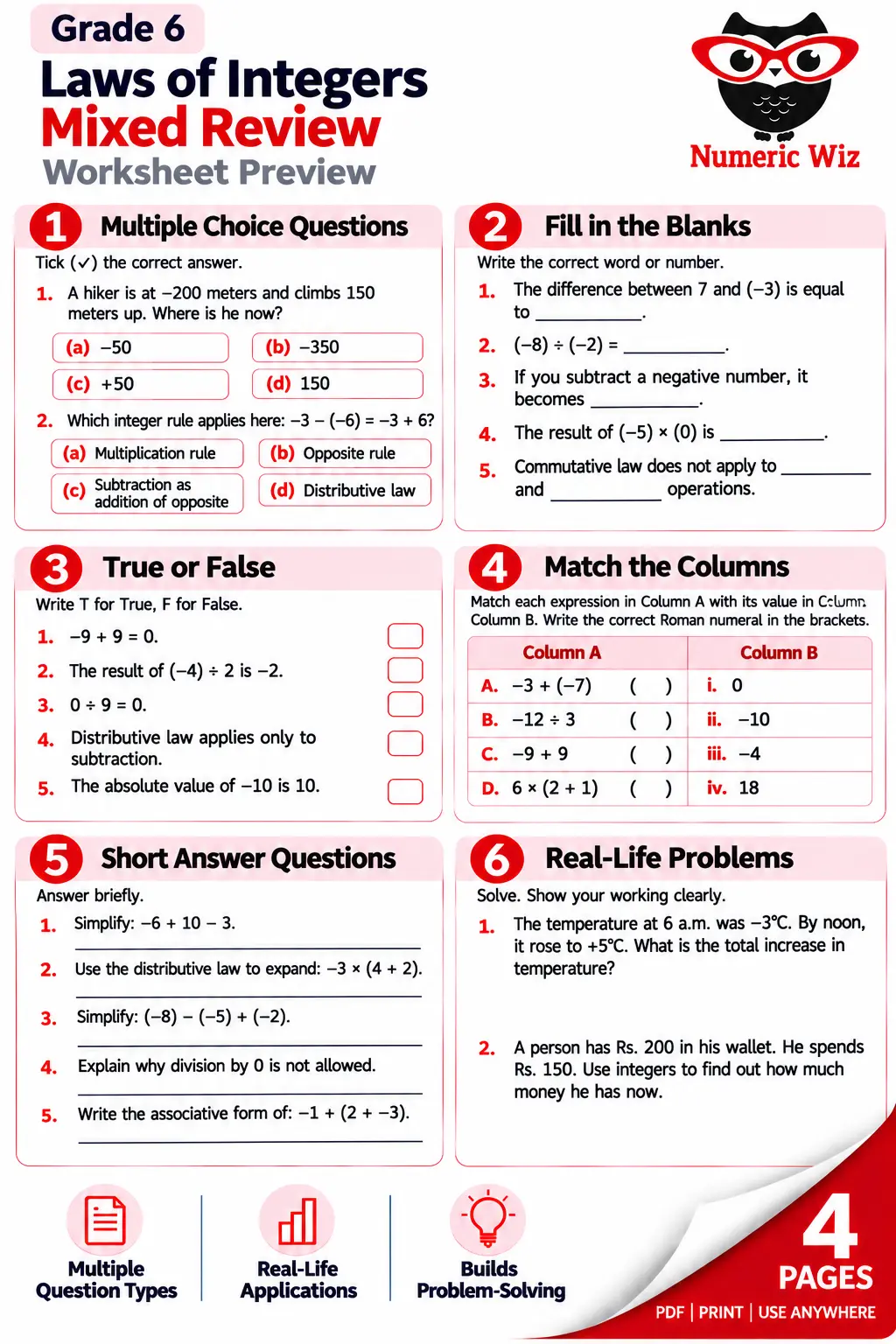
This four-page printable worksheet is organised into six sections, followed by a riddle and challenging questions. Section A uses multiple-choice questions about the laws of integers, division, and division by zero. Section B provides fill-in-the-blanks practice, including the difference between two integers, rewriting subtraction as addition, and the laws that do not apply to subtraction and division. Section C asks students to judge statements as true or false, covering additive inverses, division, zero, the distributive law, and absolute value. Section D matches expressions in one column with their values in the other, and Section E gives short-answer practice, including expanding a distributive expression, writing an associative form, and explaining why division by zero is not allowed. Section F applies the laws to real-life situations involving temperature and money. A riddle and two challenging problems finish the worksheet, including a hot-air balloon problem and a points game, and invite students to explain their thinking.
Students begin with multiple-choice questions that check whether they recognise the correct law and result, then move to fill-in-the-blanks and true-or-false questions that test the laws in words. Matching and short-answer questions ask them to work out results and write equivalent expressions for themselves, and the real-life problems show where the laws are used outside the textbook. The riddle and challenging questions ask for reasons as well as results, so students practise explaining the laws of integers, not only calculating with them.
Parents and teachers can use this worksheet for classroom practice, homework, or revision before a test. Because it reviews addition, subtraction, multiplication, division, and the laws of integers together, it is easy to see which rule a student still needs to practise. The worksheet is a free printable PDF, so it can be used again for extra practice, and its mix of question types keeps the review varied while staying focused on the laws of integers.
The commutative law lets you change the order of the numbers in addition and multiplication without changing the result. It does not apply to subtraction and division, where changing the order can change the result.
The distributive law connects multiplication with addition and subtraction. The number outside the brackets is multiplied by each number inside the brackets, and the results are then added or subtracted, giving an expression that is equivalent to the original.
Division by zero is not allowed because there is no number that, multiplied by zero, gives a non-zero number. A division with zero as the divisor therefore has no defined result and is undefined.
The absolute value of an integer is its distance from zero on the number line. Because distance is never negative, the absolute value of an integer is always zero or positive, even when the integer itself is negative.
For a limited time