
Finding the factors of up to 3-digit numbers becomes much easier when you understand one simple idea: a factor divides a number exactly, with no remainder.
For example, 6 is a factor of 42 because: 42 ÷ 6 = 7
There is no remainder. So, both 6 and 7 are factors of 42.
As numbers get larger, randomly testing numbers can become confusing. A better approach is to use factor pairs, divisibility rules, and an organized step-by-step method. These skills also prepare students for prime factorization, HCF, LCM, fractions, and later algebra. Factor pairs and divisibility are commonly used when teaching students to identify factors efficiently.
What Is a Factor?
A factor is a whole number that divides another whole number exactly without leaving a remainder.
For example, consider 18. We can write:
1 × 18 = 18
2 × 9 = 18
3 × 6 = 18
Therefore, the factors of 18 are: 1, 2, 3, 6, 9, 18
The multiplication combinations 1 × 18, 2 × 9, and 3 × 6 are called factor pairs.
Two Important Facts to Remember
For every positive whole number:
- 1 is always a factor.
- The number itself is always a factor.
For example, 1 and 75 are factors of 75 because: 1 × 75 = 75
These properties are useful starting points whenever students are asked to list all the factors of a number.
What Does “Factors of Up to 3-Digit Numbers” Mean?
A 3-digit number is a whole number from 100 to 999.
Finding factors of up to 3-digit numbers means identifying the whole numbers that divide numbers in this range, or smaller numbers, exactly.
For example:
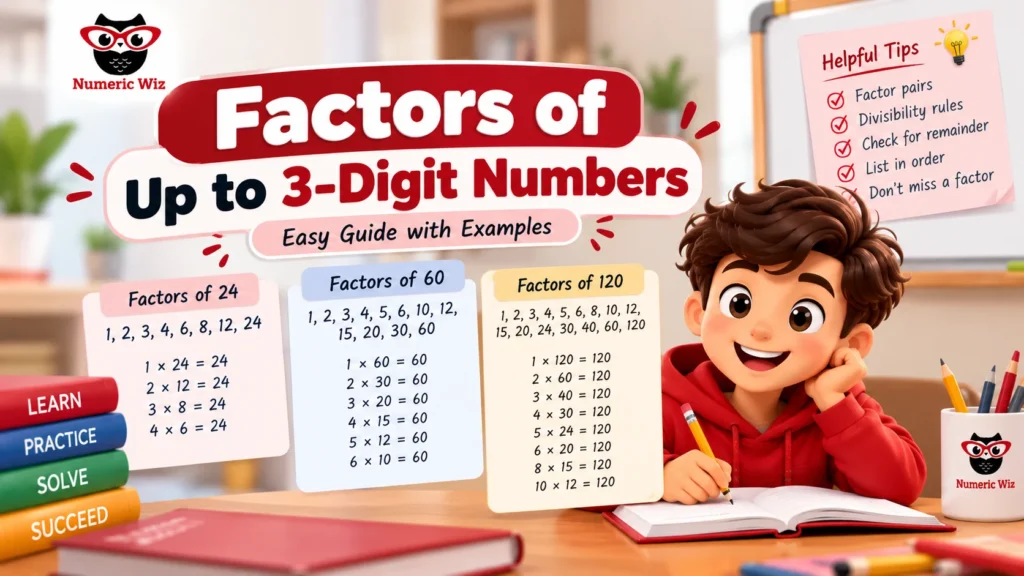
Factors of 24: 1, 2, 3, 4, 6, 8, 12, 24
Factors of 100: 1, 2, 4, 5, 10, 20, 25, 50, 100
Factors of 120: 1, 2, 3, 4, 5, 6, 8, 10, 12, 15, 20, 24, 30, 40, 60, 120
Identification of factors up to 3-digit numbers is also explicitly included as a factors-and-multiples learning topic in school mathematics resources.
How to Find Factors of a Number
The easiest method for students is to look for factor pairs.
Suppose we want to find all the factors of 36.
Start with 1: 1 × 36 = 36
Continue checking:
2 × 18 = 36
3 × 12 = 36
4 × 9 = 36
6 × 6 = 36
Now collect each number from the factor pairs: Factors of 36 = 1, 2, 3, 4, 6, 9, 12, 18, 36
Notice that we write 6 only once, even though the pair is 6 × 6.
A Simple Step-by-Step Method
When finding factors:
- Start with 1.
- Ask whether the number divides exactly.
- If it does, write the factor pair.
- Continue checking possible divisors in order.
- Stop once the factor pairs begin to repeat.
- List all factors from smallest to greatest.
This organized approach reduces the chance of missing a factor.
Example 1: Find All Factors of 48
Let’s find the factor pairs of 48.
1 × 48 = 48
2 × 24 = 48
3 × 16 = 48
4 × 12 = 48
6 × 8 = 48
Therefore:
Factors of 48 = 1, 2, 3, 4, 6, 8, 12, 16, 24, 48
Quick Check
Can 5 be a factor of 48?
48 ÷ 5 = 9 remainder 3
No. Therefore, 5 is not a factor of 48.
Example 2: Find the Factors of 72
Look for pairs that multiply to make 72:
1 × 72
2 × 36
3 × 24
4 × 18
6 × 12
8 × 9
So:
Factors of 72 = 1, 2, 3, 4, 6, 8, 9, 12, 18, 24, 36, 72
Factor pairs make it easier to find all the factors without listing numbers randomly.
Example 3: Find the Factors of 120
Now let’s work with a 3-digit number. Start forming factor pairs:
1 × 120
2 × 60
3 × 40
4 × 30
5 × 24
6 × 20
8 × 15
10 × 12
Therefore: Factors of 120 = 1, 2, 3, 4, 5, 6, 8, 10, 12, 15, 20, 24, 30, 40, 60, 120
The method is exactly the same as it is for smaller numbers. The main difference is that a larger number may have more possible factors.
Use Divisibility Rules to Find Factors Faster
When working with 2-digit and 3-digit numbers, divisibility rules can save time.
Instead of performing long division repeatedly, students can first check whether a number is likely to divide exactly. Divisibility tests are commonly taught alongside factors and multiples for this purpose.
| Divisor | Quick Divisibility Check |
|---|---|
| 2 | Last digit is even: 0, 2, 4, 6, or 8 |
| 3 | Sum of the digits is divisible by 3 |
| 4 | Last two digits form a number divisible by 4 |
| 5 | Number ends in 0 or 5 |
| 6 | Number is divisible by both 2 and 3 |
| 9 | Sum of the digits is divisible by 9 |
| 10 | Number ends in 0 |
Example: Is 3 a Factor of 126?
Add the digits:
1 + 2 + 6 = 9
Since 9 is divisible by 3, 126 is divisible by 3.
Check:
126 ÷ 3 = 42
Therefore:
3 and 42 are a factor pair of 126.
Factors vs. Multiples: What Is the Difference?
Students often confuse factors and multiples, but they describe different relationships.
| Factors | Multiples |
|---|---|
| Divide a number exactly | Come from multiplying a number |
| Factors are limited | Multiples continue indefinitely |
| Factors of 12 include 1, 2, 3, 4, 6, 12 | Multiples of 12 include 12, 24, 36, 48, 60… |
For example: 4 × 6 = 24
This tells us:
- 4 is a factor of 24.
- 6 is a factor of 24.
- 24 is a multiple of 4.
- 24 is a multiple of 6.
A number is a multiple of each of its factors.
Prime and Composite Numbers
Understanding factors also helps students recognize prime and composite numbers.
Prime Number
A prime number has exactly two positive factors: 1 and itself
For example, the factors of 17 are: 1 and 17. So, 17 is prime.
Composite Number
A composite number has more than two positive factors.
For example: Factors of 18 = 1, 2, 3, 6, 9, 18. Since 18 has more than two factors, 18 is composite.
Recognizing prime and composite numbers naturally connects factor work with later learning about prime factorization.
What Happens With Perfect Squares?
Perfect squares have an interesting factor pattern.
Consider 144.
One of its factor pairs is: 12 × 12 = 144
Because the two factors are the same, 12 is listed only once when writing all the factors.
The complete list is: Factors of 144 = 1, 2, 3, 4, 6, 8, 9, 12, 16, 18, 24, 36, 48, 72, 144
This is why perfect squares have an odd number of positive factors: the square-root factor pairs with itself.
Common Mistakes When Finding Factors
Mistake 1: Confusing Factors With Multiples
The factors of 8 are:
1, 2, 4, 8
But:
8, 16, 24, 32…
are multiples of 8.
Mistake 2: Forgetting 1 and the Number Itself
Every positive whole number has 1 and itself as factors.
So, if you are finding the factors of 96:
1 and 96 must be included.
Mistake 3: Including Numbers That Leave a Remainder
For example:
50 ÷ 3 = 16 remainder 2
Therefore, 3 is not a factor of 50.
A factor must divide the number exactly.
Mistake 4: Missing a Factor Pair
If you discover:
8 × 15 = 120
you must include both 8 and 15.
Writing factors as pairs helps prevent this mistake.
Mistake 5: Repeating the Middle Factor
For:
10 × 10 = 100
write 10 only once in the final factor list.
Why Are Factors Important in Math?
Factors are not just another multiplication skill. They form the foundation for several later concepts.
Students use factors when learning:
- Prime and composite numbers
- Prime factorization
- Common factors
- Highest Common Factor (HCF/GCF)
- Lowest Common Multiple (LCM)
- Simplifying fractions
- Divisibility
- Number patterns
- Algebraic factorization
School mathematics sequences commonly move from factors and multiples into prime factorization, HCF, and LCM, showing how these ideas build on one another.
Real-Life Example of Factors
Imagine a teacher has 36 students and wants to arrange them into equal rows.
Possible arrangements include:
1 row of 36
2 rows of 18
3 rows of 12
4 rows of 9
6 rows of 6
These arrangements come directly from the factor pairs of 36.
This is one reason arrays and equal-group models are useful for helping children understand what factors actually represent.
Need Practice Material?
Explore Our Expert Created Worksheet: Factors of Up to 3-Digit Numbers Worksheets | Grade 6 Math PDF
Quick Review
Before moving on, remember these key ideas:
- A factor divides a number exactly with no remainder.
- Factors usually occur in pairs.
- 1 and the number itself are always factors of a positive whole number.
- Divisibility rules can make finding factors faster.
- A prime number has exactly two positive factors.
- A composite number has more than two positive factors.
- Factors and multiples are related, but they are not the same thing.
Frequently Asked Questions
What are factors of a number?
Factors are whole numbers that divide another whole number exactly without leaving a remainder. For example, 4 is a factor of 20 because 20 ÷ 4 = 5.
How do you find the factors of a 3-digit number?
Start with 1 and look for factor pairs. Use divisibility rules to quickly test possible factors, and write both numbers whenever you find a pair.
What are factor pairs?
Factor pairs are two whole numbers that multiply together to make a given number. For example, 6 and 8 are a factor pair of 48 because 6 × 8 = 48.
Is 1 a factor of every number?
Yes. For every positive whole number n, 1 × n = n. Therefore, 1 is a factor of every positive whole number.
Is every number a factor of itself?
Yes. Every positive whole number divides itself exactly. For example, 125 ÷ 125 = 1, so 125 is a factor of 125.
What is the easiest way to check whether a number is a factor?
Divide the number by the possible factor. If the answer is a whole number with no remainder, then it is a factor.
Build Stronger Number Sense with NumericWiz
Learning factors of up to 3-digit numbers is about more than memorizing lists. Students learn to recognize multiplication relationships, use divisibility rules, organize factor pairs, and reason about how numbers are connected.
At NumericWiz, our math resources support this progression through structured practice, visual learning, mathematical reasoning, and problem-solving.
With regular practice, students can move from simply testing numbers to confidently recognizing factor relationships and using them in more advanced mathematics.
NumericWiz — Making Math Simple. Building Confidence.