
Have you ever sat with a student who tries, but still gets it wrong?
I’ve seen that look many times. The quiet frustration. The moment they stop asking questions.
The truth is… it’s rarely about ability.
Most students struggle in math because of hidden learning gaps, poor teaching methods, and weak conceptual understanding. It’s not about intelligence. When basics are missing and pressure builds, students develop math anxiety, lose confidence, and start believing they “just can’t do math.” That belief becomes the real problem.
The Real Reasons Behind Math Struggles
Here’s what I’ve noticed after working with struggling students again and again.
It always comes back to the same few issues.
1. Learning gaps in math
A student misses one concept, then another.
Soon, everything starts falling apart.
For example, I once worked with a student who couldn’t solve fractions.
Not because fractions were hard… but because place value was never clear.
That’s how a learning gap silently grows.
2. Weak number sense
If a student doesn’t feel numbers, math becomes mechanical.
They rely on memorized steps.
The moment a question changes, they freeze.
3. Poor teaching methods
Fast teaching. No checks. Same pace for everyone.
I’ve seen classrooms where teachers move on after one explanation.
But slow learners need time. They need space to think.
4. Memorization without understanding
This is the biggest trap.
Students memorize formulas.
But they don’t know why they work.
So when they forget… everything collapses.
Cognitive Factors That Affect Math Learning
Now let’s talk about what’s happening inside the brain.
Cognitive load
Too much information at once overwhelms students.
They stop processing.
They start guessing.
Working memory limitations
Some students can’t hold multiple steps in their mind.
So even if they understand step 1…
they lose track by step 3.
Attention span issues
Long explanations don’t work.
I’ve noticed students perform better with short, focused learning bursts.
Retention problems
They understand today.
But forget tomorrow.
That’s not laziness.
It’s a retention issue.
Emotional Barriers Students Face
This part matters more than most people think.
Math anxiety
That nervous feeling before solving a question.
Hands slow down. Mind goes blank.
I’ve seen students who knew the answer…
but panic made them forget.
Fear of failure
They stop trying.
Because trying means risking being wrong.
Low confidence
They start saying:
“I’m just bad at math.”
And slowly… they believe it.
Lack of motivation
When nothing makes sense, effort feels useless.
So they give up.
Root Cause vs What Actually Works
| Problem | Root Cause | What Actually Works |
| Weak basics | Learning gap | Rebuild number sense |
| Forgetting concepts | Poor retention | Use spaced repetition |
| Fear of math | Math anxiety | Build confidence slowly |
| Slow progress | Cognitive load | Teach step-by-step |
Real Experience
I remember a student who failed every math test for months.
Not because she couldn’t learn.
But because no one fixed her learning gaps.
Once we slowed down, rebuilt basics, and removed pressure…
her grades improved within weeks.
That’s when I realized:
The problem isn’t the student.
The problem is the approach.
How to Teach Math to Slow Learners Effectively (Core Principles)
Have you ever explained something again and again, and the student still looks confused?
I’ve been there. Many times.
That moment tells you one thing:
it’s not about repeating… it’s about changing the way you teach.
To teach math to slow learners effectively, you need to simplify concepts, teach step by step, use visual learning, and build confidence gradually. When teaching matches the student’s pace and thinking style, understanding improves, retention increases, and fear starts to fade.
The 5 Golden Principles of Teaching Math
These are not theories.
These are things I’ve used with real students who were struggling badly.
1. Teaching Math Step by Step (Scaffolding Approach)
Students don’t fail because math is hard.
They fail because steps are skipped.
Break everything into micro steps.
Instead of:
“Add these fractions”
Start with:
- What is a fraction?
- What does the denominator mean?
- Why do we need common denominators?
I once worked with a student who couldn’t solve simple equations.
We broke it into tiny steps. One concept per day.
Within two weeks… things started clicking.
That’s the power of teaching math step by step.
2. Focus on Conceptual Understanding (Not Memorization)
Here’s the truth.
Memorization works… until it doesn’t.
If a student doesn’t understand why, they won’t survive new questions.
For example:
Instead of memorizing formulas for area…
Ask:
“Why does this formula make sense?”
Connect math to real life:
- measuring a room
- sharing food
- dividing money
That’s how conceptual understanding builds.
3. Use Visual Learning Techniques
Some students don’t learn through words.
They learn through what they see.
Use:
- diagrams
- number lines
- models
I’ve seen students struggle with negative numbers.
Then we used a simple number line.
Suddenly, subtraction started making sense.
Visuals reduce confusion instantly.
4. Apply Differentiated Instruction
Not every student learns the same way.
One student needs repetition.
Another needs examples.
Another needs visuals.
This is where differentiated instruction matters.
Adjust:
- pace
- explanation style
- practice level
I’ve had students in the same class with completely different needs.
The moment teaching became flexible… results improved.
5. Build Confidence Through Small Wins
Slow learners don’t need pressure.
They need success.
Start with easy questions.
Let them win.
Then slowly increase difficulty:
easy → medium → slightly challenging
Each small success builds confidence.
And confidence changes everything.
Traditional Teaching vs What Actually Works
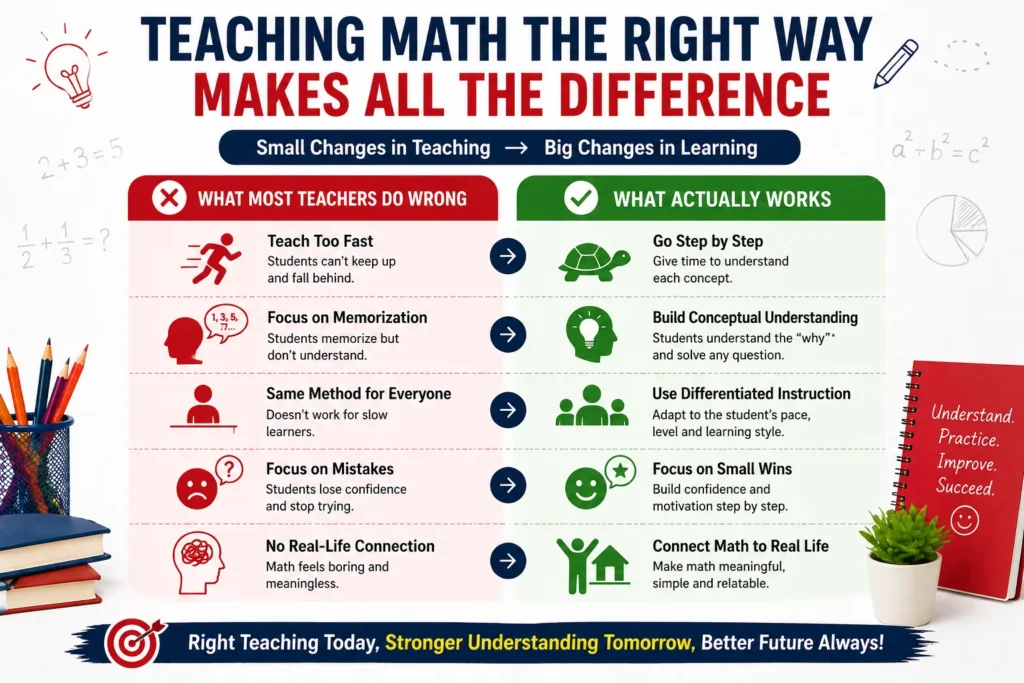
| Traditional Method | Effective Method |
| Memorization | Conceptual understanding |
| Fast teaching | Step-by-step learning |
| Same for all | Differentiated instruction |
| No feedback | Continuous feedback loop |
Real Experience
I once taught a student who used to say:
“Just tell me the formula.”
That’s all she relied on.
We stopped memorizing.
We started understanding.
At first, it felt slow.
But after a few weeks… she stopped asking for formulas.
She started solving on her own.
That’s when I knew the method worked
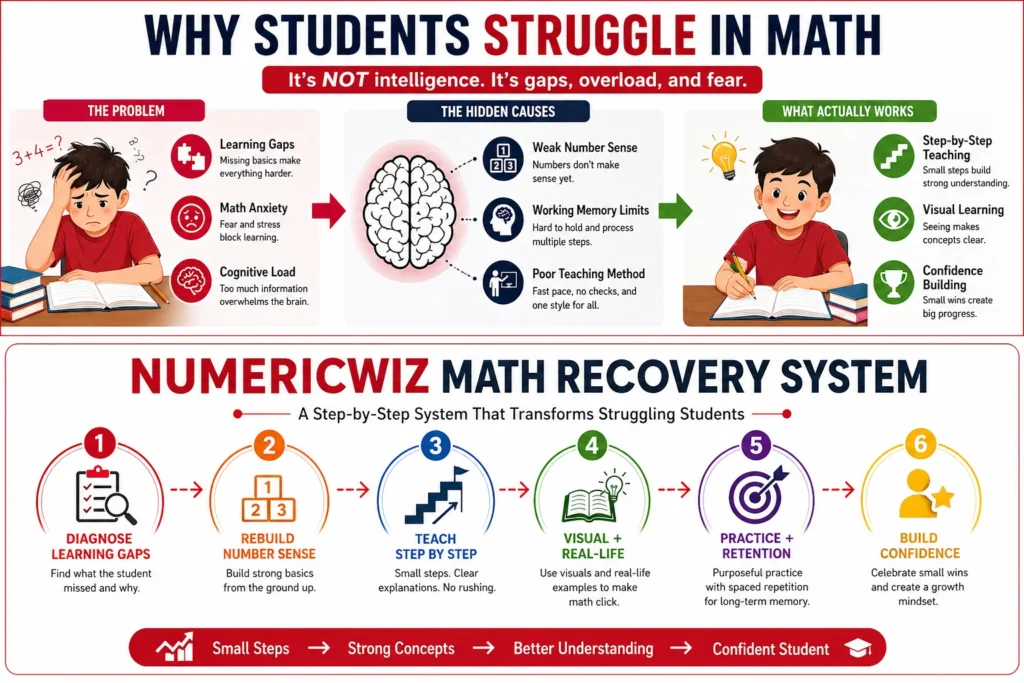
The NumericWiz Math Recovery System
Explore More: Why Students Struggle with Algebra? Common Causes, Misconceptions, and Solutions
I’ve seen this pattern too many times.
Students try harder.
Parents push more.
Teachers repeat again.
But nothing changes.
Why?
Because effort without a system leads to frustration.
The fastest way to improve struggling students is by following a structured system. When learning gaps are diagnosed, concepts are rebuilt step by step, and practice is designed for retention, students begin to understand, remember, and gain confidence. Random tips don’t fix long-term problems — structured systems do.
Step 1 – Diagnose Learning Gaps
Before teaching anything… stop and check.
Where is the student stuck?
Most people skip this step.
And that’s why progress stays slow.
Ask simple questions:
- Can they handle basic arithmetic operations?
- Do they understand place value?
- Can they explain their thinking?
I once had a student struggling with algebra.
After checking basics, we found the issue:
weak multiplication skills.
That’s how hidden learning gaps block everything.
Step 2 – Rebuild Number Sense
This is the foundation.
Without number sense, math feels like guessing.
Focus on:
- number line understanding
- place value clarity
- basic operations fluency
Use simple tools:
- counting blocks
- visual grouping
- real-life examples
When students start “feeling” numbers…
everything becomes easier.
Step 3 – Teach Concepts Step by Step
Now we build slowly.
No jumping ahead.
No rushing.
Break topics into:
- small lessons
- clear steps
- simple explanations
Let the student own each step before moving on.
This is where structured teaching changes results.
Step 4 – Visual + Real-Life Application
Students learn faster when math connects to life.
Instead of abstract problems…
Use:
- shopping examples
- time calculations
- everyday situations
Add visuals:
- diagrams
- models
- drawings
I’ve seen students understand fractions faster with pizza examples than textbooks.
That’s the power of visual learning + real-life connection.
Step 5 – Practice + Retention System
Understanding is not enough.
Students forget.
That’s where most teaching fails.
Use:
- spaced practice
- repeated exposure
- mixed questions
For example:
Teach today → revise tomorrow → revisit after 3 days
This strengthens retention strategies.
Step 6 – Confidence Building System
This step changes everything.
Without confidence, learning stops.
Focus on:
- small achievements
- positive feedback
- safe environment
Never rush.
Never compare.
I’ve seen students go from silent to confident just because they felt safe making mistakes.
Confidence is not a bonus. It’s a requirement.
Competitors vs NumericWiz System
| Competitors | NumericWiz System |
| Random tips | Structured system |
| No clear flow | Step-by-step roadmap |
| Same for all | Adaptive learning |
| No retention focus | Practice + memory system |
Real Experience
One student I worked with failed math for two years.
We didn’t start with formulas.
We started with number sense.
Then step-by-step learning.
Then structured practice.
Within 3 months, grades improved.
But more importantly…
The student stopped saying:
“I hate math.”
That’s when I knew the system works.
Teaching Math Without Memorization (Game-Changer Section)
I’ve heard this so many times:
“Just tell me the formula.”
And honestly… that’s where things start going wrong.
Because the moment a student depends only on memory, they’re one step away from forgetting everything.
Students learn math faster and more deeply when they understand patterns and logic instead of memorizing formulas. When concepts make sense, students can solve new problems, adapt to different questions, and retain knowledge longer. Memorization may help short-term, but understanding builds long-term success.
Why Memorization Fails in Math
Memorization feels easy at first.
But it doesn’t last.
1. No deep understanding
Students follow steps blindly.
If a question changes slightly… they get stuck.
2. Easy to forget
Formulas don’t stay forever.
I’ve seen students forget something they memorized just a day before.
3. No problem-solving ability
They can solve familiar questions.
But new problems?
That’s where everything breaks.
I once taught a student who memorized every formula in algebra.
But when I changed the numbers…
he couldn’t solve the question.
That’s when I realized — memory without understanding is fragile.
How to Teach Math Conceptually
So what actually works?
Shift from “remember this”
to “understand this”
Pattern recognition
Math is full of patterns.
Help students notice:
- what changes
- what stays the same
For example:
In multiplication, patterns repeat.
Once students see that…
they don’t need to memorize everything.
Logic-based learning
Ask questions like:
- Why does this step work?
- What happens if we change this value?
This builds thinking, not memorizing.
Problem-solving approach
Give slightly different questions.
Let students think.
Let them struggle a little — safely.
That’s how problem-solving skills grow.
Example-Based Learning Strategy
This is one of the simplest and most effective methods I’ve used.
Real-life problems
Instead of abstract numbers:
Use:
- money
- time
- daily situations
For example:
“Divide 10 candies among 5 kids”
Suddenly, division makes sense.
Relatable situations
Students connect faster when they see meaning.
I once explained fractions using pizza slices.
The student who struggled for weeks…
understood in minutes.
That moment sticks.
Memorization vs Understanding
| Memorization | Understanding |
| Short-term | Long-term |
| Fragile | Stable |
| Step-based | Logic-based |
| Easily forgotten | Easily applied |
Real Experience
There was a student who depended on formulas for everything.
Every question started with:
“Which formula should I use?”
We changed one thing.
Instead of giving answers, I asked questions.
Slowly… the student started thinking.
And one day, she solved a problem without asking.
That moment?
That’s real learning.
How to Build Math Confidence in Students
You can teach all the concepts in the world…
but if a student doesn’t believe they can do it, nothing sticks.
I’ve seen students who knew the method…
but still left questions blank.
Not because they didn’t understand.
Because they didn’t trust themselves.
Confidence in math builds when students experience small successes, receive consistent encouragement, and feel safe making mistakes. When fear is reduced and progress is visible, students begin to try more, think clearly, and stay engaged with learning instead of avoiding it.
Confidence Building Techniques
Confidence doesn’t appear suddenly.
It’s built step by step — just like math.
Celebrate small wins
Don’t wait for perfect answers.
Even partial understanding matters.
I remember a student who solved just one step correctly.
We paused. We acknowledged it.
That one moment changed how she approached the next question.
Small wins create momentum.
Remove fear from learning
Fear blocks thinking.
If a student is scared of being wrong…
they stop trying.
Create a space where mistakes are normal.
Say things like:
- “It’s okay to get it wrong.”
- “Let’s fix it together.”
That shift changes everything.
Use positive feedback consistently
Not just “good job.”
Be specific:
- “You understood the pattern correctly.”
- “Your first step was perfect.”
This builds clarity and confidence together.
Motivation Strategies
Confidence grows when effort feels worth it.
Simple rewards
Not big prizes.
Just small acknowledgments:
- stickers
- verbal praise
- progress tracking
Track progress visually
Show improvement.
Use:
- charts
- checklists
- before-and-after comparisons
When students see progress, they believe it.
Encouragement matters more than pressure
Pressure shuts students down.
Encouragement opens them up.
I’ve seen students improve more with support than with strict discipline.
Low Confidence vs High Confidence Student
| Low Confidence | High Confidence |
| Avoids math | Tries willingly |
| Fear of failure | Growth mindset |
| Gives up easily | Keeps trying |
| Needs constant help | Works independently |
Real Experience
There was a student who refused to answer any question.
Even when she knew the answer.
Every time I asked, she said:
“I’ll get it wrong.”
So we changed one thing.
We stopped focusing on correct answers.
We focused on effort.
Within weeks… she started raising her hand.
That’s when I realized:
Confidence is not built through perfection.
It’s built through safe learning.
Real Experience
You can read strategies all day…
but what really matters is this:
Does it actually work with real students?
I’ve worked with many students who were labeled “weak.”
Some had failed multiple tests.
Some had completely given up.
And almost every time… the story started the same way.
In real teaching practice, students improve when structured systems replace random methods. When teaching follows clear steps, uses visual support, and includes consistent feedback, students begin to understand concepts, retain them longer, and rebuild confidence through repeated success.
Case Study (Real Student Transformation)
I still remember one student clearly.
She had been failing math for nearly two years.
Every test ended the same way — low marks, low confidence.
She didn’t ask questions.
She avoided eye contact during lessons.
And the hardest part?
She believed she was “not a math person.”
We didn’t start with new topics.
We went back.
- We checked her learning gaps
- We rebuilt basics using number sense
- We used simple, step-by-step learning
At first, progress was slow.
Very slow.
But something started changing.
She stopped guessing.
She started thinking.
Within 2–3 months:
- Test scores improved
- Mistakes reduced
- Confidence increased
And one day, she said:
“I think I understand this now.”
That moment matters more than any grade.
What Actually Worked
Not magic.
Just the right approach.
Step-by-step teaching
No skipping.
No rushing.
Each concept was broken down clearly.
Visual learning support
We used:
- diagrams
- number lines
- simple drawings
Concepts became visible.
Not just words.
Consistent feedback
Every mistake was discussed.
Not judged.
That created a safe learning space.
Practice with purpose
Not random worksheets.
Focused practice:
- based on weak areas
- repeated over time
That improved retention.
Mini Breakdown: Before vs After
| Before | After |
| Avoided math | Participated actively |
| Guessing answers | Logical thinking |
| Low confidence | Growing confidence |
| Failing grades | Improved performance |
What I’ve Seen Over Time
This isn’t a one-time case.
I’ve seen this pattern again and again.
Students don’t suddenly become “good at math.”
They just finally get taught in a way that makes sense.
The truth is simple:
- Fix the learning gap
- Teach step by step
- Build confidence
And results follow.
FAQs
What is the best way to teach math to slow learners?
Teach step by step, focus on conceptual understanding, and use visual learning with consistent practice.
Why do some students struggle in math?
Because of learning gaps, math anxiety, weak number sense, and overloaded working memory.
How can I improve my child’s math skills at home?
Use short daily practice, revise concepts regularly, and support without pressure.
Is memorization good for learning math?
No, memorization alone fails; conceptual understanding and problem-solving work better.
How long does it take to improve in math?
With the right method, students usually show progress within 4–8 weeks.