
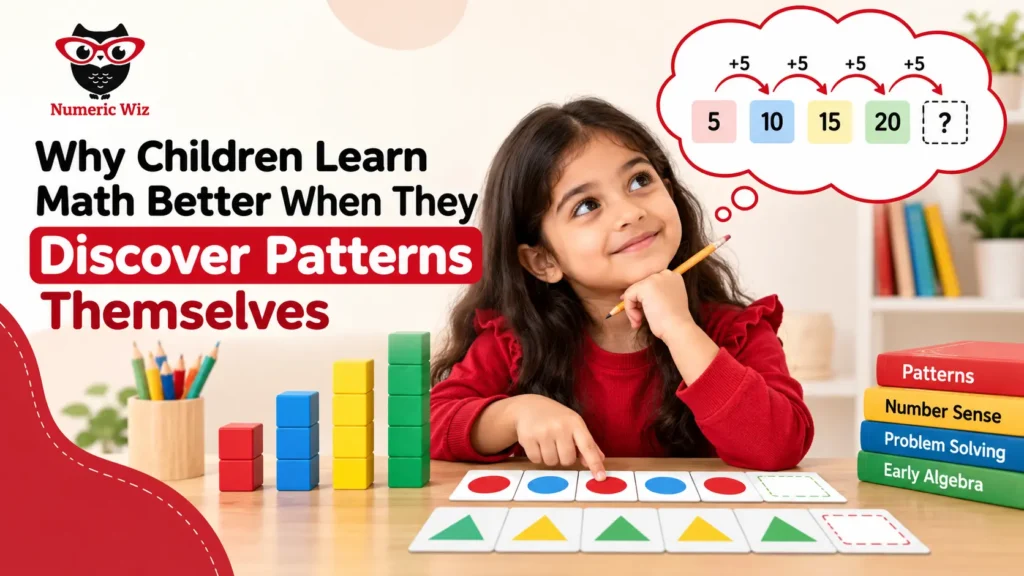
Have you ever watched a child solve five multiplication questions correctly, then freeze when the same idea appears in a slightly different problem?
The child may know the steps but not yet see the mathematical relationship behind them. That difference matters.
Children build stronger mathematical understanding when they learn to notice what changes, what stays the same, what might happen next, and why a relationship works. Instead of seeing every question as a new task, they start connecting new problems to ideas they already know.
Think about the sequence:
5, 10, 15, 20, 25…
A child could memorize those numbers. But a child who notices that each number increases by 5 has found something more useful: the rule connecting them.
That kind of thinking supports number sense, reasoning, problem-solving, prediction, and early algebraic thinking.
There’s an important catch. Children don’t need to be left alone with a difficult problem. Good guided learning means an adult provides examples, objects, pictures, hints, and thoughtful questions while giving the child enough space to think.
That’s where pattern-based math becomes powerful.
What Are Patterns in Math?
A mathematical pattern is a predictable relationship between numbers, shapes, objects, or other mathematical ideas. Children learn to identify what repeats or changes, describe the rule behind that relationship, predict what should happen next, and eventually apply the same rule in a new situation.
Many parents hear the word “pattern” and picture something like:
🔴 🔵 🔴 🔵 🔴 🔵
That’s a pattern, but mathematical patterns go much further.
A young child might work with:
▲ ● ▲ ● ▲ ●
Later, the same thinking appears in numbers:
2, 4, 6, 8, 10…
The child may notice:
“It goes up by 2 each time.”
As mathematics becomes more advanced, patterns appear in multiplication, place value, fractions, decimals, ratios, geometry, sequences, and algebra.
For example:
4 × 1 = 4
4 × 2 = 8
4 × 3 = 12
4 × 4 = 16
The child isn’t simply producing answers. They can begin noticing how the multiples of 4 are related.
Common Types of Math Patterns
Children may meet:
- Repeating patterns, such as red-blue-red-blue
- Growing patterns, where something increases each time
- Number patterns, such as 10, 20, 30, 40
- Shape patterns
- Skip-counting patterns
- Odd and even number patterns
- Multiplication patterns
- Place-value patterns
- Fraction and decimal relationships
- Geometric patterns
The real learning begins when a child moves beyond “What comes next?” and starts answering “How do you know?”
Why Is Pattern Recognition Important in Math?
Pattern recognition helps children notice relationships instead of treating every math question as an unrelated calculation. It supports prediction, number sense, logical thinking, mathematical reasoning, and problem-solving because children begin using what they already know to make sense of unfamiliar problems.
Consider:
7 + 3 = 10
17 + 3 = 20
27 + 3 = 30
37 + 3 = 40
A child can calculate each problem separately.
Or you can ask:
“What do you notice?”
Now the child has a reason to compare the calculations.
They might notice that the first number increases by 10, while adding 3 completes the next ten each time.
That observation turns four separate calculations into one connected mathematical idea.
Patterns Build Number Sense
Number sense means understanding how numbers relate to one another rather than seeing them as isolated symbols.
Suppose your child knows: 8 + 2 = 10
That relationship can help with: 18 + 2 = 20
and later:98 + 2 = 100
The known fact becomes a tool for thinking.
Patterns Support Prediction
Try: 6, 12, 18, 24, ___
Your child may answer 30.
Don’t stop there.
Ask: “How did you know?”
If the answer is, “Because we add 6 every time,” the child has identified the relationship rather than simply guessed the next number.
Patterns Strengthen Logical Thinking
Pattern work naturally encourages useful mathematical questions:
- What changed?
- What stayed the same?
- What comes next?
- What is the rule?
- Why does the rule work?
- Will it keep working?
These questions move attention away from speed and toward mathematical thinking.
Why Is Finding a Pattern Different From Memorizing a Rule?
Memorization helps children recall useful facts, while pattern-based learning helps them understand relationships between those facts. Children need both. The problem comes when memorized procedures replace understanding, because a child may know what steps to follow without knowing why those steps work or when to use them.
Take multiplication by 5.
A child could memorize: 5, 10, 15, 20, 25, 30…
That fluency is useful.
But ask:
“What do you notice about the last digit?”
The child may see that multiples of 5 end in 0 or 5.
Ask another question: “What happens when we add another group of 5?”
Now multiplication becomes a relationship between equal groups, repeated addition, skip counting, and number patterns.
The aim isn’t to choose between understanding and fluency.
Children benefit from conceptual understanding and procedural fluency working together.
| Memorizing a Procedure | Looking for Relationships |
| “Use this rule.” | “What do you notice?” |
| Recalls steps | Connects ideas |
| Focuses on the answer | Also asks why |
| May depend on memory | Can reason from known facts |
| Repeats a method | Tests whether a relationship works |
A child who understands a relationship has more than an answer. They have something they can use again.
What Happens When a Child Finds a Pattern?
Useful pattern learning usually moves through several stages: noticing a relationship, predicting what might happen next, testing that prediction, explaining the reasoning, forming a broader rule, and applying the idea somewhere else. Each stage asks the child to think rather than simply copy a procedure.
Here’s what that can look like.
1. Notice
Show: 3, 6, 9, 12, 15
Ask: “What do you notice?”
Perhaps the child says, “The numbers get bigger.”
That’s a start.
2. Predict
Ask: “What number might come next?”
The child predicts 18.
3. Test
Now ask: “How could we check?”
The child may count forward by 3.
4. Explain
Ask: “Why did you choose 18?”
A useful explanation might be:
“Every number is 3 more than the one before it.”
5. Generalize
Try: “If we keep going, what will the tenth number be?”
Now the child must use the relationship beyond the visible examples.
6. Apply
Finally, show: 4, 8, 12, 16…
Ask: “Is this pattern similar? What’s different?”
That final step matters because understanding becomes more useful when a child can use an idea in a new situation.
How Do Patterns Prepare Children for Algebra?
Patterns support early algebraic thinking because algebra is built around relationships, rules, unknown quantities, and generalization. Long before children work with variables such as x and y, they can learn to notice how quantities change and explain rules that work across many examples.
Algebra doesn’t suddenly begin when a letter appears in a textbook.
Look at: 4, 8, 12, 16, 20…
A child might say: “We add 4 each time.”
Now connect it to:
1 × 4 = 4
2 × 4 = 8
3 × 4 = 12
4 × 4 = 16
The child starts seeing a relationship between the position in the sequence and the value.
That is early algebraic thinking.
Later, the same habit helps students understand:
- multiplication rules
- equivalent expressions
- sequences
- variables
- functions
- proportional relationships
- equations
Early pattern work isn’t about teaching formal algebra to a five-year-old. It’s about building the habit of asking:
“What relationship connects these numbers?”
What Is Guided Pattern Learning?
Guided pattern learning gives children room to notice mathematical relationships while a parent or teacher provides carefully chosen examples, questions, visual models, or hints. The adult doesn’t simply announce every rule, but the child also isn’t expected to solve unfamiliar mathematics without appropriate support.
This balance matters. Suppose you’re teaching multiplication by 10.
You could simply say: “This is the rule. Memorize it.”
Instead, show:
2 × 10 = 20
4 × 10 = 40
7 × 10 = 70
13 × 10 = 130
Ask: “What do you notice about the answers?”
Then let your child explain.
If the child struggles, add another example or use base-ten blocks. A hint can keep the thinking moving without doing all the thinking for the child.
This is why guided learning shouldn’t be confused with giving no instruction.
The adult still teaches.
The difference is that the child gets a chance to notice, test, explain, and connect before a mathematical idea becomes another rule to memorize.
Why Does “How Did You Know?” Matter?
“How did you know?” asks a child to explain the thinking behind an answer. That explanation can reveal whether the child understands the mathematical relationship, used a useful strategy, guessed, or followed a procedure without understanding it. The answer gives parents and teachers far more information than correctness alone.
Imagine your child answers: 9 + 7 = 16
You could say: “Correct.”
Or you could ask: “How did you know?”
The child might reply: “I took 1 from 7 and gave it to 9. Then I had 10 + 6.”
Now you know the child used a make-10 strategy.
That’s valuable information.
Try questions such as:
- What do you notice?
- What changed?
- What stayed the same?
- What do you think comes next?
- Why do you think that?
- Can you show it with a picture?
- Can you solve it another way?
- Will that rule always work?
- How could you check your answer?
- Can you make your own example?
The goal isn’t to turn dinner into a math lesson.
One thoughtful question can be enough.
How Do Children Move From Objects to Abstract Math?
Children can build mathematical meaning by first working with objects and actions, then pictures and visual models, and later numbers and symbols. Moving gradually toward abstract notation helps connect a written expression to a relationship the child has already seen, touched, drawn, or explained.
Suppose you’re teaching an AB pattern.
1.Start With Objects
🔴 🔵 🔴 🔵 🔴 🔵
Use blocks, buttons, beads, toys, or household objects.
2.Try Movement or Sound
Clap, tap, clap, tap.
Your child experiences the same structure in a different form.
3.Move to Pictures
▲ ● ▲ ● ▲ ●
The objects have changed, but the relationship hasn’t.
4.Move to Numbers
2, 4, 2, 4, 2, 4
Now the pattern is represented symbolically.
Later, number patterns can become more complex:
5, 10, 15, 20, 25
The child moves from handling objects to reasoning about numerical relationships.
That progression can make abstract mathematics feel less like a collection of mysterious symbols.
How Can Parents Teach Math Patterns at Home?
Parents can teach mathematical patterns through ordinary routines, toys, movement, food, music, calendars, and games. The most useful activity isn’t necessarily the fanciest one. What matters is giving the child something worth noticing and asking questions that encourage prediction, explanation, comparison, and reasoning.
Your home already contains plenty of mathematics.
1.LEGO or Building Blocks
Build:
red, yellow, red, yellow…
Then ask your child to continue it.
For an older child, build towers of:
2 blocks, 4 blocks, 6 blocks, 8 blocks…
Ask what the next tower might look like.
2.Stairs
Count: 2, 4, 6, 8…
while walking up the stairs.
Change the starting number and see what happens.
3.Music
Try:
clap, clap, tap, clap, clap, tap
Ask your child to repeat and extend the rhythm.
4.Calendar
Look at dates that fall on the same weekday.
Ask:
“What do you notice about the numbers?”
5.Cooking
Recipes provide natural opportunities to discuss quantity, groups, fractions, measurement, and proportional relationships.
6.Shopping
Ask:
“If one pack has 6 juice boxes, how many would two packs have?”
The multiplication relationship now has a purpose.
7 Simple Pattern Activities for Kids
Pattern activities work best when children do more than copy a sequence. Ask them to extend, explain, correct, create, and transfer a pattern.
1. What Comes Next?
Show:
3, 6, 9, 12, ___
Ask for the next number and the reason.
2. Find the Missing Part
Try:
5, 10, __, 20, 25
Your child must use both sides of the sequence.
3. Build My Pattern
Start:
🔴 🔴 🔵 🔴 🔴 🔵
Ask your child to continue it with objects.
4. Spot My Mistake
Write:
4, 8, 12, 17, 20
Ask:
“Something looks wrong. Can you find it?”
Error analysis makes the child inspect the relationship rather than simply continue it.
5. Make Your Own
Let your child create a pattern for you.
Then make a deliberate mistake and ask them to explain it.
6. Find the Rule
Write:
20, 18, 16, 14, 12
Ask:
“What’s happening each time?”
7. Same Pattern, Different Form
Show: 🔴 🔵 🔴 🔵
Then: 👏 🦶 👏 🦶
Ask: “How are these two patterns alike?”
The objects are different, but the underlying structure is the same.
What Math Patterns Are Suitable for Different Ages?
Pattern work should become more mathematically demanding as children’s understanding grows. Young children can begin with repeating objects, sounds, and movements. Older children can examine number relationships, multiplication, fractions, factors, ratios, and sequences. Age ranges are useful guides, not fixed deadlines for every learner.
| Approximate Age | Useful Pattern Experiences |
| 3-5 | Colors, shapes, sounds, movements, repeating objects |
| 5-7 | Number patterns, counting, odd/even numbers, simple growing patterns |
| 7-9 | Skip counting, multiplication, place value, fact families, geometric patterns |
| 9-11 | Factors, multiples, fractions, decimals, complex number patterns |
| 11-14 | Integers, ratios, exponents, sequences, proportional relationships, early algebra |
A child doesn’t need to rush through these stages.
Look at what the child can explain, not just what they can complete.
What Should You Do If Your Child Cannot See the Pattern?
If your child can’t identify a pattern, make the relationship easier to see instead of immediately giving the rule. Use fewer terms, concrete objects, color, a number line, or a smaller example. Then ask one focused question at a time and gradually reduce the support as understanding improves.
Suppose this feels difficult:
24, 30, 36, 42, 48
Try:
6, 12, 18, 24
Still difficult?
Use six counters at a time:
●●●●●●
then another group of six.
Now ask:
“How many did we add?”
The issue may not be effort. The child may simply need a clearer representation.
Useful prompts include:
- “Look at these two numbers. What changed?”
- “Can we build it with blocks?”
- “Can we draw it?”
- “Can we start with an easier example?”
- “What happens from this number to the next?”
Give enough help to restart the thinking, but leave something for the child to solve.
What Mistakes Do Parents Make When Teaching Patterns?
Common mistakes include revealing the rule too quickly, asking only what comes next, using the same simple pattern repeatedly, focusing on speed, correcting every error immediately, or giving too little guidance. Better pattern learning gives children time to notice relationships while still providing clear support when needed.
Giving the Rule Too Soon
If you immediately say:
“Add 4 every time.”
the child has little reason to inspect the numbers.
Give them a moment first.
Asking Only “What Comes Next?”
A child might correctly continue:
2, 4, 6, 8, 10
without being able to explain the rule.
Follow with:
“How did you know?”
Staying With AB Patterns Too Long
Red-blue-red-blue is useful for beginners.
Children should later meet growing, shrinking, numerical, spatial, and relational patterns.
Correcting Too Quickly
A wrong answer can become a useful question:
“How could we check that?”
This keeps attention on reasoning.
Making Everything About Speed
Fast answers don’t always show deep understanding.
Sometimes a child who pauses, draws, checks, and explains is doing richer mathematical work than a child who answers immediately.
Can Play Help Children Learn Math?
Purposeful play can create natural opportunities for children to count, sort, compare, build, measure, predict, and recognize patterns. The mathematical value grows when an adult adds a simple question such as “What do you notice?” or “What would happen next?” without taking control of the activity.
A tower-building game can include:
- counting
- comparison
- height
- shape
- symmetry
- repeated structures
- growing patterns
A pretend shop can include:
- addition
- subtraction
- money
- groups
- quantities
- comparison
A bead activity can involve:
- counting
- repeating patterns
- classification
- prediction
Play doesn’t need to look like a formal lesson to contain mathematics.
A small question can turn play into a moment of mathematical thinking.
Where Do Patterns Appear Across Mathematics?
Patterns appear throughout mathematics, not only in early childhood activities.
| Math Area | Relationship Children Can Notice |
| Addition | Number bonds, make-10 relationships |
| Subtraction | Connection with addition |
| Multiplication | Equal groups, repeated relationships |
| Division | Connection with multiplication |
| Place Value | Groups of ones, tens, hundreds |
| Fractions | Equivalent fraction relationships |
| Decimals | Place-value relationships |
| Factors | Numbers that multiply to form a product |
| Multiples | Repeated multiplication patterns |
| Geometry | Symmetry, shape and transformations |
| Ratios | Equivalent relationships |
| Algebra | Sequences, variables and rules |
This is why pattern thinking shouldn’t disappear once children leave kindergarten.
The patterns simply become less obvious.
Do Patterns Help With More Advanced Math?
Pattern thinking supports later mathematics because students increasingly work with relationships rather than isolated calculations. Multiplication, fractions, ratios, proportional reasoning, sequences, functions, equations, and algebra all require learners to notice how quantities relate and to apply mathematical rules across different situations.
Consider equivalent fractions: 1/2 = 2/4 = 3/6 = 4/8
A child who looks only at the numbers sees several fractions.
A child looking for structure may notice that the numerator and denominator change together.
Or consider:2, 6, 18, 54…
An older learner can ask:
“How is each term connected to the one before it?”
That same habit becomes increasingly important in algebra and functions.
Pattern activities don’t guarantee future success by themselves. They are one part of building.
A 10-Minute Math Pattern Routine for Home
You don’t need an hour-long lesson. A short routine can give your child time to notice, test, and explain one mathematical relationship.
Minutes 1-2: Show a pattern
Example:
7, 14, 21, 28…
Minutes 3-4: Ask what they notice
Don’t correct immediately.
Listen first.
Minutes 5-6: Ask for a prediction
“What might come next?”
Then ask why.
Minutes 7-8: Test the idea
Use multiplication, addition, counters, a drawing, or a number line.
Minutes 9-10: Create something new
Ask your child to make another pattern using the same idea.
Ten thoughtful minutes can be more useful than a long page of questions completed without thinking about the relationships behind them.
When Should a Parent Step In?
Step in when your child no longer has a useful way to approach the problem, not simply because they haven’t answered quickly. A small hint, easier example, picture, object, or focused question can restart the thinking while still allowing the child to complete the important reasoning.
There’s a difference between thinking hard and being completely stuck.
A child who is trying examples, drawing pictures, checking answers, or changing strategies is still working mathematically.
A child who has no starting point may need support.
Instead of solving the problem, try:
“Can we make the numbers smaller?”
or:
“Could you draw what is happening?”
or:
“Which part do you already understand?”
Your job isn’t to remove every difficult moment.
It’s to make the next step reachable.
Be a Question-Asker, Not an Answer-Giver
A small change in language can change the whole math conversation.
Instead of “Here’s how you do it.”
try: “What do you notice?”
Instead of: “No, that’s wrong.”
try:“How could we check it?”
Instead of:“Just use the rule.”
try: “What relationship can you see?”
And instead of asking only:“What’s the answer?”
sometimes ask: “Why does your answer make sense?”
Children still need instruction, practice, correction, and fluency. But they also need chances to think.
That’s how mathematics begins to feel less like a list of rules and more like a connected system that makes sense.
Frequently Asked Questions
Why are patterns important in mathematics?
Patterns help children notice relationships between numbers, shapes, and quantities. They support number sense, prediction, reasoning, and problem-solving. As children progress, the same way of thinking helps them understand multiplication, fractions, ratios, sequences, equations, and algebra.
What is pattern recognition in math?
Pattern recognition is the ability to notice a regular relationship and identify the rule behind it. For example, a child may notice that 4, 8, 12, 16 increases by 4 each time and use that relationship to predict what comes next.
How does pattern recognition help children learn math?
Pattern recognition helps children connect new problems to mathematical relationships they already understand. Instead of treating every calculation as a separate problem, they can use known number facts and structures to predict, check, and explain new ideas.
How do patterns help children learn algebra?
Patterns introduce children to the relational thinking used in algebra. They learn to identify what changes, describe a rule, predict unknown values, and use that rule in new situations. These skills later support sequences, variables, equations, proportional relationships, and functions.
Is pattern-based learning better than memorization?
Children need both understanding and memory. Pattern-based learning helps them understand why mathematical relationships work, while practice helps useful facts become easier to recall. A balanced approach connects conceptual understanding with enough practice to build reliable math fluency.
How can parents teach math patterns at home?
Parents can use blocks, toys, stairs, rhythms, food, calendars, and everyday numbers to create simple math patterns. Ask your child what they notice, what might come next, and why. As their understanding grows, move from physical objects to pictures, numbers, and more abstract relationships.
What should I do if my child cannot recognize a number pattern?
Make the pattern simpler and easier to see. Try fewer numbers, counters, blocks, colors, drawings, or a number line. Ask what changes between two neighboring terms instead of giving the whole rule. Once your child sees the relationship, gradually return to the original problem.
At what age do children start recognizing patterns?
Children can begin noticing simple repeating patterns during the early years through colors, sounds, movements, and objects. As their mathematical understanding grows, they can work with number patterns, growing patterns, multiplication relationships, fractions, and eventually algebraic patterns.
Can learning through play improve mathematical thinking?
Purposeful play can give children natural opportunities to count, sort, compare, build, measure, predict, and notice relationships. Parents can make these experiences more mathematically meaningful by asking simple questions such as “What do you notice?” and “What do you think comes next?”
Need Practice material?
Explore our Common Core aligned Worksheets designed by the experts.