
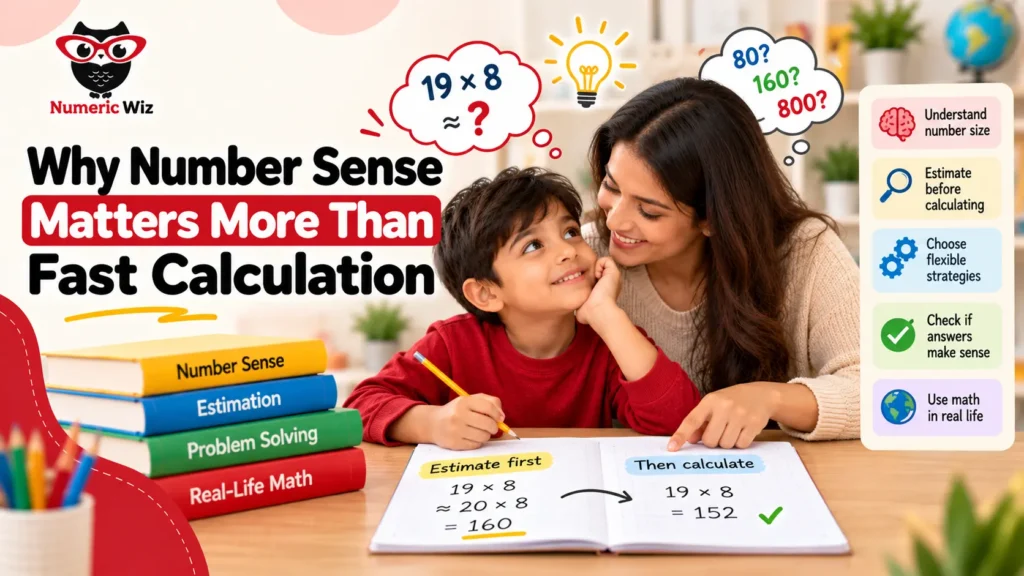
Your child answers 7 × 8 = 56 almost instantly. That looks impressive.
But then you ask, “Is 19 × 8 closer to 80, 160, or 800?” and they hesitate.
This difference matters.
Fast calculation tells you how quickly a child can produce an answer. Strong number sense helps a child understand whether that answer makes sense, how numbers relate to one another, and which strategy might work best.
Speed and accuracy still matter. Children need mathematical facts and efficient calculation methods. But speed alone is not the same as mathematical understanding.
One of the simplest ways to strengthen that understanding is to ask children to estimate before they calculate.
Research on number sense and mathematics shows that the relationship is complex, but skills involving numerical magnitude and estimation are associated with broader mathematical performance. Studies also suggest that understanding numerical magnitude across forms such as fractions, decimals, and percentages is related to mathematics achievement. So instead of always asking:
“How quickly can you get the answer?”
try asking: “About what should the answer be?”
That small change can tell you a great deal about how your child is thinking.
What Is Number Sense?
Number sense is a child’s understanding of numbers, quantities, magnitudes, and the relationships between them. It helps children think flexibly rather than seeing every math problem as a separate calculation.
A child with developing number sense begins to understand ideas such as:
- 49 is very close to 50.
- 198 is almost 200.
- 75 is three quarters of 100.
- 6 × 19 should be a little less than 6 × 20.
- 398 + 205 should be somewhere around 600.
- 0.5, 50%, and 1/2 represent the same quantity.
This understanding gives numbers meaning.
For example, suppose your child calculates: 198 + 203 = 4,001
A child focused only on carrying out a procedure might move on.
A child who first thinks 200 + 200 ≈ 400 has an immediate warning: “4,001 can’t be right.”
That ability to judge magnitude and reasonableness is an important part of mathematical thinking.
Is Being Fast at Math the Same as Being Good at Math?
No. Calculation speed is one useful part of mathematical fluency, but it doesn’t show everything a child understands about numbers.
Consider these two questions: 8 × 7 = ?
And About how much is 79 × 7?
A child may have memorized that 8 × 7 = 56 and answer immediately.
The second problem requires something different.
The child might reason: 79 is close to 80.
80 × 7 = 560.
So: 79 × 7 should be slightly less than 560.
The exact answer is 553.
The child has used estimation, place value, multiplication facts, magnitude, and reasoning together.
Fast recall is valuable. The goal isn’t to make children calculate slowly. The goal is to make sure speed grows alongside understanding.
Speed vs. Number Sense
| Fast Calculation May Show | Number Sense May Show |
| Fact recall | Understanding quantity |
| Procedural fluency | Number relationships |
| Calculation efficiency | Flexible strategy choice |
| Quick answers | Estimation |
| Practice with familiar questions | Reasonableness checking |
| Automaticity | Understanding magnitude |
A strong math learner eventually needs both.
Why Should Children Estimate Before They Calculate?
Estimating before calculating gives children an expected range for the answer. That expectation can help them choose a strategy and notice an unreasonable result.
Estimation isn’t simply guessing.
A useful estimate draws on what a child already knows about numbers, quantities, place value, measurement, and operations. Early-mathematics guidance similarly describes estimation as a reasonable response based on existing conceptual and factual knowledge rather than a random guess.
Try:297 + 406
Before calculating exactly, ask: “About how much?”
Your child might think: 300 + 400 = 700
Now calculate: 297 + 406 = 703
The estimate gave the child a benchmark.
This is one reason estimation can be more valuable than treating it as a separate worksheet exercise. It can become part of the child’s normal problem-solving process.
The Teacher Studio makes a similar distinction, arguing that estimation is especially useful for checking reasonableness, rather than simply filling an “estimate” box on a worksheet.
Estimation Is Not the Same as Rounding
Parents and children often use estimation and rounding as if they mean exactly the same thing.
They don’t.
Rounding is one method that can be used to make an estimate. Estimation is the broader process of finding a reasonable approximate value.
Suppose you need an approximate answer for: 48 + 23
You could round: 50 + 20 = 70
But you don’t always have to follow a formal rounding rule.
You can also choose compatible numbers, nearby numbers that are easier to calculate mentally.
The important question is: “What nearby numbers make this problem easier while keeping my answer reasonable?”
That requires more thought than simply applying a memorized rounding rule.
How Does Estimation Build Number Sense?
Estimation makes children think about the size of numbers before focusing on an exact answer.
Take: 51 × 9
Instead of immediately using a written method, ask:
Is the answer closer to 50, 500, or 5,000?
A child doesn’t need the exact product to eliminate 50 and 5,000.
They can reason: 50 × 10 = 500
Therefore, 51 × 9 should also be around 500.
The exact answer is 459.
This kind of thinking helps children develop a sense of scale and magnitude.
Meaningful Math similarly connects estimation with flexible thinking about quantities, magnitude, number relationships, and deciding whether answers are reasonable.
That matters because mathematics isn’t only about producing exact answers. Children also need to know what those answers mean.
Why “Does This Answer Make Sense?” Is Such a Powerful Question
This question teaches children to check mathematics using reasoning rather than depending only on the calculation they just performed.
Imagine your child solves: 48 × 6 = 2,880
Instead of immediately saying, “That’s wrong,” ask: “Does 2,880 make sense?”
If they aren’t sure, follow with: “What is 50 × 6?”
They know: 50 × 6 = 300
Now 2,880 looks unreasonable. This is an important habit.
A calculator can produce an incorrect result when the wrong numbers or operations are entered. A written algorithm can also produce a wrong answer after a small place-value error.
Number sense gives children another layer of checking.
Estimation can be useful before, during, and after calculation: to anticipate an answer, monitor whether a calculation appears reasonable, and check the final result.
What Does Strong Number Sense Look Like?
Number sense doesn’t have one single test.
You can often see it in the way a child talks about and works with numbers.
A child developing strong number sense may be able to:
- Compare numbers without calculating everything.
- Tell whether an answer is reasonable.
- Break numbers into useful parts.
- Use benchmark numbers such as 5, 10, 50, 100, 1/2, and 1.
- Move between different representations of the same quantity.
- Find more than one way to solve a problem.
- Estimate quantities and calculations.
- Explain why one number is larger or smaller.
- Notice relationships between operations.
- Use known facts to work out unfamiliar facts.
For example: 19 + 36
One child may use the standard written method.
Another may think: 20 + 36 = 56
56 − 1 = 55
Both can be valid.
The second method shows the child is using the relationship between 19 and 20 to simplify the calculation mentally.
Why Flexible Calculation Matters
Flexible calculation means choosing a method that fits the numbers instead of using the same procedure for every problem.
Consider: 99 + 37
A child could use column addition.
But another possibility is: 100 + 37 = 137
137 − 1 = 136
Now consider: 25 × 16
A child might notice: 25 × 4 = 100
And 16 = 4 × 4
So: 25 × 16 = 100 × 4 = 400
This doesn’t mean children shouldn’t learn standard algorithms.
They should.
But children also benefit from seeing that numbers can be composed and decomposed in useful ways. Place-value understanding supports seeing a number in different equivalent forms, which in turn supports reasoning, estimation, and flexible calculation.
Why Number Lines Are So Useful for Number Sense
A number line makes magnitude visible.
Ask a child where 47 belongs on a line from 0 to 100.
A child who understands magnitude should recognize that 47 is:
- less than 50,
- close to the midpoint,
- much farther from 0 than from 50.
Now ask where 0.48 belongs between 0 and 1.
Later, you can place: 1/2, 0.5, and 50%
at the same location.
These representations help children see that mathematical symbols can look different while describing the same quantity.
Research with children has found associations between symbolic number-line estimation and broader mathematics achievement, although number sense is multifaceted and the strength of these relationships varies depending on the skill and measure being studied.
Why Number Sense Becomes Even More Important With Fractions and Decimals
Whole-number procedures can sometimes hide weak understanding.
Fractions often expose it.
Ask: Which is larger: 3/4 or 5/8?
A child might try to remember a procedure immediately.
But number sense offers another route.
3/4 = 0.75
5/8 = 0.625
Or compare both fractions with the benchmark 1/2.
Similarly, a child should gradually recognize: 1/2 = 0.5 = 50%
These aren’t three unrelated facts.
They are three representations of the same magnitude.
Research involving students in Grades 6–8 found that accurately comparing magnitudes within and across fractions, decimals, and percentages was associated with broader mathematics achievement. The authors also noted that this integrated understanding did not simply improve with grade level in their samples.
How Can Parents Build Number Sense at Home?
You don’t need a long lesson. Short conversations about everyday quantities can give children useful opportunities to estimate, compare, explain, and check.
The key is not simply asking for more answers.
Ask for thinking.
Instead of: “What’s 39 + 62?”
occasionally ask: “Will the answer be more or less than 100?”
Instead of: “How many grapes are there?”
Ask: “Do you think there are closer to 20 or 50 grapes?”
Instead of: “Calculate the total cost.”
Ask: “About how much do you think we’ll spend?”
For young children who aren’t yet comfortable estimating quantities, begin with small amounts they can visualize. Counting With Kids recommends questions such as whether a quantity is more or less than a given number, or which of two numbers it is closer to, followed by asking the child to explain the choice.
7 Simple Number Sense Activities to Try at Home
1. Estimate the Jar
Put a small number of buttons, blocks, pasta pieces, or counters into a transparent container.
Ask: “About how many do you think are inside?”
For younger children, give a choice: “Is it closer to 10 or 30?”
Then count and compare.
Don’t make the goal “Who guessed exactly?”
Ask: “What helped you make your estimate?”
2. Grocery Basket Estimate
Choose several grocery items.
Suppose they cost: $4.20, $6.75, and $8.10
Before finding the exact total, ask: “About how much will these cost altogether?”
Your child might think: $4 + $7 + $8 ≈ $19
Estimation has clear real-world uses in situations such as shopping, time, measurement, and planning.
3. Which Is Closer?
Ask: 47 is closer to 40 or 50?
Then: 147 is closer to 100 or 200?
Later: 0.48 is closer to 0, 1/2, or 1?
Don’t stop at the answer.
Ask: “How do you know?”
4. Estimate Before Measuring
Point to a table.
Ask: “About how long do you think it is?”
Then measure it.
You can repeat this with height, distance, mass, capacity, and time.
Estimating before measuring helps children think about unit size and scale, then compare their expectation with an actual measurement.
5. Find the Unreasonable Answer
Give your child: 61 × 5 = 3,050
Ask: “Could this answer be reasonable?”
They might use: 60 × 5 = 300
So 3,050 is far too large.
This turns error checking into reasoning.
6. Find Another Way
Give: 49 + 28
Ask: “Can you solve it without column addition?”
Possible thinking: 50 + 28 = 78
78 − 1 = 77
Then ask: “Can you find another way?”
The purpose isn’t to force a particular strategy. It is to help your child see that numbers can be rearranged and broken apart in useful ways.
7. About How Many?
Use everyday objects.
Ask:
- About how many books are on this shelf?
- About how many steps to the gate?
- About how many minutes will this task take?
- About how many cups will fill this jug?
- About how much will these items cost?
Then check.
Children gradually learn that an estimate is informed, not random. Counting With Kids similarly recommends discussing the estimate after counting so children can consider how close it was and why.
Number Sense Activities by Age
The difficulty should grow with the child’s mathematical experience.
| Stage | Useful Number-Sense Experiences |
| Early years | Compare small groups, estimate small quantities, count objects, use “more,” “less,” “about,” and “close to” |
| Early elementary | Number lines, make 10, place value, skip counting, estimate sums, compare two-digit numbers |
| Upper elementary | Compatible numbers, multiplication estimates, fraction benchmarks, measurement estimates, mental strategies |
| Middle school | Fraction-decimal-percent comparisons, integer magnitude, proportional reasoning, percent estimates, checking calculator answers |
These aren’t strict age boundaries.
A child who struggles with a concept may benefit from returning to simpler quantities, visual models, or concrete objects before moving forward.
Early-estimation guidance also recommends beginning with concrete comparisons such as height, weight, or groups of objects and then checking the estimate.
What If My Child’s Estimates Are Always Wrong?
Don’t focus first on getting the estimate closer. Find out how your child chose it.
Suppose there are about 40 objects in a jar and your child says:
“500.”
Instead of saying: “That’s way off.”
Ask: “What made you choose 500?”
Then provide a useful reference.
Show 10 objects.
Ask: “If this is 10, does the jar look like about 5 groups of 10 or 50 groups of 10?”
Now the child has a benchmark.
Estimation takes practice and does not necessarily develop automatically. Starting with smaller quantities children can visualize and asking them to explain their reasoning can make the idea of “about how many” clearer.
Common Mistakes Parents Make When Practicing Number Sense
Turning Every Activity Into a Speed Test
A timer can be useful for some fluency practice.
It shouldn’t define every math experience.
Children also need time to compare, estimate, explain, and try different strategies.
Correcting Too Quickly
If your child says:
“198 + 205 is about 4,000,”
don’t immediately supply the answer.
Ask:
“198 is close to what friendly number?”
This gives the child a chance to reconsider the magnitude.
Treating Estimation as Random Guessing
Ask for a reason.
“Why did you choose 50?”
The explanation matters.
Teaching Rounding as the Only Estimation Strategy
Rounding is useful, but children can also use compatible numbers, benchmarks, front-end thinking, known facts, and comparisons depending on the problem. Rounding is one route to an estimate, not the entire idea of estimation.
Always Asking for Exact Answers First
Sometimes reverse the order.
Estimate → Calculate → Compare
That sequence gives the child something meaningful to compare the exact answer with.
Should Children Use Calculators If Number Sense Is Important?
Yes. Calculator use and number sense aren’t opposites. Children need to learn when a calculator is useful and how to judge the answer it produces.
Suppose a child enters a grocery calculation and gets: $1,847.50
for five inexpensive items.
The calculator performed the entered operation.
The child still needs to ask:
“Does that total make sense?”
Estimation can help.
If each item costs roughly $5 to $15, a total near $1,800 should immediately look suspicious.
Technology can perform calculations quickly.
It cannot replace the child’s responsibility to interpret the result.
Does Number Sense Mean Children Don’t Need Math Facts?
No. Number sense and fact fluency support each other.
Knowing facts efficiently reduces the amount of mental effort needed for basic calculations.
But facts become more useful when children also see their relationships.
If your child knows:
6 × 8 = 48
they can reason:
12 × 8 = 96
because 12 is double 6.
They can also reason:
6 × 9 = 54
because it is one more group of 6.
This is different from treating every multiplication fact as an isolated piece of information.
The goal is not: understanding instead of fluency or fluency instead of understanding.
A stronger goal is: understanding + useful strategies + accurate practice + increasing fluency.
A 10-Minute Number Sense Routine for Home
You don’t need another hour of homework.
Try this short routine.
Minutes 1–2: Estimate
Give one problem.
About how much is 198 + 407?
Don’t calculate exactly yet.
Minutes 3–4: Explain
Ask:
“Why is your estimate reasonable?”
Minutes 5–6: Calculate
Now find the exact answer.
198 + 407 = 605
Minutes 7–8: Compare
Ask: “How close was your estimate?”
If the estimate was 600, discuss why it worked.
Minutes 9–10: Change the Problem
Try: 198 + 807
Ask: “Can you use the same thinking?”
This keeps the focus on relationships rather than completing a long page of nearly identical calculations.
Questions That Build Better Number Sense
You don’t always need another worksheet.
Sometimes you need a better question.
Try asking:
- About how much should the answer be?
- Is your answer reasonable?
- Which number is it closest to?
- How do you know?
- Can you solve it another way?
- What number could make this easier?
- What do you notice about these numbers?
- Which answer is impossible?
- Can you find a benchmark?
- What would happen if this number doubled?
These questions shift attention from answer production toward number relationships and reasoning.
Frequently Asked Questions
Is number sense more important than calculation speed?
Number sense and calculation fluency serve different purposes. Speed can help children work efficiently, while number sense helps them understand quantities, relationships, magnitude, and whether an answer is reasonable. Strong mathematics learning should develop both rather than treating speed as the main sign of ability.
What is an example of number sense?
A child sees 98 + 51 and thinks the answer should be around 150 because 98 is close to 100 and 51 is close to 50. That shows understanding of magnitude and number relationships before exact calculation.
Why is estimation important for children?
Estimation helps children think about approximate quantities, choose useful benchmarks, make real-world decisions, and check whether calculated answers make sense. It can be used before, during, and after exact calculation.
Is estimation just guessing?
No. A useful estimate is an informed approximation based on what a child knows about quantities, numbers, measurement, or the situation. Young children often need repeated experiences before this distinction becomes clear.
What is the difference between rounding and estimation?
Rounding changes a number to a nearby benchmark according to a specified place value. Estimation is the broader process of finding an approximate value. Rounding is therefore one strategy that can be used when estimating.
How can I improve my child’s number sense?
Use short daily activities involving comparison, estimation, number lines, mental math, measurement, decomposition, and real-life quantities. Ask your child to explain how they know rather than focusing only on whether the final answer is correct.
Should my child estimate before every math problem?
Not necessarily. The goal is for children to learn when estimation is useful. It is particularly valuable when they need to predict the size of an answer, check reasonableness, make a quick decision, or decide whether an exact calculation is necessary.
At what age should children learn estimation?
Children can begin with simple estimation experiences in the early years, such as comparing small quantities, lengths, or weights and then checking them. The strategies can become more numerical and sophisticated as children’s counting, number sense, and mental computation develop.
Help Your Child Think About Numbers, Not Just Answers
A child who calculates quickly has developed a useful skill.
But mathematics asks for more than speed.
Children need to understand how large numbers are, how numbers relate, which strategies fit a problem, whether an estimate is sensible, and whether a final answer is reasonable.
That’s why a question as simple as:
can be so useful.
Try asking it before the next calculation.
Then follow with:
You may learn more about your child’s mathematical thinking from those two questions than from the speed of the final answer.
Need Practice material?
Explore our Common Core aligned Worksheets designed by the experts.