
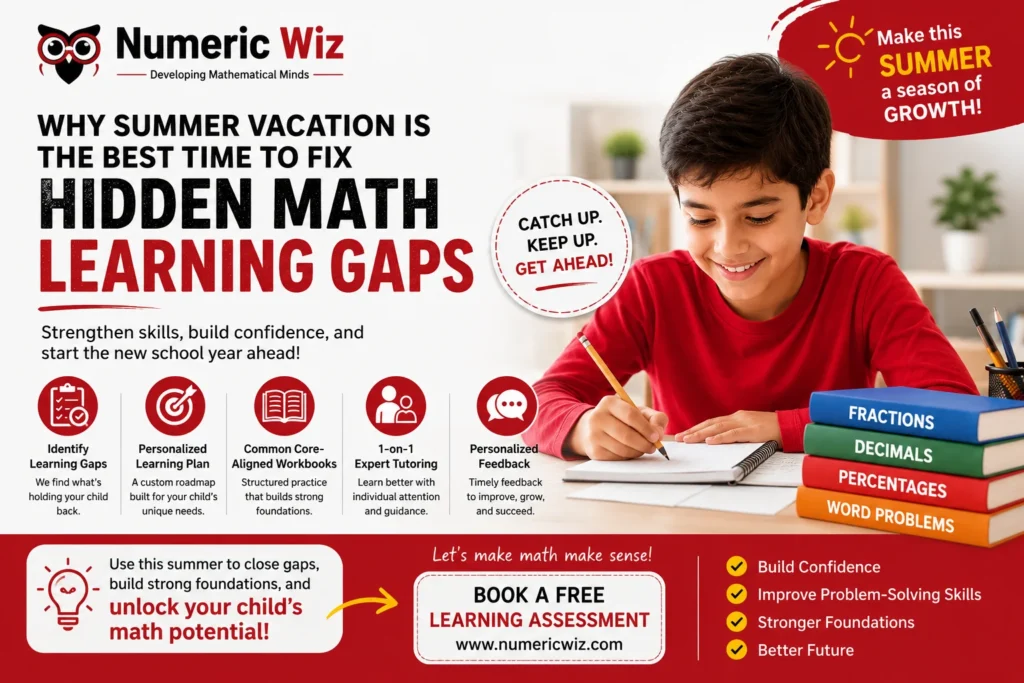
Summer vacation is often seen as a time for rest, family trips, and fun activities. After a busy school year, every child deserves a break. However, summer can also become a time when important math skills slowly fade away.
Many parents are surprised to learn that students can forget a significant amount of what they learned during the school year if they do not continue practicing. Even students who earned good grades may return to school feeling less confident and struggling to remember key concepts.
The good news is that summer vacation can be more than just a break. It can be the perfect opportunity to strengthen foundations, build confidence, and fix hidden learning gaps before they become bigger problems.
What Are Learning Gaps?
A learning gap happens when a student misses or only partially understands an important concept.
For example, a student may learn how to add fractions but never fully understand what fractions actually represent. They might be able to solve homework problems by following steps, but later struggle when fractions appear in word problems, percentages, or algebra.
These gaps are often difficult to notice because students continue moving to the next grade level. Over time, small gaps become larger gaps, and math starts feeling harder and harder.
Why Learning Gaps Grow During Summer
During the school year, students use math almost every day. They solve problems, complete assignments, and discuss concepts in class.
During summer vacation, many students stop practicing altogether.
When this happens, previously learned skills begin to weaken. Concepts that were once familiar become harder to remember. Students often return to school needing several weeks just to regain the skills they had before summer started.
This is often called the “summer slide.”
The longer learning gaps remain unnoticed, the harder they become to fix later.
Signs Your Child May Have Hidden Math Learning Gaps
Learning gaps do not always show up as failing grades.
In fact, many students with learning gaps still earn average or even good marks.
Here are some common signs:
- Your child studies but quickly forgets what they learned.
- Homework seems easier than tests.
- Simple mistakes happen again and again.
- Math homework causes frustration.
- Your child says, “I’m just not good at math.”
- Word problems feel much harder than regular questions.
- Confidence drops when new topics are introduced.
If you notice several of these signs, your child may benefit from targeted support rather than simply doing more practice.
Why Summer Is the Perfect Time to Catch Up
During the school year, students are busy learning new topics every week. Teachers have a schedule to follow, and there is often little time to revisit older concepts in depth.
Summer creates a different opportunity.
Without the pressure of daily school assignments and tests, students can focus on strengthening weak areas at a comfortable pace.
Instead of rushing through lessons, they can take the time to truly understand concepts that once felt confusing.
Many students make more progress during summer because they are learning without the stress of keeping up with an entire class.
Why More Practice Is Not Always the Answer
When students struggle, many parents naturally assume the solution is more worksheets.
Sometimes that helps.
But often the real issue is not a lack of practice.
The real issue is that the student never fully understood the concept in the first place.
Imagine practicing a basketball shot incorrectly hundreds of times. More practice would not solve the problem. It would simply repeat the mistake.
Math works the same way.
Before giving students more work, it is important to identify exactly where the confusion begins.
How Numeric Wiz Helps Students During Summer
At Numeric Wiz, we believe every student learns differently.
That is why we do not use a one-size-fits-all approach.
Our process begins with understanding the student first.
Step 1: Assessment
We start by assessing the student’s current level.
This helps us identify strengths, weaknesses, and hidden learning gaps that may be affecting performance.
Step 2: Diagnosis
Once we identify the gaps, we look for the root cause of the problem.
A student struggling with percentages may actually have weak fraction skills. A student struggling with algebra may have gaps in multiplication or number sense.
Finding the real cause helps us focus on what matters most.
Step 3: Personalized Learning Plan
Every student receives a personalized learning roadmap based on their needs.
Instead of teaching every child the same way, we create a plan designed specifically for them.
Step 4: Common Core-Aligned Workbooks
Students receive structured practice through high-quality workbooks aligned with Common Core standards.
These workbooks reinforce concepts and help students build confidence through focused practice.
Step 5: Expert One-on-One Support
Our tutors provide personalized guidance, feedback, and encouragement throughout the learning process.
Students can ask questions freely and learn at a pace that works for them.
The Benefits of Using Summer Wisely
Students who spend part of their summer strengthening math skills often:
- Return to school with greater confidence.
- Feel more prepared for new topics.
- Make fewer careless mistakes.
- Develop stronger problem-solving skills.
- Build a more positive attitude toward math.
- Start the next grade level with stronger foundations.
Most importantly, they begin believing that success in math is possible.
A Small Investment That Can Make a Big Difference
Summer vacation does not need to be filled with hours of studying.
Even a few focused sessions each week can make a meaningful difference.
The goal is not to take away summer fun.
The goal is to help students use part of their summer to build skills that will benefit them throughout the next school year and beyond.
Frequently Asked Questions
Is summer vacation really a good time for math learning?
Yes. Summer provides a unique opportunity because students are not dealing with daily homework, tests, and school pressure. This allows them to focus on strengthening weak areas at a comfortable pace and build confidence before the new school year begins.
What is the summer slide in math?
The summer slide refers to the loss of academic skills that can happen when students do not practice during summer vacation. Many students return to school having forgotten important concepts, which can make new topics more difficult to learn.
How do I know if my child has math learning gaps?
Some common signs include forgetting concepts quickly, struggling with word problems, making repeated mistakes, avoiding math homework, and losing confidence when new topics are introduced. A proper assessment can help identify these hidden gaps.
Should my child practice math every day during summer?
Not necessarily. Consistent, focused practice is usually more effective than long hours of study. Even a few structured sessions each week can help students maintain and improve their math skills.
What makes personalized math learning different?
Personalized learning focuses on the individual student. Instead of using the same lessons for everyone, it identifies specific strengths, weaknesses, and learning gaps, then creates a customized learning plan to address those needs.
Can summer math support help students who already get good grades?
Absolutely. Good grades do not always mean a student has mastered every concept. Summer learning can help strengthen foundations, improve problem-solving skills, and prepare students for more advanced topics in the next grade.
What does Numeric Wiz offer during summer vacation?
Numeric Wiz provides:
- Learning Gap Assessments
- Personalized Learning Roadmaps
- Common Core-Aligned Workbooks
- Expert One-on-One Tutoring
- Personalized Feedback
- Confidence-Building Math Support
Our goal is to help students strengthen foundations, close learning gaps, and start the new school year feeling confident and prepared.
How much time should my child spend on math during summer?
This depends on the student’s needs. Most students benefit from 2–4 focused sessions per week combined with independent practice. The emphasis should be on understanding concepts rather than spending long hours studying.
Is Numeric Wiz suitable for students who struggle with math anxiety?
Yes. Many students struggle because they have lost confidence after repeated difficulties. Our personalized approach helps students learn in a supportive environment where they can ask questions freely, build understanding, and regain confidence step by step.
How do we get started with Numeric Wiz?
The first step is a learning assessment. This helps identify your child’s strengths, weaknesses, and hidden learning gaps. From there, Numeric Wiz creates a personalized learning roadmap designed around your child’s needs and goals.
Explore More:Why Students Need Personalized Math Help
Final Thoughts
Many students struggle with math not because they lack ability, but because they carry learning gaps that were never properly identified.
Summer vacation provides a valuable opportunity to address those gaps before they grow larger.
With the right support, students can strengthen foundations, build confidence, and develop a deeper understanding of mathematics.
At Numeric Wiz, our mission is simple: help every student learn math in a way that makes sense to them.
If you would like to discover where your child stands and what skills they could strengthen this summer, start with a personalized assessment and take the first step toward a more confident school year.