Students may understand factors, multiples, prime numbers, and exponents individually but find it difficult to apply these concepts when they appear together. Recognizing whether a problem requires HCF, LCM, prime factorization, or index notation involves more than recalling formulas. Students need to understand number relationships and select the appropriate mathematical approach.
These Grade 6 Factors and Multiples Mixed Review Worksheets from NumericWiz bring important number concepts together in one structured practice resource. Through concept-checking questions, numerical exercises, matching activities, and real-life word problems, students revisit essential skills and practice applying their mathematical knowledge independently.
Factors and multiples describe two important relationships between whole numbers.
A factor divides another number exactly without leaving a remainder.
For example, the factors of 18 are:
1, 2, 3, 6, 9, and 18
A multiple is obtained by multiplying a number by a whole number.
For example, the first five positive multiples of 6 are:
6, 12, 18, 24, and 30
Understanding these relationships helps students recognize divisibility, multiplication patterns, and connections between numbers.
The mixed review worksheet revisits multiples through questions involving multiples of 9 and finding the fourth multiple of 6.
A prime number is a whole number greater than 1 that has exactly two positive factors: 1 and itself.
A prime factor is a prime number that divides another number exactly.
For example, consider 121:
121 = 11 × 11
Since 11 is prime, it is the only distinct prime factor of 121.
Prime factorization allows students to express composite numbers as products of prime numbers.
For example:
36 = 2 × 2 × 3 × 3
In index notation:
36 = 2² × 3²
This connection between prime factors and exponents helps students understand how composite numbers are constructed.
The worksheet checks students' understanding of prime factors and prime numbers through multiple-choice and true-or-false questions.
An exponent tells us how many times a number, called the base, is used as a factor in repeated multiplication.
For example:
2³ = 2 × 2 × 2 = 8
Here:
Writing repeated multiplication using exponents is called index notation.
For example:
3 × 3 × 3 = 3³ = 27
Index notation provides a shorter way to express repeated multiplication and helps students work more efficiently with powers.
In this mixed review, students evaluate exponential expressions, convert repeated multiplication into index notation, and express a whole number using powers.
The Highest Common Factor (HCF) is the largest positive whole number that divides two or more numbers exactly.
For example, consider 18 and 24.
Factors of 18: 1, 2, 3, 6, 9, 18
Factors of 24: 1, 2, 3, 4, 6, 8, 12, 24
Their common factors are 1, 2, 3, and 6.
Therefore:
HCF of 18 and 24 = 6
The Least Common Multiple (LCM) is the smallest positive number that is a multiple of two or more given numbers.
For example, consider 9 and 12.
Multiples of 9: 9, 18, 27, 36, 45...
Multiples of 12: 12, 24, 36, 48...
Therefore:
LCM of 9 and 12 = 36
HCF is useful in situations involving the largest possible equal groups, while LCM helps determine when repeating patterns or events will coincide.
This worksheet revisits HCF and LCM through numerical questions, matching activities, and practical problems involving repeating events.
Practicing one mathematical concept at a time helps students develop individual skills. However, mixed practice gives students opportunities to recognize which concept is needed without being told exactly which method to apply.
For example, a student may need to:
By bringing these ideas together, mixed review encourages students to recall previous learning, distinguish between related concepts, and apply appropriate mathematical strategies.
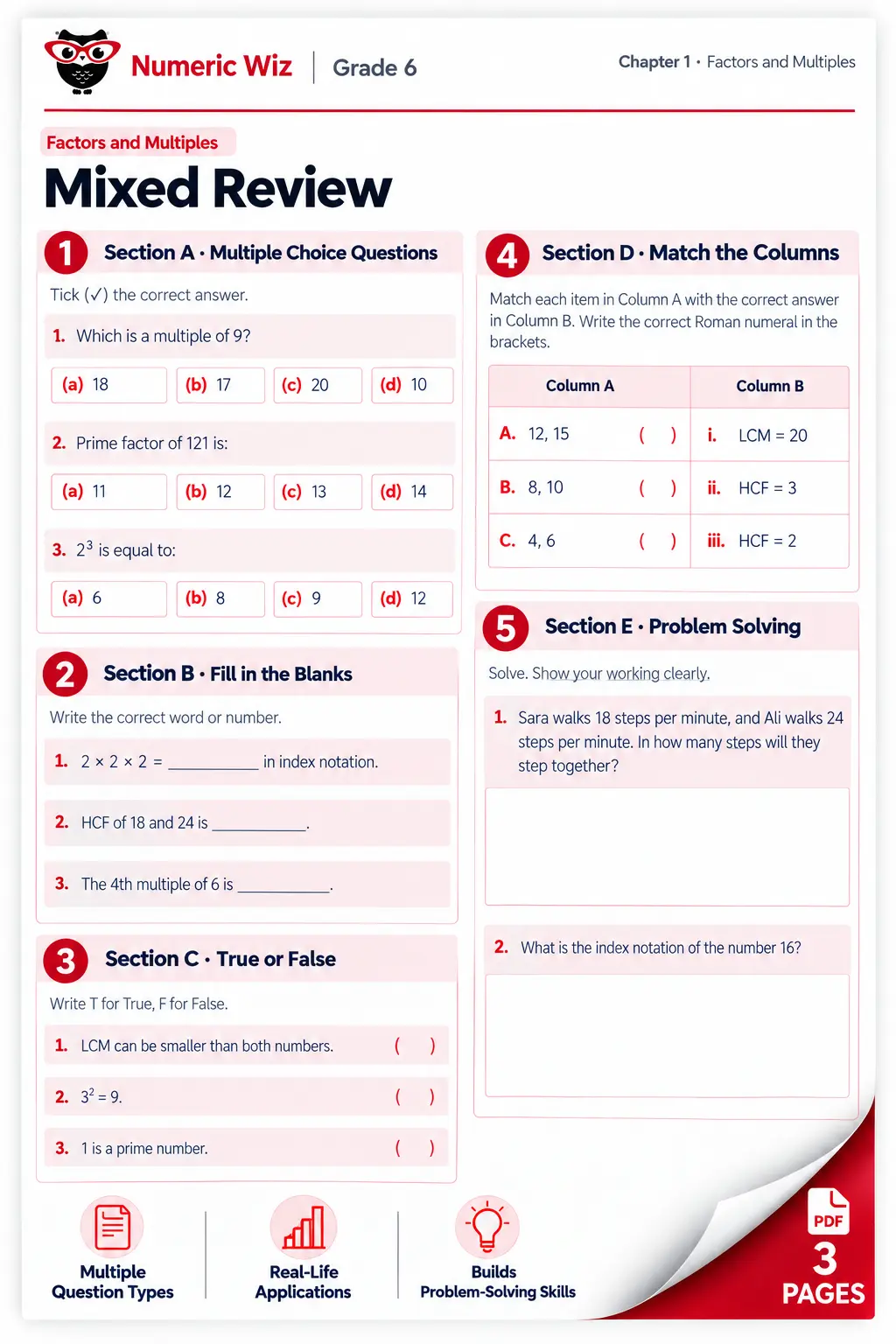
This 3-page printable math worksheet revisits essential concepts from the Grade 6 Factors and Multiples chapter.
Students begin with multiple-choice questions involving multiples, prime factors, and powers.
They then complete fill-in-the-blank questions about index notation, HCF, and multiples, followed by true-or-false statements that check their understanding of LCM, exponents, and prime numbers.
The matching section connects numerical expressions and number pairs with their correct values, HCF, or LCM.
The final sections introduce written problem-solving and challenging real-life questions involving repeated events and time intervals.
These Grade 6 mixed review math worksheets combine different question formats to revisit several related mathematical concepts.
Multiple-Choice Questions: Students identify multiples, recognize prime factors, and evaluate powers.
Fill in the Blanks: Students convert repeated multiplication into index notation, calculate HCF, and identify a specified multiple.
True or False: Students examine statements about LCM, exponents, and prime numbers, helping them identify misconceptions.
Match the Columns: Students connect expressions and number pairs with corresponding values, HCF, or LCM results.
Problem-Solving Questions: Students work with a question involving walking rates and express the number 16 using index notation.
Challenging Word Problems: Students determine when school bells and water sprinklers operating at different intervals will occur together again.
The combination of these activities encourages students to recall concepts, interpret mathematical expressions, and organize their working.
Factors and multiples are useful when quantities repeat, events follow regular schedules, or different numerical patterns need to be compared.
The worksheet includes two challenging problems involving recurring events.
One school bell rings every 45 minutes, while another rings every 60 minutes. Both bells ring together at 9:00 AM.
To determine when they will ring together again, find the LCM of 45 and 60.
Prime factorizations:
45 = 3² × 5
60 = 2² × 3 × 5
Select the highest power of each prime factor:
LCM = 2² × 3² × 5
LCM = 4 × 9 × 5 = 180 minutes
180 minutes = 3 hours
Therefore, the bells will ring together again at 12:00 PM.
One sprinkler sprays every 18 minutes, while another sprays every 30 minutes. Both begin spraying at 7:00 AM.
Prime factorizations:
18 = 2 × 3²
30 = 2 × 3 × 5
Therefore:
LCM = 2 × 3² × 5
LCM = 2 × 9 × 5 = 90 minutes
90 minutes = 1 hour 30 minutes
The sprinklers will spray together again at 8:30 AM.
These problems give students opportunities to connect LCM calculations with practical situations involving time and repeated events.
This NumericWiz resource provides 3 printable pages of mixed mathematical practice covering several concepts from the Factors and Multiples chapter.
Rather than concentrating on one isolated skill, the worksheet allows students to revisit multiple topics and demonstrate how well they can recall and apply previously learned concepts.
It can support:
The resource is particularly suitable for Grade 6 students who have already studied factors, multiples, prime factors, HCF, LCM, and index notation.
This resource brings together key concepts from the Factors and Multiples chapter through short questions, written calculations, and practical problem-solving activities.
Strong mathematical understanding involves more than remembering individual rules. Students also need to recognize relationships between concepts, choose appropriate methods, and apply their knowledge in unfamiliar situations.
These Grade 6 Factors and Multiples Mixed Review Worksheets provide opportunities to revisit essential number concepts, strengthen mathematical reasoning, and prepare for further learning through varied practice and real-life applications.
Add this NumericWiz printable mixed review worksheet to your Grade 6 math resources for focused chapter revision and meaningful problem-solving practice.
For a limited time