This free printable worksheet helps Grade 6 students read and write set notation with confidence. Your child learns the symbols ∈ and ∉, names the types of sets, and matches sets to their names. The page has multiple-choice questions, set-type sorting, matching, fill-in-the-blanks and true-or-false questions, all in plain words.
Set notation is the way we write a set, using curly brackets { } to list its members, like {3, 6, 9} or {M, O, N}. The symbol ∈ means 'is an element of', so 9 ∈ {3, 6, 9} is true, while the symbol ∉ means 'is not an element of'.
I tell children to read a set like a short sentence. The brackets say "here is a group", and the symbol says "this thing belongs in the group" or "this thing does not belong". Once a child can say the sentence out loud, the symbols stop looking scary. The letters in MOON make the point nicely: the set is {M, O, N}, with 3 elements, because a repeated letter is listed only once.
A set can be finite, with a counted number of members, like the vowels in 'Apple', or infinite, with members that never end, like the even numbers greater than 2. A singleton set has exactly one member, like {0}, and an empty set has no members, like the months with 32 days.
I sort sets into four boxes with my class, and I ask one question for each box: can you count the members, is there only one, or is there nothing at all? The vowels in "Apple" are finite. The even numbers greater than 2 are infinite, and so are the multiples of 5. The national flag of Pakistan is a singleton set, and so are the counting numbers between 5 and 7, which is just {6}. Dragons in your classroom form an empty set, and so do the months with 32 days.
The symbol ∈ means "is an element of". So 9 ∈ {3, 6, 9} is true, because 9 sits inside the brackets, while 7 ∈ {1, 3, 5} is false, because 7 is not in the set. The symbol ∉ means the opposite: "is not an element of". So 4 ∉ {2, 4, 6} is false, because 4 IS in the set, and the ∉ sign says it is not. I make children point at the number and then point inside the brackets, because the pointing stops the two symbols from swapping places in their heads.
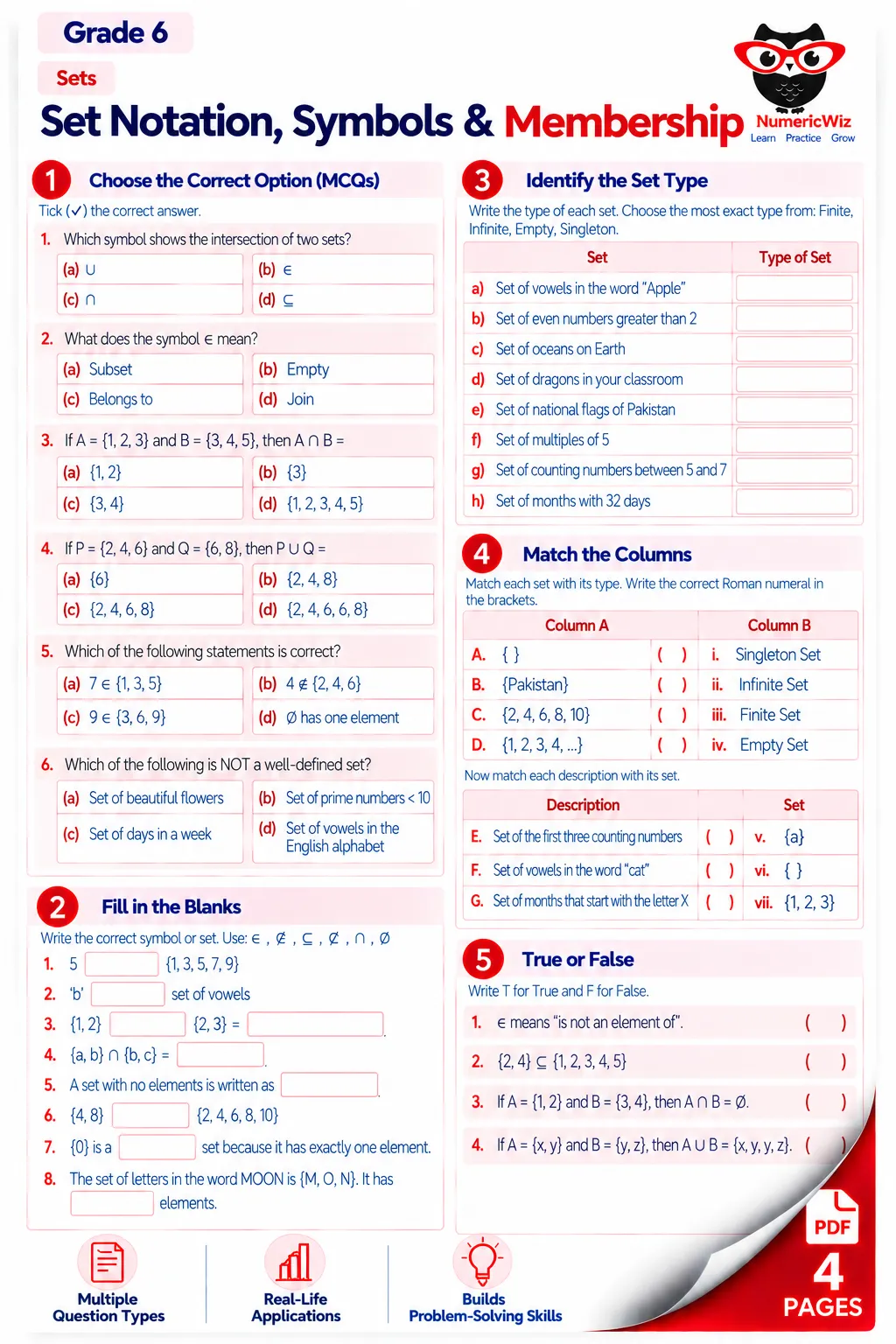
This is a printable PDF with multiple-choice questions, an "Identify the Set Type" section, a Match the Columns task, fill-in-the-blanks and true-or-false questions. In the multiple-choice questions, only one option is correct: (c) "9 ∈ {3, 6, 9}" is correct, while (a) "7 ∈ {1, 3, 5}" is false, (b) "4 ∉ {2, 4, 6}" is false, and (d) "∅ has one element" is false, because the empty set has no elements at all.
In "Identify the Set Type", your child sorts the vowels in "Apple" as finite, the even numbers greater than 2 as infinite, the oceans as finite, the dragons in your classroom as empty, the national flag of Pakistan as singleton, the multiples of 5 as infinite, the counting numbers between 5 and 7 as singleton {6}, and the months with 32 days as empty. In Match the Columns, your child pairs { } with Empty Set, {Pakistan} with Singleton Set, {2, 4, 6, 8, 10} with Finite Set, {1, 2, 3, 4, …} with Infinite Set, the first three counting numbers with {1, 2, 3}, the vowels in "cat" with {a}, and the months starting with X with { }. The fill-in-the-blanks include "{0} is a singleton set" and the letters in MOON, {M, O, N}, which has 3 elements. The true-or-false questions test the symbols, including whether ∈ means "is not an element of", which is False.
I teach it in three steps, and I never let a child skip step one. Step one: read the brackets out loud, as a sentence. Step two: count the members, or check whether the number sits inside the brackets. Step three: name the type, or say true or false. We check each answer by asking one question only: does the sentence I just read match what is written? If the sentence and the symbols agree, the answer is right.
Use this worksheet after students know what a set is, as homework, for homeschool or one-to-one tutoring, or as a quick check before set operations. Because every question turns on reading the symbols as plain words, it quickly shows whether a student owns the notation or still guesses at it. A child who finishes this page can read {M, O, N} and say "three elements" without stopping to think, and that habit carries into every set question that follows.
For more free practice at this level, browse our Grade 6 math worksheets page. Every sheet is free to print.
Yes, it is true. 9 is an element of the set {3, 6, 9}, because 9 sits inside the curly brackets. The symbol ∈ means "is an element of".
Finite. The vowels in "Apple" are A and e, so the set has a counted number of members. A finite set is one whose members can be counted.
{0} is a singleton set. It has exactly one member, the number 0. A singleton set is a set with only one element.
∈ means "is an element of". So the statement "∈ means 'is not an element of'" is false. The symbol for "is not an element of" is ∉.
For a limited time