
Have you ever wondered why a number raised to the power of zero becomes 1?
At first, it can seem confusing. After all, we usually think of zero as meaning “nothing.” But exponents follow a specific pattern, and that pattern explains exactly why this works.
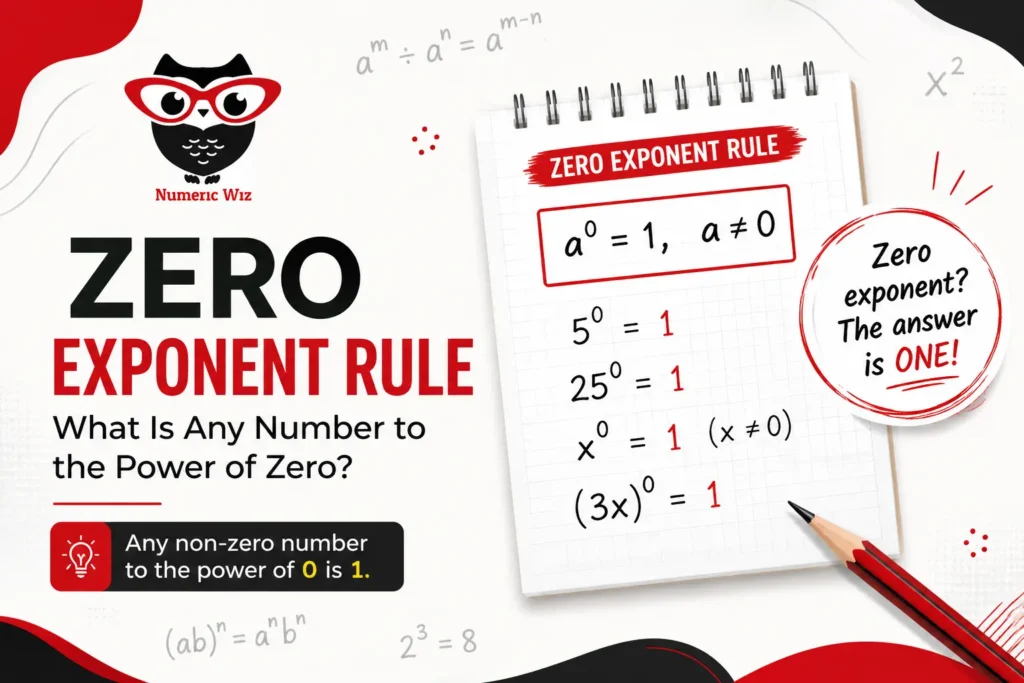
The Zero Exponent Rule states:
Anything except 0 to the power 0 is 1.
For example:
- 5⁰ = 1
- 12⁰ = 1
- 100⁰ = 1
- Any non-zero base raised to power zero equals one.
So, whenever you see a non-zero base with an exponent of 0, you can simplify it to 1.Let’s explore why this rule works, how to use it, and how to avoid common mistakes.
What Is an Exponent?
Before we look at the zero exponent rule, let’s review what an exponent means. The exponent tells you how many times to multiply the base by itself.
For example:
3⁴ = 3 × 3 × 3 × 3 = 81
In this expression:
- 3 is the base
- 4 is the exponent
The exponent tells us that 3 is used as a factor four times.
Here are a few more examples:
2³ = 2 × 2 × 2 = 8
5² = 5 × 5 = 25
10³ = 10 × 10 × 10 = 1,000
But what happens when the exponent is 0? That’s where the Zero Exponent Rule comes in.
What Is the Zero Exponent Rule?
The Zero Exponent Rule says that any non-zero number raised to the power of zero equals 1. In mathematical form:
a⁰ = 1, where a ≠ 0
Here are some examples:
7⁰ = 1
20⁰ = 1
125⁰ = 1
x⁰ = 1, where x ≠ 0
The value of the base doesn’t matter as long as it is not zero. Whether the base is 2, 50, 1,000, or a variable such as x, a zero exponent gives an answer of 1.
Why Does Any Non-Zero Number to the Power of Zero Equal 1?
The rule becomes easier to understand when we use the quotient rule of exponents. Remember that when dividing powers with the same non-zero base, we subtract their exponents.
For example: 5³ ÷ 5³ = 5³⁻³
Subtract the exponents: 5³⁻³ = 5⁰
But anything non-zero divided by itself equals 1: 5³ ÷ 5³ = 1
Therefore: 5⁰ = 1
The same reasoning works for variables.
For example: x⁵ ÷ x⁵ = x⁵⁻⁵
x⁵ ÷ x⁵ = x⁰
Since x is non-zero: x⁵ ÷ x⁵ = 1
Therefore: x⁰ = 1
This is why the zero exponent rule is not just a random mathematical fact. It follows naturally from the rules of exponents.
A Simple Pattern That Explains the Rule
You can also understand zero exponents by looking at a pattern.
Consider the powers of 2:
2⁴ = 16
2³ = 8
2² = 4
2¹ = 2
Notice what happens each time the exponent decreases by 1.
We divide the previous answer by 2:
16 ÷ 2 = 8
8 ÷ 2 = 4
4 ÷ 2 = 2
Now continue the pattern: 2 ÷ 2 = 1
So: 2⁰ = 1
Let’s try the same idea with 10:
10³ = 1,000
10² = 100
10¹ = 10
10⁰ = 1
Again, each step divides by the base.
This pattern helps explain why a non-zero number raised to the zero power equals 1.
Examples of the Zero Exponent Rule
Let’s work through some examples step by step.
Example 1: A Number Raised to Zero
Simplify: 6⁰
The base is 6, which is non-zero, and the exponent is 0.
Using the Zero Exponent Rule: 6⁰ = 1
Example 2: A Larger Number
Simplify: 25⁰
The base is 25, and its exponent is zero.
Therefore: 25⁰ = 1
The size of the number does not matter. A non-zero base raised to zero always equals 1.
Example 3: A Variable
Simplify: x⁰
The exponent is zero, so: x⁰ = 1
This is true as long as: x ≠ 0
Example 4: An Expression Inside Parentheses
Simplify: (4y)⁰
Here, the zero exponent applies to the entire expression inside the parentheses.
Therefore: (4y)⁰ = 1
provided that 4y ≠ 0.
Example 5: A More Complex Expression
Simplify: (3a²)⁰
The exponent 0 applies to the entire expression inside the parentheses.
So: (3a²)⁰ = 1
The expression inside the parentheses does not need to be calculated first.
Be Careful: What Does the Zero Exponent Apply To?
One of the most important things to check is what the exponent is attached to.
Consider: 3x⁰
The exponent 0 applies only to x.
So: 3x⁰ = 3(1)
Therefore: 3x⁰ = 3
It does not equal 1.
Now compare it with: (3x)⁰
This time, the zero exponent applies to the entire expression 3x.
Therefore: (3x)⁰ = 1
These two expressions look similar, but their answers are different.
Compare:
3x⁰ = 3 and (3x)⁰ = 1
The placement of parentheses decides what gets raised to the power.
Zero Exponent Rule: What NOT to do
Learning exponent rules is easier when you know which mistakes to avoid.
Mistake 1: Thinking the Answer Is Zero
A common mistake is to see the exponent 0 and assume the answer must also be 0.
For example: 7⁰ = 0
This is incorrect.
The correct answer is: 7⁰ = 1
Remember: The zero is the exponent, not the answer.
Mistake 2: Ignoring Parentheses
Consider these two expressions:
2x⁰ , (2x)⁰
They are not the same.
For the first expression: 2x⁰ = 2 × 1 = 2
For the second expression: (2x)⁰ = 1
Always check which part of an expression the exponent belongs to.
Mistake 3: Changing the Base to Zero
The Zero Exponent Rule does not mean that the base becomes zero.
For example: 5⁰ = 1
The base is still 5. We are simply raising 5 to the power of zero.
So: 5⁰ = 1, not 0
Mistake 4: Forgetting the Non-Zero Condition
The rule is normally written as:
a⁰ = 1, where a ≠ 0
This condition matters.
You should not automatically apply the standard zero exponent rule to: 0⁰
The expression 0⁰ requires special treatment and is not considered an ordinary example of the zero exponent rule.
For basic algebra, the safest rule to remember is:
A non-zero base raised to the zero power equals 1.
What About Zero to the Power of Zero?
You may eventually come across: 0⁰
This is different from expressions such as: 5⁰
or: 100⁰
The standard zero exponent rule applies to non-zero bases.
So we write: a⁰ = 1, where a ≠ 0
The expression 0⁰ is treated separately in different areas of mathematics, so students should not use the regular zero exponent rule to automatically conclude that 0⁰ = 1.
For now, remember the simple rule:
Non-zero base + zero exponent = 1.
Zero Exponent Rule With Variables
The Zero Exponent Rule also works with variables.
For example:
x⁰ = 1
y⁰ = 1
a⁰ = 1
m⁰ = 1
as long as the variable’s value is not zero.
It also works with expressions:
(2x)⁰ = 1
(x + 5)⁰ = 1
(3a²)⁰ = 1
provided that the entire base is non-zero.
Zero Exponents in Algebra
The rule becomes especially useful when simplifying algebraic expressions.
For example: 4x⁰
Since: x⁰ = 1
we get: 4x⁰ = 4(1)
Therefore: 4x⁰ = 4
Another example: 7a⁰b²
Since: a⁰ = 1
we can simplify: 7a⁰b² = 7(1)b²
Therefore: 7a⁰b² = 7b²
The zero exponent effectively removes that factor because it becomes 1.
Quick Trick to Remember the Zero Exponent Rule
Here’s an easy sentence to remember:
“Zero exponent? The answer is ONE!”
Whenever you see something like: 8⁰, 15⁰ , x⁰, (5x)⁰
ask yourself: Is the entire base non-zero?
If yes, the answer is: 1
Just remember that parentheses determine what the exponent applies to.
Practice Questions
Now it’s your turn to practice the Zero Exponent Rule.
Basic Practice
Simplify each expression.
- 4⁰ = ______
- 9⁰ = ______
- 20⁰ = ______
- 100⁰ = ______
- x⁰ = ______
- a⁰ = ______
- m⁰ = ______
- (5x)⁰ = ______
- (2a)⁰ = ______
- (7y²)⁰ = ______
Think Carefully
Pay close attention to what the zero exponent applies to.
Simplify each expression:
- 5x⁰
- 8a⁰
- 3(2y)⁰
- (3x)⁰
- 4(5m)⁰
Before answering, identify the base that has the zero exponent.
Answers
Basic Practice
- 4⁰ = 1
- 9⁰ = 1
- 20⁰ = 1
- 100⁰ = 1
- x⁰ = 1
- a⁰ = 1
- m⁰ = 1
- (5x)⁰ = 1
- (2a)⁰ = 1
- (7y²)⁰ = 1
Think Carefully
- 5x⁰ = 5
- 8a⁰ = 8
- 3(2y)⁰ = 3
- (3x)⁰ = 1
- 4(5m)⁰ = 4
The key is to identify exactly which part of the expression has the zero exponent.
Key Takeaway
The Zero Exponent Rule is one of the simplest exponent rules to remember:
Any non-zero number or variable raised to the power of zero equals 1.
The rule can be written as:
a⁰ = 1, where a ≠ 0
Remember these three important ideas:
- A non-zero base with a zero exponent equals 1.
- The zero exponent does not mean the answer is zero.
- Parentheses determine what the exponent applies to.
For example: 5⁰ = 1, x⁰ = 1, (3x)⁰ = 1
But: 3x⁰ = 3
Once you understand these simple patterns, zero exponents become much easier to work with in algebra.
Remember: Zero exponent = ONE!
Explore More: Quotient Rule of Exponents: Easy Explanation with Examples & Practice Questions
Frequently Asked Questions
What is the Zero Exponent Rule?
The Zero Exponent Rule says that any non-zero number or variable raised to the power of zero equals 1. For example, 8⁰ = 1 and x⁰ = 1, as long as x is not zero.
Why does any non-zero number to the power of zero equal 1?
The rule follows the pattern of exponents and the Quotient Rule. For example, 5³ ÷ 5³ = 1, while the Quotient Rule gives 5³⁻³ = 5⁰. Therefore, 5⁰ = 1.
Is 7⁰ equal to 0?
No. The exponent is zero, but the answer is 1. Therefore, 7⁰ = 1.
What is x⁰ equal to?
For a non-zero value of x, x⁰ = 1. The base must be non-zero when using the Zero Exponent Rule.
What is the difference between 3x⁰ and (3x)⁰?
In 3x⁰, the zero exponent applies only to x, so 3x⁰ = 3. In (3x)⁰, the zero exponent applies to the entire expression, so (3x)⁰ = 1.
Does the Zero Exponent Rule work with variables?
Yes. A non-zero variable raised to the zero power equals 1. For example, x⁰ = 1 and a⁰ = 1.
What happens when the base is zero?
The expression 0⁰ is not treated as a standard example of the Zero Exponent Rule. The rule is normally written for a non-zero base: a⁰ = 1, where a ≠ 0.
Is the Zero Exponent Rule part of the Common Core curriculum?
Exponent concepts are an important part of middle school mathematics and help students build the algebra skills needed for more advanced mathematics.
How can Numeric Wiz help students learn exponent rules?
Numeric Wiz helps students strengthen their math skills through Common Core-aligned worksheets, printable practice activities, learning gap assessments, personalized learning roadmaps, guided workbooks, one-on-one online tutoring, and individual feedback from experienced math educators.