
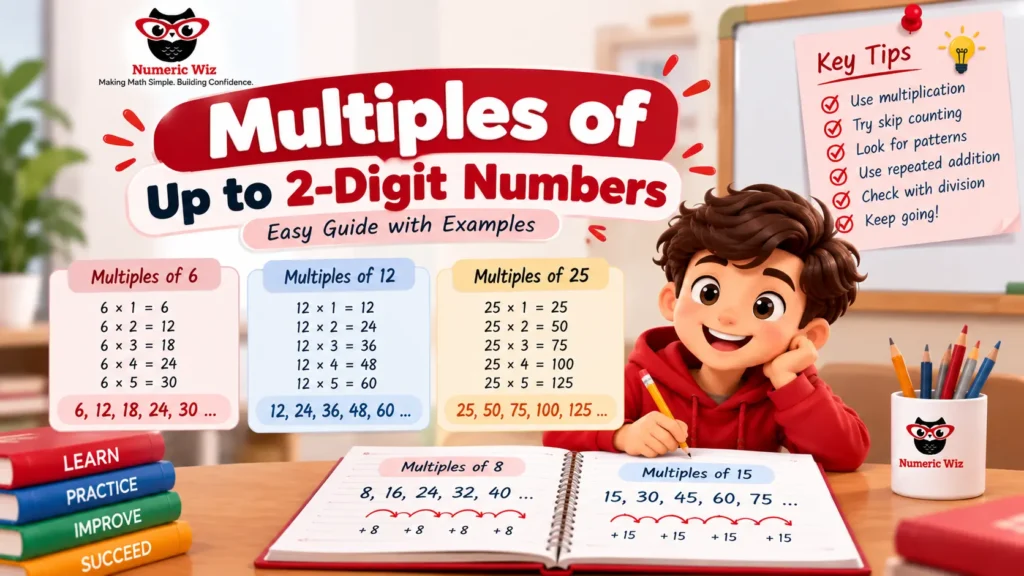
Understanding multiples of up to 2-digit numbers helps children see how multiplication creates patterns in numbers. Instead of memorizing long lists, students can learn how multiples are formed, how to find them quickly, and how they connect to multiplication tables, factors, common multiples, and real-life problems.
For example, the first few multiples of 6 are: 6, 12, 18, 24, 30, 36…
Why? Because:
6 × 1 = 6
6 × 2 = 12
6 × 3 = 18
6 × 4 = 24
The same idea works for larger numbers such as 12, 25, 36, or 48. Once students understand the pattern, finding multiples of 2-digit numbers becomes much easier.
What Is a Multiple?
A multiple is the result you get when you multiply a whole number by another whole number.
For example:
7 × 1 = 7
7 × 2 = 14
7 × 3 = 21
7 × 4 = 28
7 × 5 = 35
Therefore, the first five positive multiples of 7 are: 7, 14, 21, 28, 35
A useful way to remember this is: Number × Whole Number = Multiple
Multiples follow a predictable pattern, which makes them useful for building multiplication fluency and number sense.
What Does “Multiples of Up to 2-Digit Numbers” Mean?
A 2-digit number is a number from 10 to 99.
Finding multiples of up to 2-digit numbers means generating multiples of numbers that may have one or two digits.
For example:
Multiples of 5: 5, 10, 15, 20, 25…
Multiples of 12: 12, 24, 36, 48, 60…
Multiples of 25: 25, 50, 75, 100, 125…
Multiples of 36: 36, 72, 108, 144, 180…
Notice that the multiples themselves do not have to remain 2-digit numbers. We are multiplying a number of up to two digits, so its multiples can become 3-digit or even larger numbers.
How to Find Multiples of a Number
One of the easiest ways to find multiples is to multiply the given number by 1, 2, 3, 4, 5, and so on.
Suppose we need the first six multiples of 14.
14 × 1 = 14
14 × 2 = 28
14 × 3 = 42
14 × 4 = 56
14 × 5 = 70
14 × 6 = 84
So: First six multiples of 14 = 14, 28, 42, 56, 70, 84
A Simple Step-by-Step Strategy
- Write the given number.
- Multiply it by 1.
- Multiply it by 2, then 3, then 4.
- Continue until you have the required number of multiples.
- Check that the difference between consecutive multiples is always the original number.
For 14: 14 → 28 → 42 → 56 → 70 → 84
Each time, we add 14.
Two Easy Ways to Generate Multiples
Students do not always need to perform a new multiplication calculation. There are two useful approaches.
Method 1: Use Multiplication
To find multiples of 16:
16 × 1 = 16
16 × 2 = 32
16 × 3 = 48
16 × 4 = 64
16 × 5 = 80
So: 16, 32, 48, 64, 80…
Method 2: Use Repeated Addition
Start with 16 and repeatedly add 16: 16
16 + 16 = 32
32 + 16 = 48
48 + 16 = 64
64 + 16 = 80
Both methods produce the same multiples.
This helps children understand that multiplication and repeated addition are connected.
Example 1: Find the First 8 Multiples of 9
Multiply 9 by the numbers 1 through 8:
9 × 1 = 9
9 × 2 = 18
9 × 3 = 27
9 × 4 = 36
9 × 5 = 45
9 × 6 = 54
9 × 7 = 63
9 × 8 = 72
Therefore:
9, 18, 27, 36, 45, 54, 63, 72
Example 2: Find the First 6 Multiples of 15
Start with 15 and keep adding 15: 15
15 + 15 = 30
30 + 15 = 45
45 + 15 = 60
60 + 15 = 75
75 + 15 = 90
Therefore: Multiples of 15 = 15, 30, 45, 60, 75, 90…
Example 3: Find the First 5 Multiples of 24
Use multiplication:
24 × 1 = 24
24 × 2 = 48
24 × 3 = 72
24 × 4 = 96
24 × 5 = 120
Therefore:
24, 48, 72, 96, 120
Notice that 120 is a 3-digit number. That is completely fine. The original number, 24, is the 2-digit number whose multiples we are finding.
How to Check Whether a Number Is a Multiple
To check whether one number is a multiple of another, use division.
Ask: Can I divide this number exactly by the given number?
For example: Is 84 a multiple of 12?
Calculate: 84 ÷ 12 = 7
There is no remainder.
Therefore: 84 is a multiple of 12.
Is 85 a multiple of 12? 85 ÷ 12 = 7 remainder 1
There is a remainder, so: 85 is not a multiple of 12.
This gives students an important connection between multiplication and division.
Multiples Follow Number Patterns
Multiples are especially useful because they create patterns.
Consider the multiples of 10: 10, 20, 30, 40, 50, 60…
Every number ends in 0.
Now look at multiples of 5: 5, 10, 15, 20, 25, 30…
They end in either 0 or 5.
Multiples of 2: 2, 4, 6, 8, 10, 12, 14…
They are all even numbers.
Recognizing these patterns can help children identify multiples without calculating every answer from the beginning.
Skip Counting and Multiples
Skip counting is another useful way to understand multiples.
If you skip count by 8: 8, 16, 24, 32, 40, 48, 56…
you are actually listing multiples of 8.
Similarly, skip counting by 12 gives: 12, 24, 36, 48, 60, 72…
This connection makes skip counting a useful bridge between basic counting and multiplication.
Factors and Multiples: What Is the Difference?
Students often mix up factors and multiples, but the difference becomes clearer when we compare them.
| Factors | Multiples |
|---|---|
| Divide a number exactly | Are produced by multiplication |
| A number has a limited number of factors | Multiples continue without end |
| Usually less than or equal to the number | Can be greater than the number |
| Factors of 12: 1, 2, 3, 4, 6, 12 | Multiples of 12: 12, 24, 36, 48… |
For example: 6 × 8 = 48
This tells us that: 6 and 8 are factors of 48.
At the same time: 48 is a multiple of both 6 and 8.
Understanding this relationship helps students avoid one of the most common mistakes in this topic.
What Are Common Multiples?
A common multiple is a number that is a multiple of two or more numbers.
Consider 4 and 6.
Multiples of 4: 4, 8, 12, 16, 20, 24, 28, 32, 36…
Multiples of 6: 6, 12, 18, 24, 30, 36…
Numbers appearing in both lists include: 12, 24, 36…
These are common multiples of 4 and 6.
The smallest positive common multiple is 12, which is called the Least Common Multiple (LCM).
This shows why understanding basic multiples is important before students move on to LCM.
Multiples of 2-Digit Numbers
When students begin working with larger numbers, the mathematical idea does not change.
Let’s find multiples of 32.
32 × 1 = 32
32 × 2 = 64
32 × 3 = 96
32 × 4 = 128
32 × 5 = 160
Therefore:
32, 64, 96, 128, 160…
For 45:
45 × 1 = 45
45 × 2 = 90
45 × 3 = 135
45 × 4 = 180
45 × 5 = 225
Therefore:
45, 90, 135, 180, 225…
Students who understand the pattern do not need a completely new method for 2-digit numbers.
Common Mistakes When Finding Multiples
Mistake 1: Confusing Multiples With Factors
For 12:
Factors: 1, 2, 3, 4, 6, 12
Multiples: 12, 24, 36, 48, 60…
Remember:
Factors divide. Multiples multiply.
Mistake 2: Thinking Multiples Must Be Smaller Than the Number
Multiples usually grow as we continue multiplying.
For example: 25, 50, 75, 100, 125…
There is no rule saying multiples must stay below 100.
Mistake 3: Changing the Amount Added
For multiples of 13:
13, 26, 39, 52, 65…
We add 13 every time.
If the amount being added changes, the pattern is no longer the sequence of multiples of 13.
Mistake 4: Stopping When Multiples Become 3-Digit Numbers
If the question asks for multiples of a 2-digit number, the resulting multiples can still have three or more digits.
For example: Multiples of 75 = 75, 150, 225, 300…
Mistake 5: Skipping a Multiple
Writing multiples in order or using a multiplication table can prevent this.
For example, instead of guessing multiples of 18, write: 18 × 1, 18 × 2, 18 × 3, 18 × 4…
This creates an organized sequence.
Real-Life Uses of Multiples
Multiples appear in many everyday situations.
1.Equal Packs
Suppose pencils are sold in packs of 12.
The number of pencils in different numbers of packs could be: 12, 24, 36, 48, 60…
These are multiples of 12.
2.Time
A bus arrives every 15 minutes.
Starting from a given time, the waiting intervals are: 15, 30, 45, 60… minutes
These are multiples of 15.
3.Equal Groups
A teacher puts 8 students in each team.
The total number of students for 1, 2, 3, or 4 teams would be: 8, 16, 24, 32…
Again, these are multiples of 8.
Connecting multiples to real situations helps children understand why the concept matters beyond a worksheet.
Why Learning Multiples Is Important
Understanding multiples of up to 2-digit numbers supports several later math skills, including:
- Multiplication and division
- Times tables
- Divisibility
- Factors and multiples
- Common multiples
- Least Common Multiple (LCM)
- Equivalent fractions
- Adding and subtracting fractions
- Ratios and proportions
- Number patterns
- Problem-solving
Rather than treating multiples as an isolated topic, students should see how they connect to other number relationships.
Quick Review
Remember these key ideas about multiples:
- A multiple is produced by multiplying a number by a whole number.
- Multiples can be generated using multiplication or repeated addition.
- Skip counting produces a sequence of multiples.
- Multiples follow predictable number patterns.
- A number has infinitely many multiples.
- Multiples of 2-digit numbers can become 3-digit or larger numbers.
- Factors and multiples are related but different.
- Common multiples help students understand LCM.
Need Practice Material?
Explore Our Latest Worksheets on Similar topics designed by Experts:
Multiples of Up to 2-Digit Numbers Worksheets | Grade 6 Math PDF
Frequently Asked Questions
What is a multiple of a number?
A multiple is a number produced when a given number is multiplied by a whole number. For example, 24 is a multiple of 6 because 6 × 4 = 24.
How do you find multiples of a 2-digit number?
Multiply the number by 1, 2, 3, 4, 5, and so on. For example, the first five multiples of 18 are 18, 36, 54, 72, and 90.
Are multiples and factors the same?
No. Factors divide a number exactly, while multiples are produced by multiplying a number. For example, 5 is a factor of 20, while 20 is a multiple of 5.
Do multiples ever end?
No. Multiples continue without end because you can keep multiplying a number by larger whole numbers. For example, the multiples of 5 continue as 5, 10, 15, 20, 25, 30….
Can a multiple of a 2-digit number have 3 digits?
Yes. The number whose multiples you are finding may have two digits, but its multiples can have three or more digits. For example, 25 × 4 = 100, so 100 is a multiple of 25.
How can I check if one number is a multiple of another?
Divide the number by the given number. If the answer is a whole number with no remainder, then it is a multiple. For example, 156 ÷ 12 = 13, so 156 is a multiple of 12.