
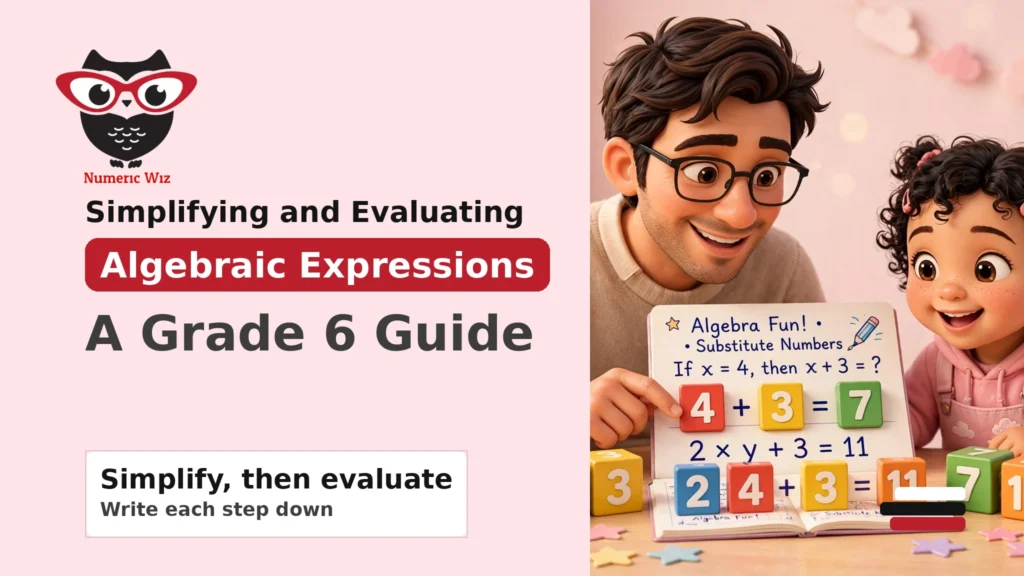
Simplifying an expression means rewriting it shorter, and evaluating means replacing each letter with a value and working out the number. Simplify first, then evaluate, and the arithmetic stays small. Most errors come from skipped steps, not hard sums.
I once watched a boy substitute the first letter in an expression and forget the second one completely. His answer looked tidy and was wrong by a mile. I made him write both substitutions down first, and his next five answers were all correct.
How Do You Simplify an Algebraic Expression?
Simplify an algebraic expression by opening brackets first, then grouping like terms and combining their coefficients, until no bracket and no repeated like term is left. A negative sign in front of a bracket flips every sign inside it, so check the signs before you combine anything at all.
Brackets at this level come in three kinds, and I teach all three. A number in front of a bracket multiplies every term inside it. A minus sign in front flips every sign inside it. A bracket inside a bracket opens from the inside out.
Try it: 3(x + 2) + 2x. Open the bracket to get 3x + 6 + 2x, then group the x terms. The answer is 5x + 6, and no bracket or repeated term is left.
How Do You Evaluate an Algebraic Expression?
Evaluate an algebraic expression by replacing every letter with its given value, then working through the arithmetic in order, with brackets first and multiplication before addition and subtraction. Write each substitution step down, because most evaluation errors come from skipping steps, not from hard sums.
Try it with two letters: 2x + 3y, with x = 4 and y = 2. Substitute both values first, 2(4) + 3(2), then multiply, 8 + 6, then add. The answer is 14.
Here is a check I love: simplify first, then evaluate, and compare with evaluating the original. For 5(y – 6) with y = 9, the direct route gives 5(3), which is 15. The simplified route gives 45 – 30, which is also 15. Same answer, two routes, and a built-in check.
Standard 6.EE.A.2 covers writing, reading and evaluating expressions in which letters stand for numbers, including evaluating at specific values of their variables. That is exactly the skill in this guide.
What Order Do You Follow When Evaluating?
Follow brackets first, then multiplication and division, then addition and subtraction, and work left to right inside each step. Write the order above each evaluation, because children who write the steps down get the answer right far more often than children who work in their heads.
A common slip is working left to right and adding before multiplying. In 2x + 3y with x = 4 and y = 2, adding before multiplying would break the sum, so multiplication always comes before addition.
Subtraction with brackets trips children first, so the adding and subtracting algebraic expressions worksheet is the right warm-up before this one. Once brackets feel safe, simplifying and evaluating become one smooth chain.
Practise With the Free Worksheet
The simplifying and evaluating algebraic expressions worksheet chains all three skills: simplify, evaluate, solve. It moves from simplifying expressions, including expressions with brackets, to evaluating with given values, and finishes with multi-step word problems.
Try These Three Yourself
- Simplify: 3x + 2x + 5. (Answer: 5x + 5, because 3x + 2x is 5x and the constant stays 5.)
- Evaluate 4a + 3 when a = 2. (Answer: 11, because 4(2) + 3 is 8 + 3.)
- Evaluate 2x + 3y when x = 4 and y = 2. (Answer: 14, because 2(4) + 3(2) is 8 + 6.)
FAQ
What is the difference between simplifying and evaluating?
Simplifying rewrites an expression in shorter form. Evaluating replaces letters with values and works out the number.
Why do brackets cause so many errors?
A sign or number in front of a bracket changes every term inside it. Open brackets first, then combine like terms.
What order do you work in when evaluating?
Brackets first, then multiplication and division, then addition and subtraction. Write each step down.
What makes a problem multi-step?
It needs more than one skill: build the expression, simplify it, then evaluate it. Each step feeds the next one.
Should you simplify before you evaluate?
You can do either, and the answer stays the same. Simplifying first is a good check, because both routes must land on the same number.
Simplify one expression tonight, then evaluate it with a value your child picks. Let them choose the number, and the skill becomes a game. Find more Grade 6 guides on the Grade 6 hub.