
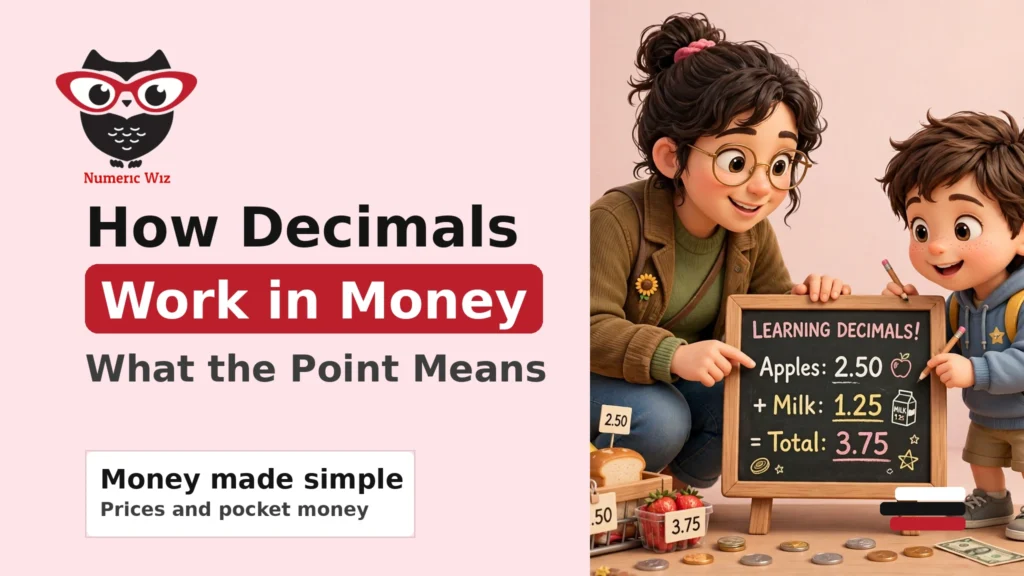
Decimals in money are just rupees and paisa written with a point between them. The digits before the point show whole rupees, and the digits after it show parts of one rupee. Once your child sees that, prices, bills and change all start to make sense.
I have watched many children freeze at a shop counter. The price tag says Rs. 245.50, and they are not sure if that is more or less than Rs. 250. That small point causes big confusion, and it is easy to fix at home.
What Does the Decimal Point Really Mean?
The decimal point separates whole rupees from parts of one rupee, so 245.50 means 245 whole rupees plus 50 parts out of 100 of another rupee. The first digit after the point counts tenths, and the second digit counts hundredths, which is why we read 50 as fifty paisa.
The first digit after the point counts tenths, so 0.5 is five tenths, or half of one rupee. The second digit counts hundredths, so 0.25 is twenty-five hundredths, or one quarter. Coins make this real: a 50-paisa piece is 0.50 of a rupee, and two of them make one whole rupee.
Decimals are close cousins of fractions, since 0.5 is the same as one half. If fractions still feel shaky, my guide on why we learn fractions will help, then come back here.
Why Does 245.50 Cost Less Than 246?
245.50 costs less than 246 because 50 after the point is only half of one rupee, so the total stays below 246 whole rupees. Children who compare digit by digit from the left see this fast: 245 is smaller than 246 before the point even matters.
Line the points up and compare from the left. First compare whole rupees, then tenths, then hundredths. So 199.99 is less than 200, even though 99 looks big, because 199 whole rupees are less than 200.
I play this game with children in class. I write two prices on the board and ask which shop is cheaper. Children who line the points up win every time.
How Do You Work Out Change in a Shop?
Work out change by rounding the price up to the next whole rupee first, then add the small steps back to the amount you paid. If a toy costs 85.75 and you pay 100, jump from 85.75 to 86, then to 100, which gives 14.25 back in change.
Play shop at home with real coins and notes. Let your child be the shopkeeper and count the change back out loud. That one game teaches more than ten pages of sums.
Start with easy prices, then move to prices like 67.35. The jump method still works, and your child stays calm at a real counter.
What Does Pocket Money Teach About Decimals?
Pocket money teaches decimals because children handle real coins and notes every week, and they quickly learn that 10.50 plus 5.25 makes 15.75 without any worksheet. Saving a little each week also shows how small decimal amounts grow into whole rupees over time.
Give a fixed amount each week and let your child plan it. Saving 12.50 a week for four weeks gives 50.00, and that small sum feels like real progress. A notebook for money in and money out turns decimals into a habit.
I tell parents to let children make small spending mistakes. A child who spends too much in week one learns more than a child who is never allowed to choose.
Common Mistakes I See With Decimals
The most common mix-up is thinking 2.50 is bigger than 2.5. It is not: a zero at the end changes nothing. Another mix-up is adding without lining up the points, so I always tell children to line the points up first and then add.
A third mix-up is reading 0.25 as “point two five” and stopping there. Say it as “twenty-five hundredths” too, so the size stays clear in your child’s mind.
Try These Three Yourself
- Which is bigger: 45.60 or 45.6? (Answer: Neither. They are equal, because a zero at the end changes nothing.)
- A pencil costs 12.25 and you pay 20. How much change do you get? (Answer: 7.75, because 20 minus 12.25 equals 7.75.)
- Sara saves 15.50 each week. How much does she save in 2 weeks? (Answer: 31.00, because 15.50 times 2 equals 31.00.)
FAQ
What is the easiest way to explain the decimal point?
Use money. Show that the point splits whole rupees from paisa, and let your child count real coins to see it.
Is 2.50 the same as 2.5?
Yes. A zero at the end of the decimal part changes nothing, so both mean two and a half.
Why is 0.75 more than 0.5?
Because 0.75 is seventy-five hundredths and 0.5 is only fifty hundredths. Compare hundredths after the point, not the number of digits.
How can I practise decimals without a worksheet?
Play shop, read price tags together, and let your child work out change. Pocket money is the best daily practice there is.
When should children learn decimals?
In Grade 6, after fractions, since decimals are fractions with denominators of 10 and 100. A child who knows halves and quarters picks decimals up fast.
Start with one price tag tonight. Ask your child what the point means, work out the change together, and let decimals become a daily habit, not a school topic. Find more Grade 6 guides on the Grade 6 hub.