
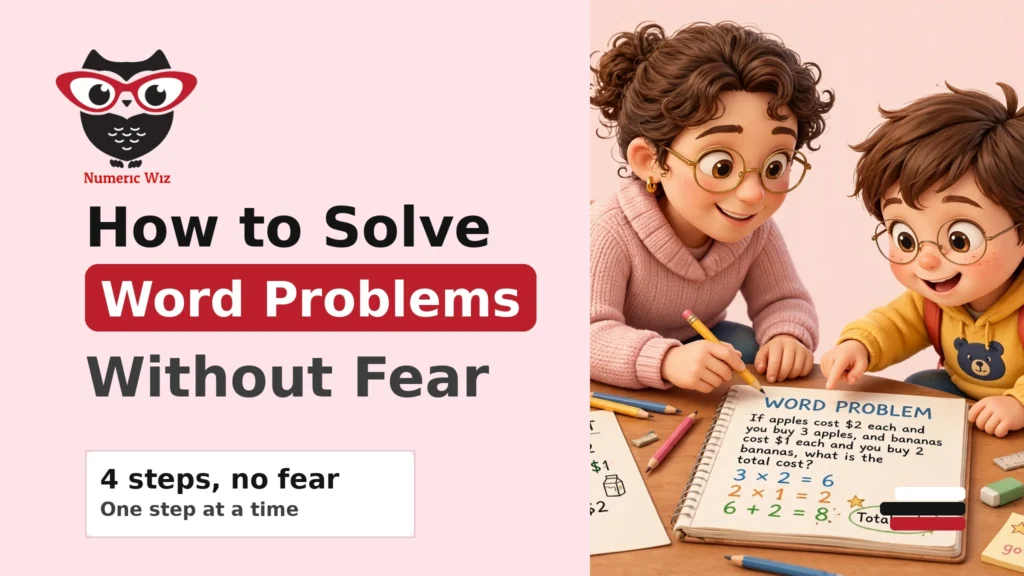
Multi-step word problems are just short stories that need two or more sums, and any child can solve them with one calm routine. The fear comes from not knowing where to start, not from the maths itself. I have taught Grade 6 math for over thirty years, and I use the same four steps every time.
Why Do Word Problems Feel Harder Than Plain Sums?
Word problems feel harder because your child does two jobs at once: first understand the story, then pick the maths that fits it. A plain sum gives the numbers and the operation, but a word problem hides both inside words, extra numbers, and a question that needs reading twice.
A plain sum says “12 minus 5”. A word problem says “Maya had 12 pencils, gave 5 to her brother, and bought 3 packs of 4 more”. The second version needs reading, sorting, and two sums before the answer shows up. That extra work is the hard part, not the subtraction.
Extra numbers make it worse. A problem may mention 5 friends, 3 red pens, and a 20 dollar note, when only two of those numbers matter. Children who grab every number at once get lost fast. Children who slow down and sort first stay calm.
Step 1: Find What the Question Is Really Asking
Read the whole problem once, then read the last sentence again. The last sentence almost always holds the question, and it tells you what the answer must look like. Ask out loud: “What must I find?” If you cannot answer that in one short sentence, read it once more before touching any number.
I tell my pupils to circle the question sentence. A circled question is a target, and every step after it must point at that target. Without a target, even correct sums wander off course.
Step 2: Sort the Numbers You Need from the Numbers You Do Not
Underline the numbers that belong to the question, and cross out the rest. A number that never joins a sum is a decoy, and crossing it out is not cheating, it is good maths. Say each kept number with its unit: “3 packs”, “4 pencils in each pack”, “20 dollars paid”. Units stop silly mix-ups, like adding packs to dollars.
Try it on this line: “Tom, aged 11, has 24 apples and buys 2 bags with 6 apples in each bag.” Tom’s age never joins a sum, so cross it out. The kept numbers are 24, 2, and 6, and now the path is clear.
Step 3: Work in Order, One Step at a Time (Worked Example 1: Shopping)
Maya buys 3 packs of pencils at 4 dollars each, and pays with a 20 dollar note. How much change does she get? Step one: find what she spent. 3 packs times 4 dollars is 12 dollars. Step two: take that off what she paid. 20 dollars minus 12 dollars is 8 dollars. Her change is 8 dollars.
One step at a time is the whole trick. Write each step on its own line, with its own small answer, and the next step starts from that answer. If a problem adds a ratio, like 2 notebooks for every 3 pens, the same steps hold, and my How Ratios Work in Real Life guide shows that link in full.
Step 4: Check It Like a Real Person Would (Worked Example 2: Sharing)
96 stickers are shared equally among 8 children, then each child gives 3 stickers to a friend. How many does each child keep? Step one: 96 shared by 8 is 12 stickers each. Step two: 12 minus 3 is 9 stickers kept. Now check it like a real person: 9 kept plus 3 given is 12, and 12 times 8 children is 96, which matches the start. The answer fits, so it stands.
A real-person check asks one plain question: “Does this answer make sense in real life?” If each child kept 40 stickers from 96 shared by 8, that fails the check at once, and you know to look back. Checking is not extra work, it is the step that catches slips.
Try It Yourself: 3 Quick Questions
Cover the answers, let your child try, then check together.
- Sara buys 5 notebooks at 3 dollars each and pays with a 20 dollar note. How much change does she get?
Answer: 5 dollars. 5 times 3 is 15 dollars spent, and 20 minus 15 is 5. - 72 marbles are shared equally among 9 children, then each child gives 2 marbles away. How many does each child keep?
Answer: 6 marbles. 72 shared by 9 is 8 each, and 8 minus 2 is 6. - Tom, aged 11, has 24 apples and buys 2 bags with 6 apples in each bag, then gives 5 apples to his sister. How many apples does he have now?
Answer: 31 apples. 2 bags times 6 is 12 new apples, 24 plus 12 is 36, and 36 minus 5 is 31. Tom’s age was a decoy.
Key Takeaways
- Fear comes from not knowing where to start, not from the maths.
- Step 1: find the question, and say it in one short sentence.
- Step 2: keep the numbers you need, cross out the decoys.
- Step 3: work in order, one step and one line at a time.
- Step 4: check the answer against real life before you trust it.
If your child handled those three questions, she has the routine. Use it on the next homework problem, and the freeze will shrink fast.
For more topics at this level, browse our Grade 6 math worksheets page.
Frequently Asked Questions
Why does my child freeze on word problems?
Children freeze when they do not know where to start, not when the maths is too hard. A fixed routine, read, sort, work in order, check, gives them a first step every time.
Should they write every step down?
Yes, at least while they learn. Written steps show where a slip happened, and they turn a long problem into short, safe pieces.
What if they pick the wrong operation first?
Let them finish, then check the answer against real life. A wrong operation shows up fast in the check, and fixing it teaches more than a perfect first try.
How many practice problems a day is enough?
Three to five good problems beat twenty rushed ones. Short, calm practice builds the routine, and tired practice builds mistakes.
Do word problems matter outside school?
Yes, shopping, cooking, travel, and bills all arrive as word problems. School problems are practice for those real ones.