Order integers from least to greatest and greatest to least
Compare integers using >, < and =
Compare the order of integers with the order of their absolute values
Use ordering in real-life situations like temperature and bank balances
Place the integers on a number line and read them left to right. The leftmost number is the least, the rightmost is the greatest. So −9, −2, 0, 4, 7 runs from least to greatest. Negative numbers always sit left of zero, so they always come first.
That is the whole method. I draw the line on the board, mark each number with a dot, and read the dots like words in a sentence. No memorizing. No tricks. If your child can point left and right, they can order integers.
Because on the number line, −8 sits farther left than −3, so −8 < −3. A bigger digit after a minus sign means a smaller value. Think of debt: owing $8 is worse than owing $3. That's why −20, −9, −1, 5 is the correct least-to-greatest order.
This is the spot where most students slip. They see 8 and 3, and their brain shouts "8 is bigger!" I stop the class right there every year. With negatives, the rules flip. The number with the bigger digit is actually the smaller number. Once they picture the number line, the flip clicks.
A quick check I use: cover the minus signs and order the digits, then flip the order back. 1, 9, 20 becomes 20, 9, 1. Put the minuses back: −20, −9, −1. It works every time.
For positive numbers, both orders match: 2, 5, 9 and |2|, |5|, |9| both run least to greatest. For negative numbers, they flip: −9, −5, −2 runs least to greatest, but their absolute values 9, 5, 2 run greatest to least. The minus sign reverses the order.
This is the heart of worksheet 2.4, and it is worth slowing down for. Order asks "which value is smaller?" Absolute value asks "which is farther from zero?" For negatives, those are opposite questions. −9 is the smallest of the three, yet |−9| = 9 is the biggest distance.
I tell my students: the bars strip the direction and keep the size. Ordering keeps the direction and compares the size. Same numbers, two different questions, two different answers.
The bank. Three accounts show these balances: −$45 (overdrawn by 45), −$10 (overdrawn by 10), and +$20. Order them from least to greatest: −45, −10, 20. The most negative balance is the smallest, even though 45 is the biggest digit. A $45 debt is worse than a $10 debt, and both are worse than having $20 in hand.
The weather. Skardu records −5°C, Lahore records +8°C, Karachi records +24°C. Coldest first: −5, 8, 24. The minus tells you Skardu sits below freezing, so it leads the list. Farmers, pilots and shopkeepers read temperatures this way daily: order first, then decide.
Temperature is one place where ordering matters daily. I collected 10 real-life integer examples every Grade 6 student should know.
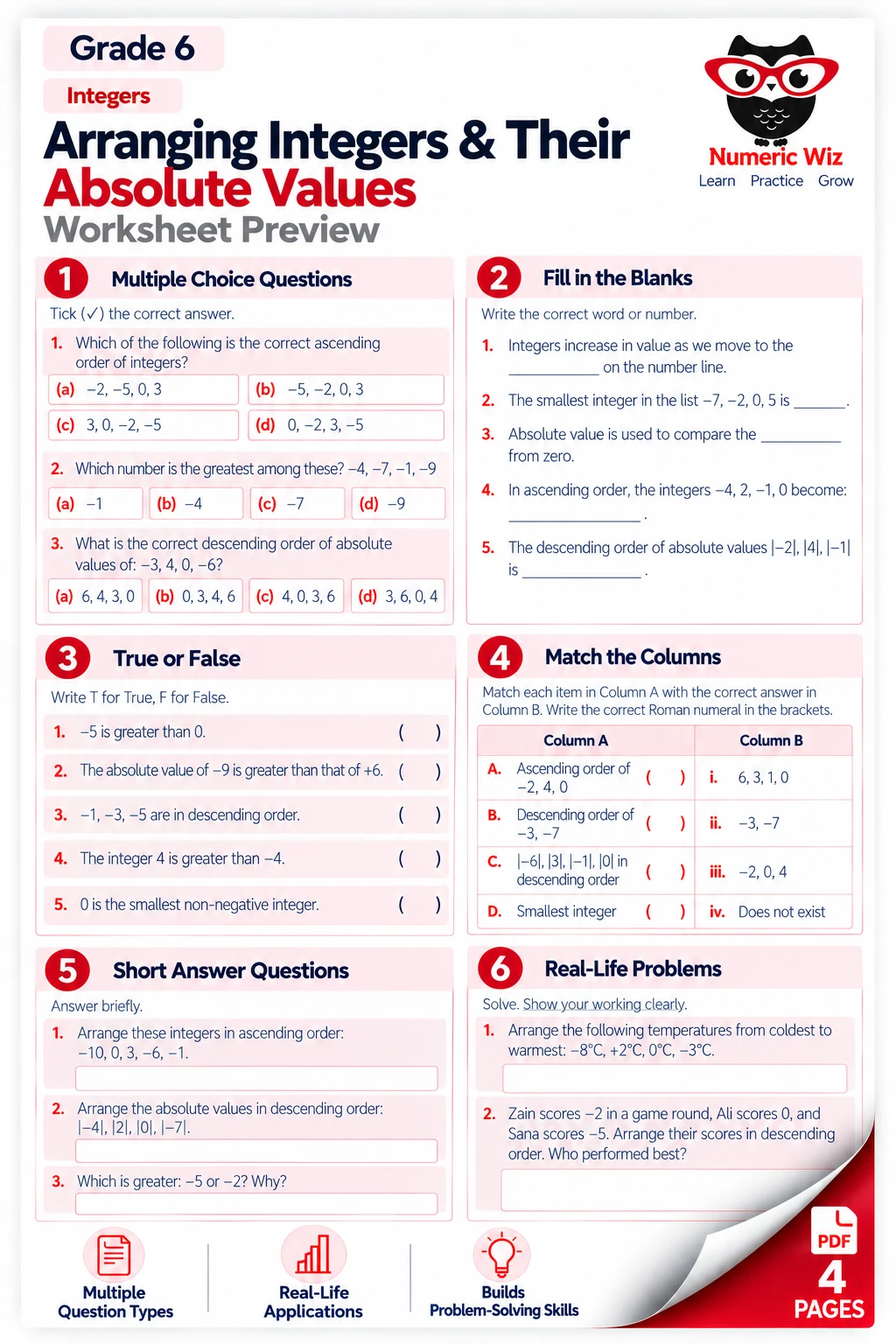
This 4-page printable PDF builds ordering step by step, the way I teach it in class. It opens with multiple choice questions on ascending and descending order and on ordering absolute values. Fill in the blanks ask students to complete orders and key facts, like the smallest integer in a set. True or false statements target the classic traps, like "−5 is greater than 0". Match the columns pairs ascending and descending orders with the right sets. Short written answers ask students to arrange integers in ascending order, arrange absolute values in descending order, and explain which of −5 or −2 is greater and why. Real-life problems close the practice: arranging temperatures from coldest to warmest, and ranking the game scores of Zain, Ali and Sana to see who performed best.
Students start by placing dots on the number line and reading left to right, because seeing beats memorizing. Then they meet the negative flip and practise until −8 < −3 feels natural. Only after that comes the twist: ordering absolute values, where negatives reverse again. By the end, they explain in their own words why −9 is the least yet |−9| is the greatest distance. That's when I know it stuck.
Try these with your child:
Use this worksheet right after the absolute value lesson, as homework, for homeschool or one-to-one tutoring, or as a warm-up before comparing rational numbers. Because it mixes question formats on one idea, it quickly shows which students truly get the negative flip and which ones are still letting the bigger digit boss them around.
Which is greater, −8 or −3?
−3. On the number line, −3 sits to the right of −8, closer to zero. With negatives, the number with the smaller digit is the greater number.
How do you order negative numbers from least to greatest?
Put them on a number line; the one farther left is smaller. So −20, −9, −1 runs least to greatest. A quick trick: order the digits, then flip the order back and add the minus signs.
Is the order of absolute values the same as the order of the numbers?
Only for positive numbers and zero. For negatives it flips: −9, −5, −2 runs least to greatest, but |−9|, |−5|, |−2| = 9, 5, 2 runs greatest to least.
What does "least to greatest" mean?
Smallest value first, biggest value last. For 4, −6, 0, −1, the least-to-greatest order is −6, −1, 0, 4.
Which Common Core standard does this worksheet cover?
6.NS.C.7: understanding ordering and absolute value of rational numbers, including interpreting statements of inequality and order on the number line.
For a limited time