
Ask a class of eleven-year-olds what a negative number is for, and hands shoot up with the same honest question: “Miss, where do we ever use these in real life?” After more than thirty years of teaching mathematics, I can tell you that this question deserves a proper answer — not a rule from the board. Integers feel strange to children because, until now, their maths has lived above zero: counting mangoes, measuring ribbon, sharing pizza. Then one winter morning we write −5 on the board and expect them to believe in a number smaller than nothing. The good news? Children already live in a world full of integers. They have seen temperatures below zero in Murree and Skardu, ridden lifts that sink below the ground floor, and lost points in games. Our job is simply to connect the symbol to the world they know. That is what this guide does: integers explained the way an experienced teacher explains them, with ten real-life examples that have worked in real classrooms.
What Are Integers, in Simple Words?
Integers are the whole numbers that can be positive, negative or zero: … −3, −2, −1, 0, 1, 2, 3 … They never carry a fraction or a decimal part, which is why ½ and 2.5, however friendly they look, are not integers. Picture a straight line with zero in the middle. Positive integers march off to the right, negative integers to the left, and zero sits quietly in the centre belonging to neither side — a detail children love to argue about, and one worth letting them argue about, because the argument is the learning. The sign of an integer is really just a direction: up or down, gain or loss, above or below. Hold on to that one idea and the whole topic softens. The Grade 6 curriculum (Common Core standard 6.NS.C.5) asks exactly this of students — to use positive and negative numbers for quantities with opposite directions or values — and every example below is a small rehearsal for it.
10 Real-Life Examples of Integers
1. Temperature
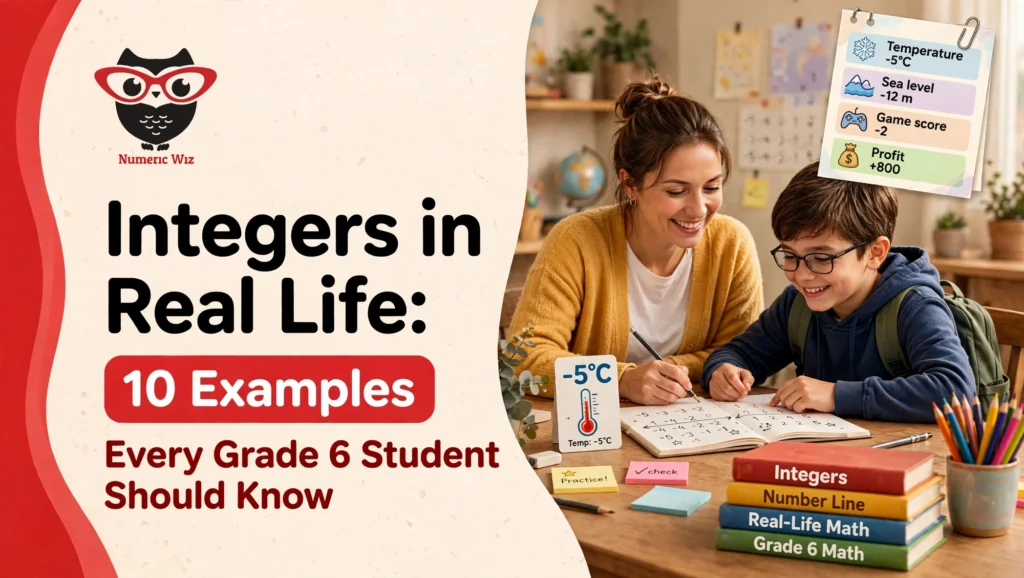
I always begin here, because weather never fails me. On the same January morning, Skardu may sit at −5°C while Islamabad enjoys +12°C. The little minus sign does serious work: it tells a child, before any calculation, that Skardu is below freezing. Then comes the satisfying part — “So how much colder is it?” — and the class discovers that 12 − (−5) = 17 almost without noticing they have done Grade 6 mathematics.
2. Money and Bank Accounts
Nothing concentrates a young mind like money. What a child owns or saves is positive; what is spent or owed is negative. Rs 500 saved (+500) and Rs 200 spent (−200) move a balance exactly the way a counter slides along a number line. Every loan, debt and overdrawn account your family discusses at the dinner table is integer arithmetic wearing everyday clothes.
3. Sea Level, Height and Depth
Sea level is nature’s zero. A peak rising 1,500 metres above it is +1500; a diver floating 12 metres beneath the surface is at −12. And here I slip in a question examiners adore: “How far is the diver from the surface?” Twelve metres — the absolute value of −12 — and suddenly a new term has been learned inside a story instead of a definition.
4. Floors in a Building
Ground floor is 0, the floors above it +1, +2, +3, and the parking basements −1 and −2. Send an imaginary lift from the ground floor up 4 floors and then down to −2, and ask how many floors it travelled in all. Children count 4 up and 6 down and land on 10, delighted. In three decades, this little lift has never once failed to make a class smile — or think.
5. Game Scores
Every child who has played a board game or a quiz already keeps an integer score in their head. Points won (+4), a penalty (−3), a bonus (+2), another penalty (−5) — and the final score is −2, which surprises them every time. They were adding integers long before anyone used the word; we are only giving their game a grown-up name.
6. Profit and Loss
In most homes, children hear “positive” and “negative” first from business talk, not from a textbook. A shopkeeper’s day of Rs 800 profit is +800; a slow day of Rs 300 loss is −300. When a child connects the maths lesson to their father’s shop or their mother’s small business, the topic stops being schoolwork and starts being life.
7. Sports
Golfers speak pure integers: “two under par” is −2 and “three over par” is +3. Football teams gain eight yards (+8) and lose five (−5) in the same match. A team’s position at any moment is one running integer total — and children who follow sports will happily calculate it for you.
8. Weight and Height Changes
Open any child’s health chart and integers are quietly at work: +2 kg gained since last year, −3 kg during an illness. A sunflower that grows +6 cm in a month tells the same story. Change, in either direction from a starting point, is one of the deepest ideas in this topic, and one of the easiest to show at home.
9. Prices Going Up and Down
A price that rises by Rs 50 has changed by +50; the same price dropping in a sale changes by −50. Listen to the evening news — “the market closed up 120 points, down 85 points” — and you are hearing integer changes read aloud to the whole country, every single day.
10. Timelines and Years
History teachers are secret integer teachers. The year 300 BC lies three hundred years on the “before” side of zero, and the AD years lie on the “after” side. It is the same number line from the classroom wall, stretched across centuries — and children who see that connection remember both subjects better.
3 Mistakes Children Commonly Make with Integers
In thirty years of marking exercise books, the same three mistakes return like old friends. First, children insist that 0 must be positive — it feels too important to be nothing. It is neither; zero is the neutral starting point, and it deserves its own little ceremony when you teach it. Second, they declare −5 “bigger” than −2 because 5 beats 2. Stand them in front of a thermometer and ask which morning feels colder, −5°C or −2°C, and the number line rearranges itself in their minds. Third, they happily adopt fractions and decimals as integers. A gentle test sorts it out: if it has a piece missing — a half, a point-something — it is not an integer.
A 5-Minute Home Activity
Here is the activity I have given to hundreds of parents at school meetings. Draw a number line from −10 to +10 on the back of an old calendar and put a coin on zero. Now call out small stories from your own home: “The lift went down 3 floors.” “You found Rs 100 in your uniform pocket.” “The night turned 6 degrees colder.” Your child slides the coin to the right integer each time. Five minutes, no worksheets, no pressure — and you have practised direction, the very heart of this topic, in the language of your own household.
Practise with a Free Worksheet
Stories and activities open the door; written practice is what makes the learning stay. When your child is ready, begin with our free printable Introduction to Integers worksheet for Grade 6. It practises precisely what this guide has discussed — recognising integers, finding opposites, and solving real-life problems about temperature and lift travel — through MCQs, fill in the blanks, true or false, matching and short answers. And when that page feels easy, you will find plenty more waiting on our Grade 6 worksheets page.
Frequently Asked Questions
What are integers in simple words?
Integers are whole numbers that can be positive, negative or zero — numbers like −2, 0 and 5, with no fraction or decimal part hiding inside them.
What are 5 examples of integers in real life?
A temperature below zero, money owed to a bank, a depth below sea level, a basement floor in a building, and points lost in a game — five examples any child can verify from their own week.
Is 0 a positive or negative integer?
Neither, and children find this genuinely surprising. Zero is neutral: the starting point from which positive and negative integers set off in opposite directions.
Are fractions integers?
No. Fractions and decimals such as ½ and 2.5 are not integers, because an integer has no fractional or decimal part. They live between the integers on the number line.
Why do Grade 6 students learn integers?
Because the world runs on opposites — hotter and colder, profit and loss, above and below sea level — and integers are the language we use to describe them. They also lay the groundwork for algebra, where letters will soon stand for these very numbers.