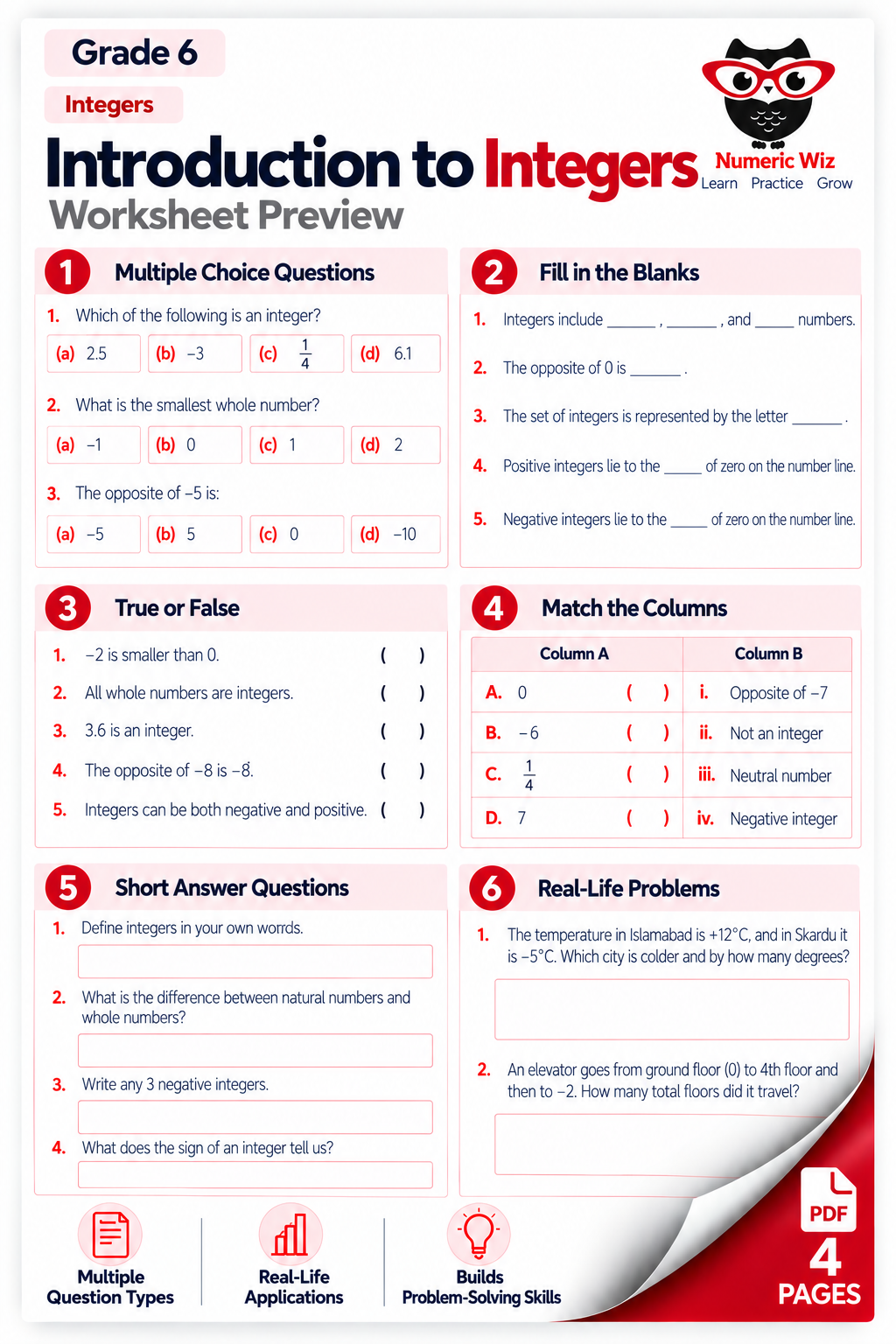
Integers are the whole numbers that include positive numbers, negative numbers and zero: … −3, −2, −1, 0, 1, 2, 3 … They do not include fractions or decimals, so ¼ and 2.5 are not integers, while −3 is an integer. The sign of an integer tells us its direction from zero: positive integers lie to the right of zero on the number line, and negative integers lie to the left. Zero itself is neutral — it is neither positive nor negative. The set of integers is represented by the letter Z. This Grade 6 worksheet is the first step of Chapter 2 (Integers) and builds the base for number line work, opposites and absolute value. It aligns with Common Core standard 6.NS.C.5.
Every integer has an opposite at the same distance from zero on the other side. The opposite of −5 is 5, and the opposite of +6 is −6. The opposite of 0 is 0 itself. A number added to its opposite always gives zero — a fact students meet again in this worksheet's riddle: 'I am a number. If you add me to my opposite, you get zero. What number could I be?'
Temperature: The temperature in Islamabad is +12°C and in Skardu it is −5°C. Which city is colder, and by how many degrees? Skardu is colder. The difference is 12 − (−5) = 17, so Skardu is colder by 17 degrees.
Lift travel: An elevator goes from the ground floor (0) up to the 4th floor and then down to floor −2. It travels 4 floors up and 6 floors down, so it travels 10 floors in total.
Examples like these show students why negative numbers exist: temperatures below zero, floors below ground, and points lost in a game are all described with integers.
I collected 10 real-life integer examples every Grade 6 student should know, from bank balances to cricket scores. It pairs well with this worksheet.
This is a 4-page printable PDF. Section A has 5 multiple-choice questions (identifying integers, the smallest whole number, opposites). Section B has 5 fill-in-the-blanks questions (the set of integers, positions on the number line). Section C has 5 true-or-false statements. Section D is Match the Columns (0 as the neutral number, −6 as a negative integer, ¼ as 'not an integer', 7 as the opposite of −7). Section E has short-answer questions, including the difference between natural numbers and whole numbers. Section F applies integers to real-life problems, and the worksheet ends with a 'Riddle Me This' question and a Challenging Level section where students track changing scores in a maths contest and a board game step by step using integers.
Students first recognise integers among mixed numbers, then complete definitions, judge statements as true or false, and match numbers with their descriptions. Only after this concept checking do they write short explanations in their own words and solve real-life and challenging score-tracking problems, showing their working clearly at every step.
Use this worksheet for a first Integers lesson, as homework, for homeschool or one-to-one tutoring, or as a quick check before moving to number lines and absolute value. Because it mixes question formats on a single idea, it quickly shows which students truly understand what an integer is and which students are still confusing integers with fractions and decimals.
For a limited time