
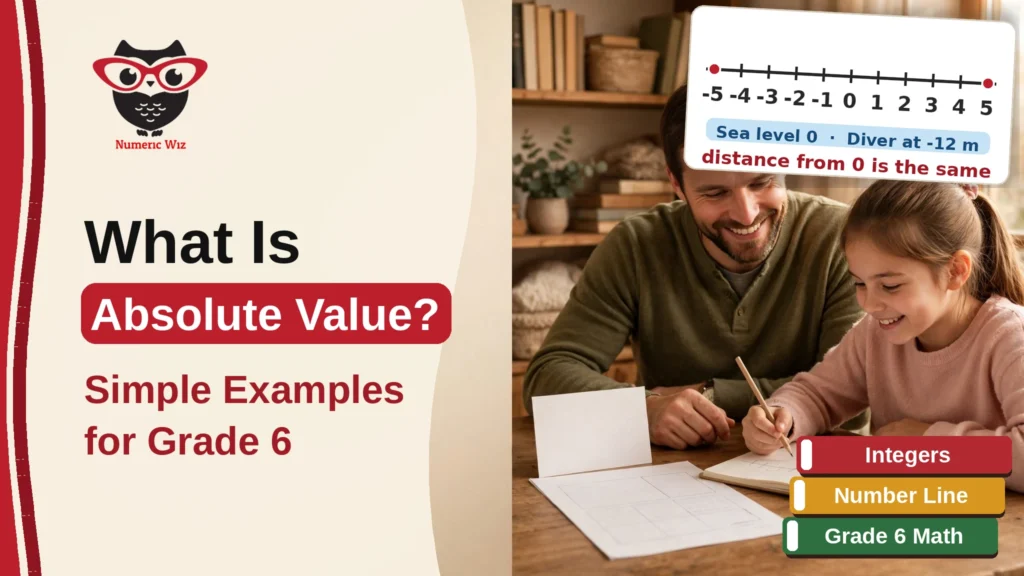
Absolute value means one plain thing: how far a number sits from zero. When your child writes |−7| = 7, she has it exactly right. The number −7 sits seven steps away from zero, and distance is all that absolute value ever measures.
I have taught Grade 6 math for over thirty years, and this topic clicks fast once children stop fearing the minus sign. I explain it the way I explain it at my own classroom board: with a short walk home, a number line, and real winter weather.
What Is Absolute Value?
Absolute value tells you how far a number sits from zero on a number line. You ignore the sign and count the distance only. That is why the absolute value of −7 is 7, written |−7| = 7. Distance cannot be negative, so the answer always comes out positive or zero.
Picture your home as zero on your street. Walk five houses to the left and you stand at −5, or walk five houses to the right and you stand at 5. Either way, your legs carried you exactly five houses.
That walk is the whole secret. Absolute value counts the houses and skips the left or right part. I give my students one short line to keep: absolute value answers “how far”, never “which way”.
If negative numbers still feel shaky at home, start with my free Introduction to Integers worksheet first. It builds the number line slowly. This lesson will feel much easier after that practice.
How Do You Find the Absolute Value of a Number?
Finding absolute value takes three short steps. First, look at the number inside the two vertical bars. Next, ask one question: how far is it from zero? Then write that distance as a positive number, or zero if the number is zero itself. The sign never survives the bars.
Here is the routine on real numbers, starting with |−9|. The number inside the bars is −9, and −9 sits nine steps from zero, so |−9| = 9.
Now take |4|. The number 4 already sits on the positive side, four steps from zero. So |4| = 4, and nothing changes.
One last one: |0| = 0. Zero sits right on top of zero. No steps, no distance, and the answer is simply zero.
Parents often ask me about the bars themselves. The two bars are not brackets and they are not the number one. They are a pair of straight lines that hug the number, and they carry one instruction only: report the distance from zero.
Why Can Two Different Numbers Share the Same Absolute Value?
Opposite numbers sit the same distance from zero, just on different sides. The number −5 sits five steps left of zero, and 5 sits five steps right of zero. Both are five steps away, so both have an absolute value of 5. Direction differs, distance matches.
Numbers like −5 and 5 are called opposites. They mirror each other across zero. Their signs differ, but their distance from zero is identical.
In class, I tape a zero line on the floor and stand two children back to back on it. One walks five steps forward, the other five steps backward. The whole class sees it at once: same distance walked, opposite directions taken.
Is Absolute Value Always Positive?
Absolute value is always positive or zero, and it can never be negative. It measures distance, and distance never drops below zero. A number far left of zero still has a positive distance from zero. Only zero itself gives an answer of zero, because it sits right on zero.
Think about a car trip. The odometer only counts forward, whichever way the car points. A drive of 12 kilometres is 12 kilometres, north or south.
So the rule is safe to memorise: the answer is positive, unless the number is zero. I have marked thousands of quizzes over the years. This one rule prevents most of the silly errors I see.
Where Do We Use Absolute Value in Real Life?
You use absolute value whenever direction matters less than distance. A diver 12 metres below sea level sits at −12, yet the distance from the surface is 12 metres. Cold weather works the same way. A temperature of −4°C is simply 4 degrees away from zero.
Both of those examples sit inside our own practice pages. A diver at 12 m below sea level has an absolute value of 12, because depth is a distance. When the temperature in Quetta drops to −4°C, the absolute value is 4 degrees from zero.
Money tells it too. A bank balance of −30 dollars means a debt, and |−30| = 30 tells you the size of that debt. The minus sign shows the direction of the money, while the absolute value shows the amount, and amounts are what we pay.
Stairs tell the same story. One child stands 9 stairs above ground level and another stands 9 stairs below it. Both are 9 stairs from ground level, so both have an absolute value of 9.
This is exactly what Common Core standard 6.NS.C.7 asks Grade 6 students to understand: absolute value as distance from 0, used as size in real situations. My guide to integers in real life collects more of these everyday stories for homework evenings.
Ready for paper practice? The free Absolute Value Worksheet for Grade 6 uses these same sea level and temperature stories, so the questions will feel familiar.
Common Mistakes I See Every Year
Mistake one: a child writes |−7| = −7. She copies the sign instead of counting the distance. Send her back to the number line and let her count the steps out loud.
Mistake two: a child thinks |0| has no answer. Zero is a real answer here. Zero sits on zero, so its distance is zero.
Mistake three: a child compares −9 and 3 and calls 3 the bigger one in absolute value. But |−9| = 9, and 9 beats |3| = 3 every single time.
One habit fixes all three mistakes. Before writing any answer, I make my students whisper one question: “How far from zero?” That tiny pause, repeated for a week, turns shaky guesses into steady marks.
Try It Yourself: 3 Quick Questions
Cover the answers, let your child try, then check together.
- What is |−12|?
Answer: 12. The number −12 sits twelve steps from zero. - Which is greater, |−6| or |4|?
Answer: |−6|. It equals 6, and 6 is greater than 4. - A lift stops 8 floors below ground level. What is the absolute value of its position?
Answer: 8. The lift sits 8 floors from ground level, and ground level is zero.
Key Takeaways
- Absolute value means distance from zero.
- |−7| = 7, and |0| = 0.
- Opposite numbers like −5 and 5 share the same absolute value.
- The answer is always positive or zero, never negative.
- Real life uses it for depth below sea level, cold temperatures and distances from home.
If your child handled those three questions, she is ready for a full page of practice. Print the free Absolute Value Worksheet for Grade 6 and sit with her for the first two questions only. You will be surprised how quickly she takes over.
For more topics at this level, browse our Grade 6 math worksheets page. Every sheet is free to print, and each one grows out of a lesson I have taught in a real classroom.
Frequently Asked Questions
What does absolute value mean in simple words?
Absolute value means the distance of a number from zero. You ignore whether the number is positive or negative. You only count how far it sits from zero on the number line.
What is the absolute value of −7?
The absolute value of −7 is 7, written |−7| = 7. The number −7 sits seven steps away from zero. Distance has no sign, so the answer is positive 7.
Can absolute value ever be negative?
No, absolute value can never be negative. It measures distance, and distance is always positive or zero. The only time the answer is zero is for the number zero itself, because |0| = 0.
Why do −5 and 5 have the same absolute value?
They are opposites, and opposites sit the same distance from zero. The number −5 is five steps left of zero and 5 is five steps right of zero. Same distance, so the same absolute value: 5.
What is the symbol for absolute value?
The symbol is two vertical bars around the number, like this: |−7|. You read |−7| as “the absolute value of negative seven”. The bars tell you to report the distance from zero and drop the sign.