
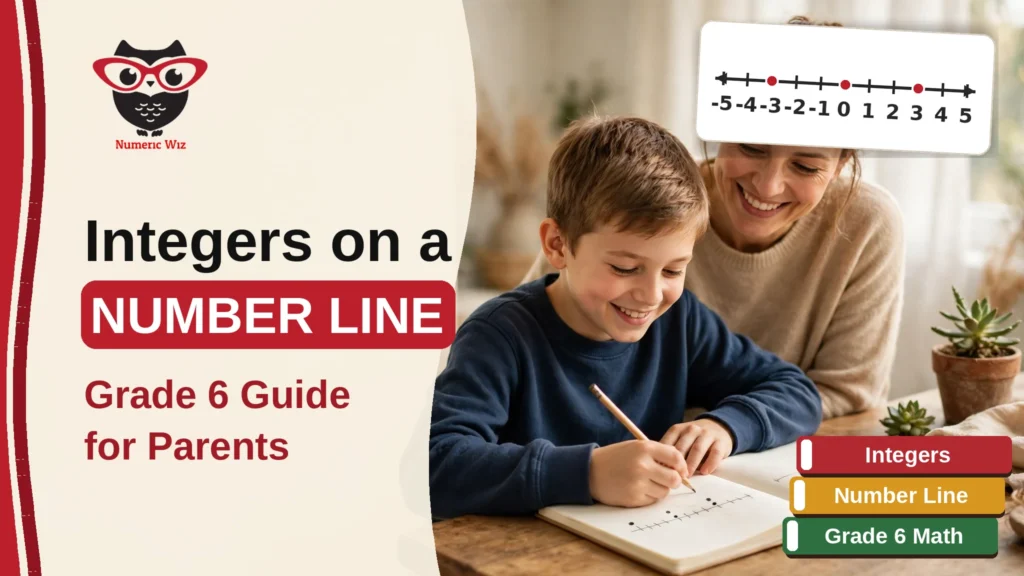
Integers sit on a number line in order, with zero in the middle, positive numbers to the right, and negative numbers to the left. You plot any integer by starting at zero and counting steps, right for positive numbers and left for negative ones. Once your child sees that picture, comparing and ordering integers gets much easier.
I’ve taught this topic for over 30 years, and I always start with the number line, not with rules. Rules fade by Friday. A clear picture of where numbers live stays with a child all year.
What Are Integers on a Number Line?
Integers on a number line are whole numbers placed in order on a straight line, with zero in the middle. Positive integers sit to the right of zero, negative integers sit to the left, and every integer sits the same distance from its neighbours, one step apart.
Picture a straight line with small marks spaced evenly along it, like the marks on a ruler. Zero sits in the centre. The marks to the right read 1, 2, 3, and so on, and the marks to the left read -1, -2, -3.
Arrows at both ends tell you the line never stops. Numbers keep growing to the right and keep shrinking to the left, with no final number on either side. Every mark sits exactly one unit from its neighbours, and that equal spacing matters a lot.
If integers are brand new in your house, start with our Introduction to Integers worksheet first. It covers what integers are and where they show up in daily life. Then come back here and put those numbers on the line.
How Do You Plot Integers on a Number Line?
To plot an integer, start at zero and count steps in the right direction. Move right for a positive integer and left for a negative integer, then place a dot on the tick mark you land on and label it with the number.
Step 1: Find zero first. Every plot starts at zero, so locate it before you move anywhere. I tell my students to put a finger on zero and keep it there until they know the direction.
Step 2: Read the sign. A plus sign, or no sign at all, means you move right. A minus sign means you move left, every single time.
Step 3: Count the steps. The digit tells you how many marks to count. For -4, count four marks to the left of zero.
Step 4: Mark and label. Place a clear dot on the mark you land on. Write the number just above or below the dot, so the plot reads at a glance.
Watch it come together with +3 and -4. From zero, three steps right lands on +3, so the dot goes there. Back at zero, four steps left lands on -4, and that dot sits the same distance from zero, just on the other side.
A Way to Picture It: One Long Street
I picture the number line as one long, straight street. Zero is your home, standing right in the middle of the street. Houses to your right carry the numbers 1, 2, 3, and houses to your left carry -1, -2, -3.
Walking right takes you to bigger numbers, and walking left takes you to smaller ones. Your child already knows this street idea from real life, because an address tells you both a distance and a direction from home. Plotting an integer is just finding the right house.
What Are Opposite Numbers on a Number Line?
Opposite numbers are two integers that sit the same distance from zero but on opposite sides of it. The numbers +4 and -4 are opposites because both sit four steps from zero. Zero is the only integer that is its own opposite.
Finding an opposite takes one move: flip the sign. The opposite of +6 is -6, and the opposite of -9 is +9. My students picture a mirror standing on zero, because every number has a matching reflection the same distance away on the other side.
Here is a fact that surprises many children: a number plus its opposite always equals zero. Try it with +5 and -5, and you land right back at zero. Teachers also call opposites additive inverses, and this idea returns often in Grade 7 algebra.
Ready to practise? Our Number Line & Opposites worksheet gives your child plotting practice, opposite pairs, and a lift problem to solve. It matches this guide point by point.
How Do You Compare Integers on a Number Line?
Compare integers by their position, because the number farther right is always greater. On a number line, +3 beats -1, and -2 beats -5 even though 5 looks bigger than 2. Position wins every time, so check the line before you trust the digits.
Negative numbers cause the classic mix-up here. A child sees 8 and 3, knows 8 is bigger, and picks -8 as the bigger number. On the line, though, -8 sits far to the left of -3, so -3 is greater.
Cold weather makes this click fast. A day at -3°C feels warmer than a day at -8°C, and your child knows that from stepping outside. Warmer means greater, and greater means farther right on the line.
Ordering a set works the same way. Plot -2, +4, -5, and 0, then read the dots from left to right: -5, -2, 0, +4. Left to right always gives you smallest to largest.
Where Do You See Integers on a Number Line in Real Life?
You see integers on a number line every day in thermometers, lift buttons, sea level signs, and bank balances. Ground floor acts as zero in a lift, floors above it count positive, and basement floors count negative, exactly like points on a vertical number line.
Ride a lift with me for a moment. You start at the ground floor, which we call 0, and ride up five floors to +5. Then you ride down eight floors, passing ground level and ending at -3, the third basement level.
That one ride explains direction, distance, and position in a single story. My students act it out with a drawn building, and the idea sticks. For more everyday examples, read my guide to integers in real life, which covers temperature, money, and sea level.
Mistakes I See Every Year
Four mistakes show up in my classroom again and again. Catch them early at home, and your child skips a lot of confusion.
- Uneven spacing. Marks squeezed together or stretched apart break the whole picture. Use squared paper or a ruler while your child builds the habit.
- Counting zero as step one. Zero is the starting point, not the first step. The first mark to the left of zero is -1, not -2.
- Trusting the digit, not the position. Children pick -7 over -2 because 7 beats 2. Remind them that position on the line decides which number is greater.
- Calling zero negative. Zero is neither positive nor negative. It is the middle point, and it is its own opposite.
Quick Check: Try These 3 Questions
Grab a pencil and a scrap of paper. Answer from the number line in your head, then check the answers together.
- What is the opposite of -7?
- A lift starts at ground floor 0, rides up 4 floors, then goes down 6 floors. On which floor does it stop?
- Which number is greater, -3 or -8? How do you know?
Answers: 1) +7, because it sits seven steps from zero on the right side. 2) -2, the second basement floor, because 0 + 4 – 6 = -2. 3) -3, because it sits farther right on the number line.
Key Takeaways
- Zero is the centre. Positive integers go right, negative integers go left, and the spacing stays equal.
- Plot from zero every time. The sign picks the direction, and the digit counts the steps.
- Opposites mirror each other. They sit the same distance from zero on opposite sides, and zero is its own opposite.
- Farther right means greater. Position beats digits, so -2 is greater than -5.
- Real life uses this daily. Lifts, thermometers, and sea level all work like number lines.
Practise With Free Printable Worksheets
Short, daily practice beats one long session every time in my classroom. Print the Number Line & Opposites worksheet for this exact topic, and keep the Introduction to Integers worksheet nearby if the basics still feel shaky.
You will find more topics, from fractions to ratios, on our Grade 6 math worksheets page. Every sheet is free to print, and each one comes with clear questions, real-life problems, and space to show working.
Give the number line ten honest minutes a day for one week. Most children I teach stop guessing and start seeing the answers.
Frequently Asked Questions
What is a number line?
A number line is a straight line that shows numbers in order. Numbers sit at equal distances from each other, zero sits in the middle, positive numbers run to the right and negative numbers run to the left. Teachers use it to make comparing, ordering and opposites easy to see.
Is zero a positive or negative number?
Zero is neither positive nor negative. It sits in the middle of the number line and splits the positive side from the negative side. Zero is also its own opposite, the only integer with that property, which is why standard 6.NS.C.6 names it directly.
What is the opposite of -9?
The opposite of -9 is +9. Both numbers sit exactly nine steps from zero, one on the left side and one on the right side. Flip the sign and keep the same distance, and you have the opposite every time.
Which is greater, -4 or -1?
-1 is greater than -4. On a number line, -1 sits closer to zero and farther right than -4, and the number farther right is always greater. Think of temperature: -1°C is warmer than -4°C.
How can I help my child practise number lines at home?
Draw a line, mark zero in the middle, and call out integers. Use paper, or tape on the floor so your child can stand on each answer. Five minutes of this game, a few times a week, builds strong number sense fast.