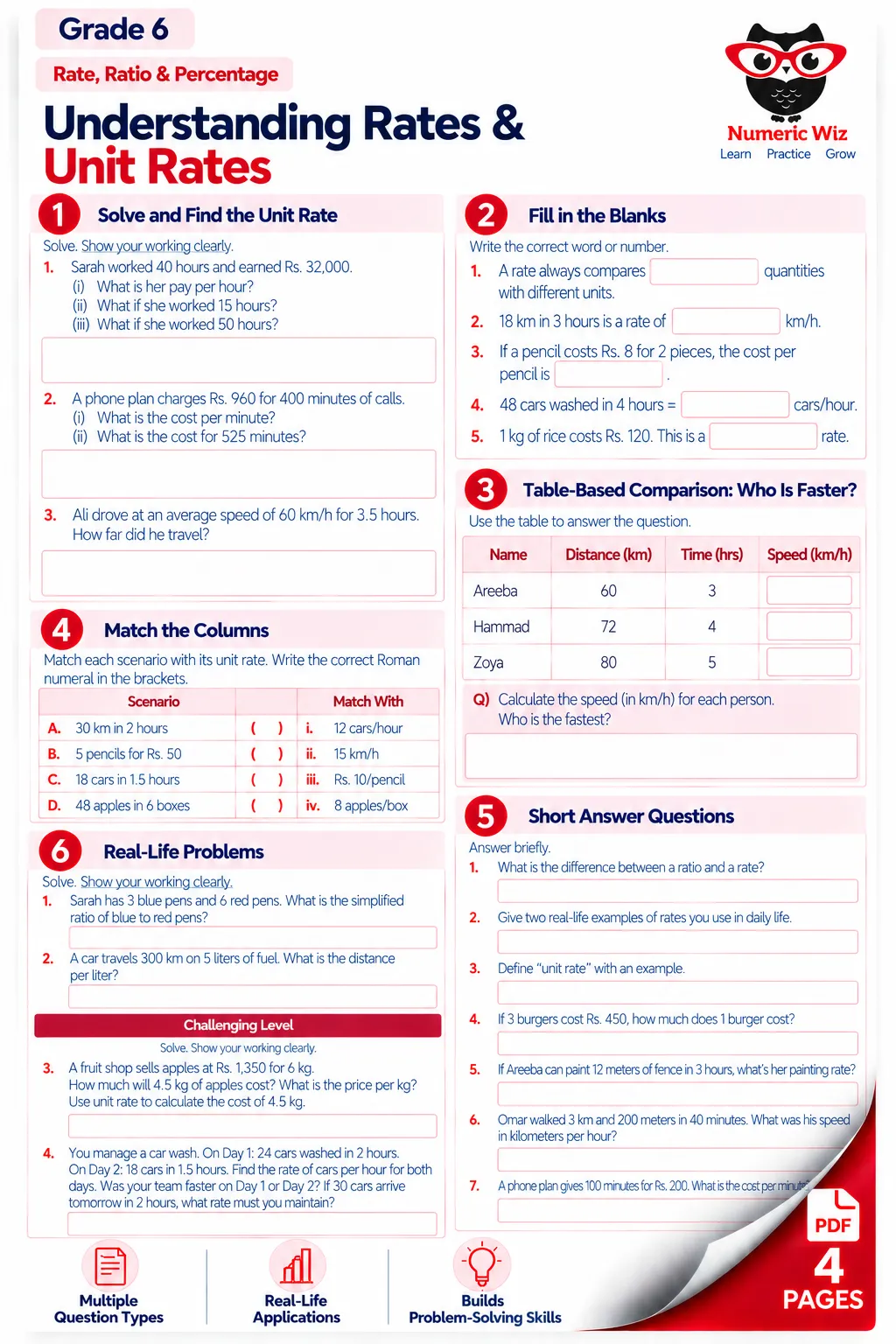
This free printable worksheet helps Grade 6 students find unit rates with confidence. A unit rate tells you the value for one unit, like the cost of one pencil or the speed for one hour. Your child practises real-life rates, from pencils and apples to cars and car washes, with tables, matching and step-by-step problems.
A unit rate tells you how much of one thing goes with exactly one unit of another thing, like the cost of one pencil or the speed for one hour. You find it by dividing the first number by the second, so 30 km in 2 hours is 15 km per hour.
The words "per hour", "per pencil" and "per litre" are the giveaway. Whenever your child sees "per", the question is asking for a unit rate. I teach children to hunt for that little word first, because it tells them what the answer should look like before they do any sums.
To find a unit rate, write the rate as a fraction, then divide the top number by the bottom number until the bottom number is 1. For example, 5 pencils for Rs. 50 means Rs. 50 divided by 5, which is Rs. 10 for one pencil.
The same move works for every rate on this page. For 18 cars in 1.5 hours, divide 18 by 1.5 to get 12 cars per hour. For 48 apples in 6 boxes, divide 48 by 6 to get 8 apples per box. I tell children to label the unit every time, because "12" alone means nothing, while "12 cars per hour" is a full answer.
This is the skill Common Core standard 6.RP.A.2 asks for: understand the concept of a unit rate and use rate language in the context of a ratio relationship.
This is a printable PDF with a "Who is Faster?" table, a Match table, Real-Life Problems and Challenging questions. In "Who is Faster?", your child works out that 30 km in 2 hours means 15 km per hour. In the Match table, your child pairs 5 pencils for Rs. 50 with Rs. 10 per pencil, 18 cars in 1.5 hours with 12 cars per hour, and 48 apples in 6 boxes with 8 apples per box.
The Real-Life Problems use a car that travels 300 km on 5 litres, which is 60 km per litre. One question in that section is a ratio question, not a unit-rate question: Sarah's blue and red pens simplify to the ratio 1:2. The Challenging questions ask for the price of apples at Rs. 1,350 for 6 kg, which is Rs. 225 per kg, so 4.5 kg costs Rs. 1,012.50, and for a car wash comparison where Day 1 washes 24 cars in 2 hours and Day 2 washes 18 cars in 1.5 hours, so both days wash 12 cars per hour and neither day is faster, while washing 30 cars in 2 hours needs 15 cars per hour.
I teach it in three steps, and I never let a child skip step one. Step one: write the rate as a fraction, with the words attached. Step two: divide the top number by the bottom number. Step three: write the answer with its unit, like "Rs. 10 per pencil". We check each answer by asking one question only: does the unit match what the question asked for? If the unit is right and the number is right, the answer is right.
Use this worksheet after students can simplify ratios, as homework, for homeschool or one-to-one tutoring, or as a quick check before ratio problems with money and speed. Because every question ends with a labelled unit, it quickly shows whether a student owns the unit-rate idea or still divides the wrong way round. A child who finishes this page can say the unit before the number, and that habit carries into every rate problem that follows.
For more free practice at this level, browse our Grade 6 math worksheets page. Every sheet is free to print.
A unit rate tells you how much of one thing goes with exactly one unit of another thing. For example, 30 km in 2 hours is a unit rate of 15 km per hour, and 5 pencils for Rs. 50 is a unit rate of Rs. 10 per pencil.
Rs. 10 per pencil. Divide Rs. 50 by 5 to get Rs. 10. This is the unit rate for one pencil.
12 cars per hour. Divide 18 by 1.5 to get 12. The same rate appears in the car wash question, where both days wash 12 cars per hour.
Rs. 1,012.50. Apples cost Rs. 1,350 for 6 kg, which is Rs. 225 per kg, and 225 × 4.5 is 1,012.50.
For a limited time