
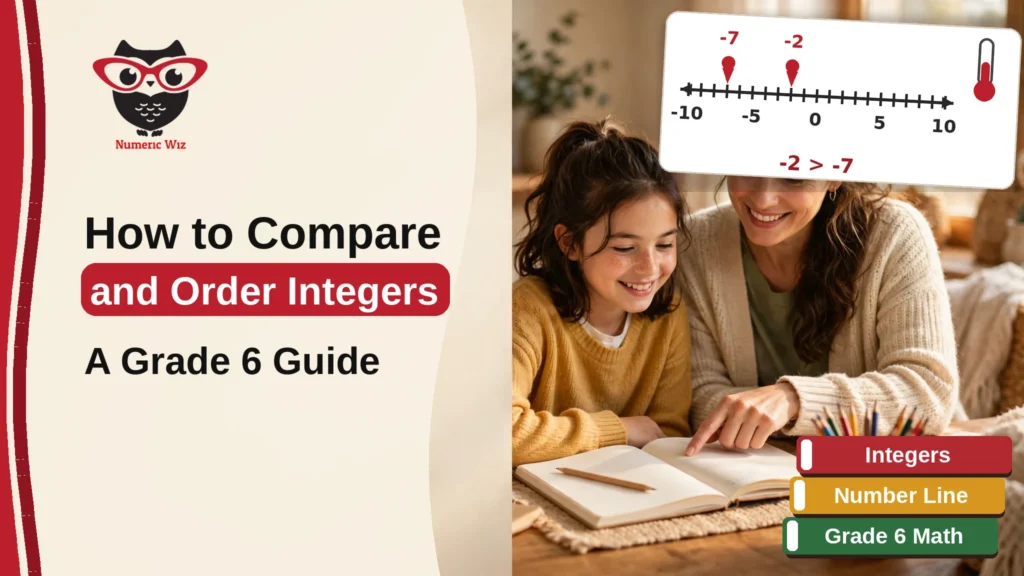
To compare and order integers, picture a number line. Numbers grow as you move right and shrink as you move left. Any positive integer beats any negative integer, and between two negatives, the one closer to zero is greater, so -2 > -7. Sort negatives first, then zero, then positives.
I have taught Grade 6 math for over 30 years, and this single picture fixes most integer mistakes I see. Parents share the same story: the positives make sense, then the negatives flip the whole game. Ten minutes with a number line stops the flipping.
New to negative numbers? Start with our Introduction to Integers worksheet. It builds the number line step by step, so ordering feels easy when your child gets here.
What Does It Mean to Compare Integers?
Comparing integers means deciding which of two numbers is greater, smaller, or equal, and we write that decision with the symbols >, <, or =. On a number line, the number sitting further to the right is always greater, while the number further left is always smaller.
You read these symbols out loud. 5 > 3 reads “five is greater than three,” and -6 < -2 reads “negative six is less than negative two.” The open side of the symbol always faces the bigger number.
Picture a lift in a shopping plaza. The ground floor is zero, floors above ground are positive, and parking levels below ground are negative. A higher floor always means a greater number, even below ground: level -1 sits above level -3, so -1 > -3.
Which Is Greater: A Positive or a Negative Integer?
A positive integer is always greater than a negative integer, no matter how big the negative number looks. Think of +1 as one rupee saved and -50 as fifty rupees owed. The saved rupee puts your child ahead, and the debt puts the other number behind.
Zero plays referee here. Zero beats every negative and loses to every positive, so 0 > -9 and 0 < 4. My classroom rule is short: check the sign first, digits second. That one habit prevents half the errors I mark each term.
Why Is -2 Greater Than -7?
-2 is greater than -7 because -2 sits closer to zero on the number line, only two steps to the left, while -7 sits seven steps away. With negative numbers, a smaller distance from zero means a greater value, so -2 > -7 every single time.
Think about money again. Owing 2 rupees hurts far less than owing 7 rupees, so -2 leaves you better off, and better off means greater. In class I phrase it as trouble: with negatives, less trouble wins.
Temperature tells the same story. A morning at -2°C feels chilly, but -7°C bites through a jacket. The weather report calls -2°C the warmer reading, and warmer means higher on the line.
The Bigger Digit Trap and the Ten Second Fix
This mistake has a name in my classroom: the Bigger Digit Trap. A child knows 7 beats 2 with positive numbers, so the child picks -7 as greater than -2. The digits look right, yet the minus sign quietly turns the whole contest around.
The fix takes ten seconds. Cover the minus signs with a finger and order the digits, then flip the order when you lift the finger. Digits say 2 comes before 7; negatives run the other way, so from least to greatest it reads -7, then -2. My students chant it: same digits, flipped order.
How Do You Order Integers From Least to Greatest?
To order integers from least to greatest, sort them in three groups: negatives first, then zero, then positives. Inside the negatives, put the number farthest from zero first. Inside the positives, use normal counting order. Then join the three groups into one line.
Here is the method on a real set: -4, 3, -1, 0, 5, -7.
Step 1: Split the set into groups. Negatives: -4, -1, -7. Zero: 0. Positives: 3, 5.
Step 2: Order the negatives. Farthest from zero comes first: -7, -4, -1.
Step 3: Order the positives the normal way: 3, 5.
Step 4: Join the groups. The full order from least to greatest is -7, -4, -1, 0, 3, 5.
This guide matches Common Core standard 6.NS.C.7 on ordering rational numbers. Sets like this one fill the Ordering Integers worksheet, which gives your child four pages of guided ordering practice.
How Do You Order Integers From Greatest to Least?
Ordering from greatest to least is the same list read backwards: start with the biggest positive, work down through zero, and finish with the negative farthest from zero. Using our set, the order is 5, 3, 0, -1, -4, -7, exactly reversed from before.
Teachers call least to greatest ascending order and greatest to least descending order. The words change, the line stays the same. When a question says descending, write the ascending list first, then read it backwards.
How Do You Order Integers by Absolute Value?
To order by absolute value, ignore the signs and compare distances from zero instead. | -9 | equals 9, so -9 has a bigger absolute value than +4, even though -9 is the smaller integer. Value asks where a number sits; absolute value asks how far it sits.
This split matters in real questions. “Who owes more?” asks about absolute value, because owing 900 rupees (-900) is a bigger debt than owing 400 rupees (-400), even though -900 < -400 on the line. “Who has more money?” asks about value, and -400 wins that one.
The Absolute Value worksheet trains exactly this split, with debt and distance questions side by side.
Ordering Integers in Real Life
Temperature. Skardu records -6°C, Quetta records -1°C, and Islamabad records 9°C on a January morning. Coldest to warmest reads -6, -1, 9, plain least to greatest.
Building floors. An office sits on floor 4, the lobby is 0, and parking is level -2. Lowest to highest: -2, 0, 4. The lift rides the number line all day.
Money. Owing a friend 300 rupees is -300, and saving 150 rupees is +150. Since -300 < +150, the debt always sits lower than the saving.
Sea level. A boat deck floats at +12 metres while a diver swims at -18 metres. The diver is lower, because -18 < 12.
My integers in real life article shares ten more settings like these, from bank balances to mountain passes.
Quick Self Check: Three Questions
Try these without peeking. Answers sit below, so cover them with a hand first.
- Which is greater, -4 or -9?
- Order from least to greatest: 3, -2, 0, -5, 1.
- Which has the bigger absolute value, -8 or +5?
Answers: 1) -4, because it sits closer to zero. 2) -5, -2, 0, 1, 3. 3) -8, because | -8 | = 8, and 8 beats 5.
Two or three right? Your child is ready for full worksheet sets. One right? Reread the Bigger Digit Trap section together and try again tomorrow.
Key Takeaways
Key Takeaways
- On a number line, right means greater and left means smaller.
- Any positive beats any negative, and zero beats every negative.
- Between two negatives, the number closer to zero is greater: -2 > -7.
- Order in three groups: negatives, zero, positives.
- Absolute value measures distance from zero, not position on the line.
Keep Practising the Smart Way
Short, daily practice beats one long session. Print one page, work it together, and check answers out loud so your child hears the reasoning. Our full Grade 6 math worksheets collection keeps every integers topic in one place, free to print at home.
Frequently Asked Questions
Is zero greater than a negative integer?
Yes, zero is greater than every negative integer, because zero sits to the right of all of them on the number line. Even a huge negative loses: 0 > -1,000. Zero is still smaller than every positive integer.
Which is greater, -5 or -3?
-3 is greater than -5. Both numbers are negative, so the one closer to zero wins. -3 sits only three steps left of zero, while -5 sits five steps away.
How do you write integers in ascending order?
Ascending order means least to greatest. Group the negatives first with the farthest from zero in front, add zero, then write the positives in normal counting order. Read the joined list left to right.
Can two different integers share the same absolute value?
Yes. -6 and +6 share the absolute value 6, because both sit exactly six steps from zero, one on each side. Numbers like these are called opposites.
What does greatest to least mean?
Greatest to least means starting with the biggest number and ending with the smallest. Write the least to greatest list first, then reverse it. Teachers also call this descending order.