
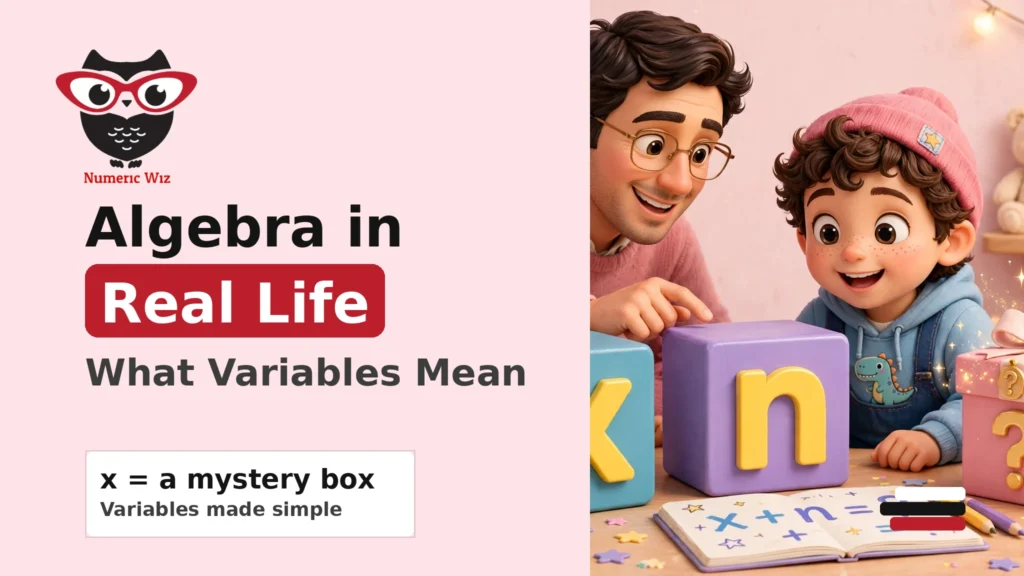
Algebra sounds hard, but a variable is just a box holding a number we do not know yet. That is the whole secret, and once a child sees it, algebra stops looking scary. I have taught Grade 6 math for over thirty years, and I start algebra with boxes, not with rules.
A Variable Is a Box, Not a Mystery
A letter like x is a box with a number inside that we have not found yet. If I write 3 plus x equals 10, the box must hold 7, because 3 plus 7 is 10. Nothing magic happened, we just gave the unknown number a short name so we can talk about it.
Letters beat blanks because a blank cannot move around a sum. You can write 2 times x, or x plus 5, and the box travels with the maths. A blank sits still, but a letter works like any other number once you know what it holds.
Example 1: Pocket Money and the Unknown Number of Notebooks
Sara has 30 dollars, and each notebook costs 5 dollars. How many notebooks can she buy? Call the unknown number n. Then 5 times n equals 30, and n must be 6, because 5 times 6 is 30. Sara can buy 6 notebooks.
The letter did not make the problem harder, it made it shorter. “5 times n equals 30” says in five marks what a whole sentence says in words. Children who write the short form first solve faster, because the sum is already set up.
Example 2: Recipes, Doubling a Recipe Without Guessing
A recipe uses n cups of flour for 4 people. For 8 people, you need twice as much, so you need 2 times n cups. If n is 2, then 2 times 2 is 4 cups, and the dish still tastes right. If n is 3, then 2 times 3 is 6 cups, with no new thinking needed.
That is why cooks love variables, even when they never call them that. One recipe line works for any guest count, because the letter holds the amount that changes. Fix the letter, and the whole recipe follows.
Example 3: A Taxi Fare and the Part That Changes
A taxi charges 3 dollars fixed, plus 2 dollars for each kilometre. The fare is 3 plus 2 times k, where k is the kilometres travelled. For 5 kilometres, the fare is 3 plus 10, which is 13 dollars. For 10 kilometres, it is 3 plus 20, which is 23 dollars.
Here the variable marks the part that changes, and the fixed part stays put. Adults read bills like this every day: a fixed charge plus a part that grows with use. Once a child spots that split, phone plans and delivery fees stop looking like tricks.
From Words to a Short Equation (and Back Again)
Turn words into an equation in three moves. First, name the unknown with a letter. Second, write what happens to it, in order. Third, solve it, then read it back as words to check it.
Try this one: “I think of a number, double it, add 4, and get 14.” Name the number n. Doubling it and adding 4 gives 2 times n plus 4 equals 14. So 2 times n must be 10, and n is 5. Read it back: double 5 is 10, plus 4 is 14. It fits, so the answer stands.
Try It Yourself: 3 Quick Questions
Cover the answers, let your child try, then check together.
- 4 times x plus 3 equals 19. What is x?
Answer: 4. 4 times x must be 16, and 16 shared by 4 is 4. - A phone plan costs 10 dollars plus 2 dollars for each gigabyte, and the bill is 16 dollars. How many gigabytes were used?
Answer: 3 gigabytes. 16 minus 10 is 6, and 6 shared by 2 is 3. - A recipe uses n spoons of sugar for 2 cakes. For 6 cakes it uses 3 times n spoons. If n is 2, how many spoons is that?
Answer: 6 spoons. 3 times 2 is 6.
Key Takeaways
- A variable is a box holding a number we do not know yet.
- Letters let the unknown move through a sum like any number.
- Pocket money, recipes, and taxi fares all use variables daily.
- Turn words into an equation, solve it, then read it back as words.
- The fixed part stays put, and the variable marks what changes.
If your child handled those three questions, she can read a letter in maths without fear. Keep spotting variables together for one week, in shops, recipes, and bills, and algebra will feel like shorthand, not a mystery.
For more topics at this level, browse our Grade 6 math worksheets page.
Frequently Asked Questions
What is a variable in simple words?
A variable is a box holding a number we do not know yet. A letter like x names that box so we can use it in a sum.
Why do we use letters instead of a blank?
A blank cannot move through a sum, but a letter can. You can double x, add 5 to x, and solve for x, all with short, clear writing.
Is algebra only for older students?
No, Grade 6 is a fine place to start. Children already use unknowns when they ask “how many more do I need”, algebra just gives that question a short form.
Where do adults use variables?
Adults use them in bills, budgets, recipes, and travel fares. Any price with a fixed part plus a part that changes is a variable in plain clothes.
What is the first algebra mistake to watch for?
The first mistake is treating the letter as a label instead of a number. In 3x, the x holds a number, so 3x means 3 times that number, not “3 x’s”.